


How to Install a 6.0 Powerstroke EGR Delete Kit Key Takeaways
A step-by-step installation overview and essential mechanic tips for fitting an EGR delete kit on 2003–2007 Ford 6.0L Powerstroke engines:
- Preparation & Teardown: Requires fully draining the cooling system, removing the alternator, intake elbow, air filter assembly, and unbolting the turbocharger to access the factory EGR cooler and up-pipe connections beneath the intake manifold.
- Installation Precision: Install the new solid up-pipe (or block-off plate), secure the intake manifold bypass tube, and use new gaskets with proper torque specs to ensure leak-free exhaust and coolant sealing.
- Post-Install Steps: Refill and bleed the cooling system with CAT EC-1 ELC coolant, inspect for vacuum or fluid leaks, and load custom ECM tuning to disable EGR diagnostics and prevent limp mode before test driving.
Owners of the Ford Super Duty in the 2003-2007 period are already aware of the reputation of the 6.0L engine. It is a wonderful monster, but it has a certain Achilles heel that keeps its owners up at night. The weakness is the Exhaust Gas Recirculation (EGR) system.
Your 6.0 Powerstroke keeps overheating and throwing codes because the EGR cooler failed again. An EGR delete for Ford 6.0 can fix that for good and drop your EGTs by 200°F+.
An 6.0 Powerstroke EGR delete removes the factory EGR valve and cooler, stops hot exhaust from mixing with intake air, and bypasses the coolant circuit. Done right with a tune, it makes the 6.0 reliable again.
This 2026 guide walks you through a safe 6.0 Powerstroke EGR delete kit installation —step-by-step, with tools, tips, and tuning advice to drop EGTs 150°F and boost reliability.
I did my first 6.0 EGR delete in 2012 on my own 2005 F-350. It had 180k miles and three dead EGR coolers. After the delete and a good tune, it finally stopped puking coolant. Keep reading if you want the exact steps I still use today.
Table of Contents
- Should You Install an EGR Delete on Your 6.0 Powerstroke?
- What You Need Before Installing a 6.0 Powerstroke EGR Delete
- Step-by-Step Guide: How to Install a 6.0L Powerstroke EGR Delete Kit
- Do You Need a Tune After an EGR Delete?
- Common Mistakes to Avoid
- Installation by Professional vs. DIY: Which Is Better?
- Legal & Emissions Disclaimer
- FAQs
- Final Verdict
Should You Install an EGR Delete on Your 6.0 Powerstroke?
Many owners delete EGR on a 6.0 Powerstroke for reliability and lower temps, but upgrades like Bulletproof coolers stay legal and fix issues without fines.
Common EGR Problems on the 6.0 Powerstroke
The factory design has significant flaws. First, the oil cooler is frequently clogged with debris. When the oil cooler receives less coolant, the EGR cooler (which comes later in the line) will starve of fluid.
The factory EGR cooler clogs with soot in 60-80k miles on most trucks. Hot exhaust goes through tiny passages cooled by engine coolant. Soot builds up, coolant flow stops, and the cooler ruptures.
Coolant goes into the intake, hydrolocks the engine, or steams out the degas bottle. I have seen trucks with oil coolers also clogged because the same coolant flows through both.
This leads to:
- White Smoke: Coolant burning in the combustion chamber.
- Overheating: High engine oil temperatures.
- Hydro-locking: In severe cases, coolant fills a cylinder and stops the engine cold.

Benefits of the EGR Delete
Installing a 6.0 EGR delete kit means removing the EGR cooler and the valve.
- Reliability: You remove the chance of the cooler cracking. No cooler implies that there is no leaking of coolant into the engine.
- Low EGTs: EGTs drop 150-250°F under load, oil temps drop 10-20°F, no more soot in the intake manifold, and the truck finally stays cool towing.
- Clean Intake: You stop feeding soot back into your manifold. Your engine breathes new air, not smogged air.
Risks and Legal Concerns
The main threat is compliance. EPA says it is illegal for road use. Fines hit $5,000+.
In a state that imposes severe visual inspection or OBDII testing to check the emissions, a deleted truck will not pass. If you daily drive in California or the Colorado Front Range, think twice.
Also, Warranty voids. Resale drops. And it is necessary to have a tuner to disable the Check Engine Light (CEL) to delete the EGR 6.0 Powerstroke. The fan clutch can lead to other overheating problems, as without a tune, it cannot work properly. <Learn more pros and cons of deleting 6.0 Powerstroke EGR>
Recommended Alternatives
Consider an EGR cooler upgrade. A bulletproof EGR cooler from BulletProof Diesel lasts 300k+ miles if you also do oil cooler and head studs. It stays legal and fixes the weak point.
Aftermarket "bulletproof" coolers feature heavy-duty welded tubes that do not rupture like the factory honeycomb design. This keeps the emissions system intact while solving the failure point. I recommend that route for 90% of owners.
|
Option
|
Cost Range
|
Legality
|
Reliability Gain
|
Power Gain
|
|---|---|---|---|---|
|
EGR Delete
|
$200–$500
|
Off-road only
|
High
|
Moderate
|
|
Bulletproof Cooler
|
$800–$1,200
|
Legal
|
High
|
Low
|
|
Regular Cleaning
|
$100–$300
|
Legal
|
Medium
|
None
|
|
Full Bulletproofing
|
$3,000+
|
Legal
|
Very High
|
Low
|
What You Need Before Installing a 6.0 Powerstroke EGR Delete
Preparation is the key to a smooth Ford 6.0 EGR delete installation. Wrong prep leads to leaks and extra work. Gather quality tools, fresh coolant, and a good kit—plan 4-7 hours for smooth install.
You need basic hand tools plus a few specialty items and the right delete kit. Have everything ready before you start.
Tools Required
- 3/8 ratchet + extensions
- 8, 10, 13, 15, 18mm sockets
- Torque wrench (ft-lb and in-lb): 13mm wrench for turbo bolts. This cannot be ignored. You must torque intake manifold bolts to spec to avoid boost leaks later.
- Pick set for O-rings: Hooked picks are very useful when it comes to stripping old O-rings and loosening stuck electrical connectors without breaking the tabs.
- Coolant catch pan: You will be emptying a number of gallons of fluid, so you will need a large and clean pan.
- Pliers for hose clamps: Take a pair of hose clamp pliers or a regular pair of channel locks to adjust the spring clamps on the coolant lines.
- T40 and T45 Torx bits: Required for the intake bolts.
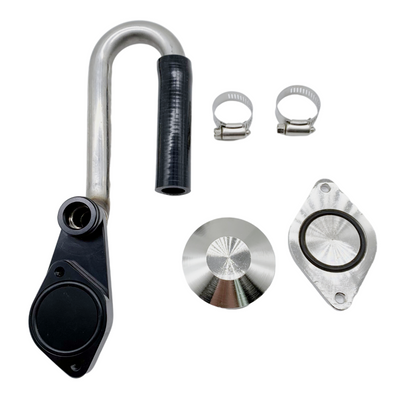
Parts Included in a Typical 6.0 Powerstroke EGR Delete Kit
When you purchase the best EGR delete kit for 6.0 Powerstroke, you should verify the box contents immediately. (I use the EGR Performance Ford 6.0 EGR delete kit)
A typical kit will contain:
- Billet aluminum EGR block-off plate: These are heavy metallic plates that are placed over the exit holes on the manifold.
- Welded Up-pipe: The majority of quality sets contain a new stainless steel up-pipe assembly. Some cheaper versions only provide a plug for the stock pipe, but a full replacement pipe is better for flow.
- Coolant bypass hose with clamps: Since the cooler is being removed, you need a way to route coolant back to the heater core. This is usually a J-shaped tube or silicone hose.
- New O-rings, gaskets, and stainless hardware: To seal the leak, locate new bolts, washers, and high-temperature gaskets of high temperature.
Additional Items to Have Ready
Don't get stuck halfway through installing EGR delete 6.0 Powerstroke parts because you are missing consumables.
- 3-4 gallons of Motorcraft Gold coolant: You will lose a lot of coolant. Have at least 3–4 gallons of Motorcraft Gold or an ELC (Extended Life Coolant) rated for diesel engines ready to go.
- Intake Cleaner: Once the manifold is off, you will see how dirty it is. Have a few cans of carb cleaner or brake cleaner to scrub out the soot buildup.
- Extra 6.0 EGR valve O-rings (Ford part VC-8) and Blue Loctite: This is optional but highly recommended. Specifically, buy a new turbo oil drain O-ring and top gasket. The old ones have a tendency to leak oil in the valley upon reuse.
Estimated Time and Difficulty Level
You need to be realistic about your timing before beginning to delete an EGR on the 6.0 Powerstroke.
- Estimated Time:4–7 hours. When it is your first time, you should lean towards the 8-10 hours. Bolts that are rusted or frozen may easily increase the time.
- Difficulty: 7/10 – turbo removal is the hard part. The project entails the removal of the turbocharger and intake manifold. It requires patience and mechanical aptitude.
|
Tool Category
|
Essentials
|
Why Needed
|
|---|---|---|
|
Basic
|
Sockets, wrenches, pliers
|
Remove bolts and hoses
|
|
Precision
|
Torque wrench
|
Ensure proper sealing and correct torque
|
|
Cleanup
|
Wire brush, cleaner
|
Clean gasket and mating surfaces
|
|
Safety
|
Gloves, drain pan
|
Safe coolant handling and spill control
|
Step-by-Step Guide: How to Install a 6.0L Powerstroke EGR Delete Kit
Follow these 8 steps carefully. We will walk through installing the EGR delete 6.0 Powerstroke components—Drain coolant first, torque right, and check leaks for safe deletion.
I wrote this guide from doing over 40 deletes myself. These are the tricks that save hours.
Step 1: Disconnect Batteries & Drain Coolant
Disconnect Batteries: Begin with the disconnection of negative terminals on both batteries using an 8mm wrench. This is to avoid short-circuiting accidents whenever you are working around the alternator and starter wiring.
Drain Coolant: Find the radiator drain petcock, which is on the driver's side, and this is on the bottom of the radiator. Place your catch pan underneath and open the valve.
Pro Tip: To remove more fluid and minimize the mess, you should also pull the engine block drain plugs (usually an 8mm Allen head) located on the side of the engine block.
Watch Spills: Keep your workspace clean. Wipe it immediately in case of spillage.

Step 2: Remove Intake Components
The EGR system is located at the top of the 6.0 Powerstroke engine and therefore has to be cleared.
- Access Airbox: Unscrew the hose clamp on the air filter box and take off the whole assembly.
- Disconnect Intake Tube: Disconnect the Mass Air Flow (MAF) sensor and take out the plastic intake tube.
- Turbo Inlet Tube: Take off the metal or plastic turbo inlet tube that attaches the air filter to the turbo face.
- Clean Accessible Parts: Check these parts that are off. In case you find the presence of oil in intercooler pipes, then it is likely that your turbo seals have leaks.
Step 3: Remove the Turbocharger (If Required)
Most of the 6.0 EGR delete kits installation processes involve the removal of the turbo in order to access the up-pipe.
- Bolt Locations: The turbo is held down by three bolts. Two can be seen on the front top, though the third one lies hidden on the back. A very long extension or special curved wrench will be required to reach it.
- Disconnect Clamps: Relax the V-band clamps to the up-pipe (exhaust in) and the downpipe (exhaust out). Also, loosen the clamp connecting the turbo to the intake "spider" (Y-pipe).
- Tips to Avoid Damaging the Drain Tube: This is the most critical part of deleting the EGR 6.0 Powerstroke. The turbo sits on an oil drain tube. Do not yank the turbo sideways. Lift it straight up.
Step 4: Remove Factory EGR Valve & Cooler
The turbo is not in the way, so the intake manifold is completely accessible.
Taking Off Coolant Lines: Disconnect the heater hose that extends to the EGR cooler. Expect some additional spillage of coolant here.
Removing Mounting Bolts:
- Take out the two bolts that are holding the EGR valve. Pull the valve straight up. It might be stuck due to carbon buildup; wiggle it gently.
- Unbolt the intake manifold. There are usually 18 bolts.
Common Problems:
- Seized Bolts: Exhaust bolts on the up-pipe tend to rust. Wet them with some penetrating oil, and attempt to loosen them in 30 minutes.
- Coolant in Intake: On pulling the manifold, look at the intake ports. If they are wet and "steam cleaned," your EGR cooler was likely already leaking.
Step 5: Install EGR Performance Components
Now, we install the new hardware included in your 6.0 Powerstroke EGR delete kit.

- Installation of the Block-off Plates: The exhaust block-off plate is installed on the passenger up-pipe. Ensure that the gasket is fitted. If your kit came with a full replacement up-pipe (highly recommended), install that now.
- Proper Torque Specs: Do not guess. Intake manifold bolt: 96 in-lbs (inch-pounds, not foot-lbs!).
- Exhaust clamps: Tighten until fitting, then tighten to specification (depending on V-bands, usually around 11 ft-lb, but consult your manual).
- Assuring No Exhaust Leaks: Before continuing, place your hand around the plate of the block-off. Make sure that the plate and clamp are flush. An exhaust leak in this case will result in a hissing noise and soot in the engine bay.
Step 6: Reroute Coolant Lines
As the EGR cooler (that served as a coolant bridge) is removed, you have to reestablish the flow.
- Connect Coolant Bypass Hose: Your package contains a tube bypass (also commonly referred to as a J-tube) or a silicone hose. One end is connected to the oil cooler outlet cover, and the other to the heater return line.
- Prevention of Leaks: Screw the hose clamps on the hose and then press it into the barb. Place the clamps beyond the barb flare to provide a tight seal. Squeeze them tight, but do not slice the silicone.
Step 7: Reassemble Turbo & Intake Components
Now, we put the puzzle back together.
- Reinstall Turbo: Carefully lower the turbo back onto its pedestal. Ensure the oil drain tube seats directly into the grommet.
- Connect Intake Piping: Reinstall the Y-pipe (spider), the charge air cooler pipes, and the metal turbo inlet tube.
- Refill Coolant: Close the radiator petcock. Fill the degas bottle with fresh coolant. You will need to add coolant slowly as air bubbles surface.
Note: Many people forget to check the oil level when installing. Check it now to ensure no coolant spilled into the crankcase.
Step 8: Check for Leaks, Codes & Final Test
It is installed physically, but the task is not completed until you check everything.
Post-Installation Checklist
- Leak Verification: Look under the truck. Is there coolant dripping?
- Component Fastening: Unexpected loose bolts are a disaster. Go back and make sure that the turbo clamps and the intake bolts are tight.
- Coolant Level Checks: Top off the degas bottle.
- Idle Check: Reconnect the batteries and start up the truck. Let it idle for 10-15 minutes. Check the temperature of the coolant and check the white smoke (steam) or blue smoke (oil).
- Scan Tool Check: Connect your OBDII tuner or scanner.
Road Test Tips: Drive gently at first. Listen for the "tea kettle" whistle of an exhaust leak.
Monitoring for Error Codes and Check Engine Lights – Managing CEL issues
Deleting an EGR on a 6.0 Powerstroke is likely to trigger a Check Engine Light (CEL) on your truck.
- Codes: P0401 (Insufficient EGR flow) and P0403/P0405 (EGR Circuit errors).
- Managing the Light: This is where the tuner comes in. Use your handheld tuner (SCT, H&S, etc.) to flash a "delete tune" to the ECU. This tells the computer to ignore the missing EGR valve, turning off the CEL and restoring proper fan clutch operation.
Do You Need a Tune After an EGR Delete?
Yes. Without a tune, you will throw P0401, P0404, and sometimes limp mode. A proper tune turns off EGR operation in the PCM and adds power. Most guys gain 60-80 hp with a delete + tune.

Why a 6.0 Powerstroke Throws CEL After a Delete
The EGR valve is supposed to provide some data to the truck computer (PCM). On disconnection, the PCM will signal a circuit failure. Moreover, it anticipates pressure variation in the intake during the opening of the valve. When such changes fail to occur, it causes codes such as P0401 (Insufficient Flow) or P0404.
Benefits of Tuning
A custom tune does more than just turn off the yellow light on your dashboard.
- Fan Control: Fan Control is linked to the cooling fan logic on the 6.0L. Your fan might not start when it is supposed to without a tune.
- Performance: Tuners can optimize fuel timing now that the engine isn't choking on exhaust gas.
Recommended Tuners
To ensure your truck runs reliably after the 6.0 Powerstroke EGR delete procedure, you need a reputable tuning device and a custom "delete file" written for your truck's modifications.
- SCT (Streamline Custom Tuning): This is one of the most common and robust platforms for the 6.0L Powerstroke (2003-2007), offering handheld devices like the X4.
- EZ Lynk: It is a powerful, cloud-based platform, offering custom tuning, monitoring, and diagnostics through their AutoAgent device and mobile app
- Mini Maxx (V1 & V2): A popular tuner for Ford 6.0 Powerstroke after the EGR delete, offering horsepower gains, DPF/DEF/EGR delete, speedometer calibration, digital gauges, and custom shift-on-the-fly tuning, with V2 being the newer, more advanced model for newer trucks..
Risks of Running Without a Tune
Whenever you want to take your truck on more than a short test run without showing a delete tune, you are likely to get into serious trouble:
- Overheating: The logic of the fan clutch will be unstable, and temperatures will increase, which can lead to damage to head gaskets or oil coolers.
- Limp Mode: To prevent the perceived failure of the PCM, the engine can be shut off in a low-power "limp mode" which causes the truck to be undrivable.
- Injector Problems: The disoriented computer can also tell the engine to inject wrong amounts of fuel, and this will result in the engine running roughly, lots of smoke, and improper fuel economy.
Always remember the delete cost and tuning before installing an EGR on the 6.0 Powerstroke.
Common Mistakes to Avoid
Even the experienced ones may make a mistake when installing EGR delete on 6.0 Powerstroke. Over-torque plates warp them; skip air purge traps bubbles and overheats.
The following are the traps to be avoided:
- Over-tightening Block-off Plates: The intake manifold is made of aluminum and not as hard as steel. Do not strip the threads. Use a torque wrench.
- Forgetting to Purge Air: The 6.0 cooling system traps air easily. If you don't "burp" the system, you can create a hot spot and warp a head.
- Turbo Drain Misalignment: If the turbo drain tube isn't seated perfectly in the O-ring, you will pump gallons of oil into the engine valley in seconds.
- Running Without a Tune: As mentioned, ignoring the tune can lead to higher engine temps because the fan clutch logic gets confused.
- Using Cheap Kits: Do not use eBay specials. Stick to reputable brands like egrperformance. A cheap Powerstroke EGR delete kit has bad welds on the up-pipe or gaskets that burst out in one month.
The worst is reusing old O-rings. They look fine, but harden with heat cycles. I always replace them with Ford green O-rings. Second worst is not cleaning the intake manifold.
Soot builds up for years. Spray it out with brake cleaner while everything is apart. Takes 10 extra minutes, saves you from doing it again in two years.
|
Mistake
|
Result
|
Fix
|
|---|---|---|
|
Over-torque
|
Warped block-off plate or gasket
|
Replace damaged parts and torque to factory spec
|
|
No coolant bleed
|
Overheating
|
Properly burp and bleed the cooling system
|
|
Cheap kit
|
Early failure or leaks
|
Buy a quality kit with proper materials
|
|
No tune
|
Check engine light, rough running
|
Install a compatible tuner or ECU reflash
|
Installation by Professional vs. DIY: Which Is Better?
Is it best that you do it yourself or have a pro do it?
DIY costs $200-$350 in parts. Shop charges $1,000–$1,500 total. DIY if you have tools, time, and at least moderate skill. Shop if you have emissions testing or no place to work.

Cost Comparison
- DIY: Kit costs ($150-300) and fluid costs ($50). Total: ~$200-$350.
- Professional: You pay for the kit plus 6–8 hours of labor. Prices of labor in diesel shops are between 120 and 180 per hour. Total: ~$1,000–$1,500.
When DIY is Not Recommended
Unless you have a garage, do not make the attempt. If you don’t have a solid collection of tools or you have never taken off a turbocharger, this may be excessive. The rounding off of the back bolts of the turbo is notorious and can be a cause of despair.
Shop Installation Expectations
A good shop will also inspect your oil cooler while they are in there. In case the oil cooler is clogged (delta exceeding 15 degrees between oil temperature and coolant temperature), they will suggest its replacement. Listen to them.
They already have the tricks and will spot other issues while they are in there (leaking oil cooler, bad STC fitting, etc.). If your truck is a daily driver and you cannot have it down for a weekend, pay the shop. I still do my own because I enjoy it, and I am cheap.
Legal & Emissions Disclaimer
Federal law says removing EGR is illegal on 2003-2007 trucks for road use. Period.
- Federal Rules: Tampering with emissions control devices on any vehicle on the public roads registered under VIN is an offense. The EPA fined shops millions for selling delete kits. Most companies now sell "off-road only".
- State Inspections: States such as California, Colorado, and most of the counties in the Northeast do visual inspections. If they see that the EGR cooler is missing, you fail. If you get caught, the fine can be $5000+ per violation.
- Warranty: If your truck somehow still has a warranty (unlikely for a 6.0L, but possible with aftermarket warranties), a delete will void it.
- How to Stay Compliant: If you drive on the street, stick to "Bulletproofing" with an upgraded EGR cooler rather than a full delete.
I am not telling you to break the law. I am telling you what thousands of 6.0 owners do.
FAQs
1. Are there alternatives to a full EGR delete?
Yes. You can install a "Bulletproof" EGR cooler. It looks stock on the outside but has heavy-duty internal tubes that don't crack. This keeps you emissions compliant.
2. Will my truck overheat if I delete the EGR?
In fact, the reverse is most likely to hold. Deleting 6.0 Powerstroke EGR systems removes a massive heat source from the coolant system. But be sure you have a fine working cooling fan with a tune.
3. What's the difference between an EGR delete and an EGR cooler upgrade?
A delete simply deletes the component. Upgrade replaces the faulty factory product with a powerful one, which serves the same purpose.
4. How much horsepower and torque will I gain from an EGR delete?
The delete does not give it enormous horsepower as such, most likely 5-10 horsepower due to the better airflow. The actual strength is the tune that you're running after the delete.
5. What error codes will I get if I don't tune my truck after the delete?
They are P0401 (EGR Flow Insufficient), P0403 (EGR Control Circuit) and P0405 (EGR Sensor A Circuit Low).
6. My truck is running rough or hesitating after the EGR delete. What's wrong?
This is usually an air leak. Examine the boots at the intercooler pipes and the V-band clamp at the turbo. The escaping air distorts the air/fuel mixture when it comes out before the engine.
Final Verdict
The possession of a 6.0L Powerstroke is a love-hate affair. The engine block is sound, yet it is the accessories that fail it. Performing a 6.0 Powerstroke EGR delete kit install is one of the most effective ways to increase the reliability of your truck.
A 6.0 Powerstroke EGR delete with Up/Y-Pipe includes everything, a stainless steel up-pipe assembly and not just a block off plate, one-year warranty. This guarantees an easier exhaust flow to the turbo.
6.0 Powerstroke EGR delete + tune makes a 6.0 reliable and cooler running, but it is illegal on the road in the US.
It stops coolant from entering the cylinders, lowers engine oil and coolant temperatures, and keeps the intake manifold clean of soot.
If you use your truck for off-road work, drag racing, or sled pulling, a delete is a no-brainer. If you are a daily driver in a strict emissions state, look into an upgraded cooler instead. Check our guide to 6.0 Powerstroke upgrading.


