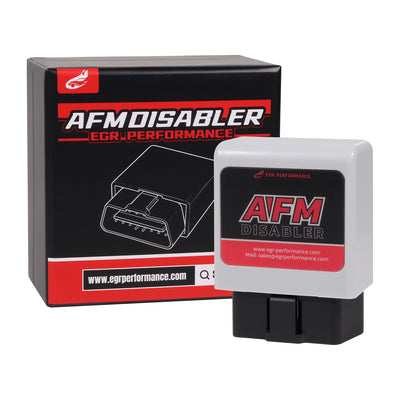

What Is an AFM Disabler? Key Takeaways
A summary of how plug-and-play AFM disablers work, their primary benefits, and safety for GM vehicle owners:
- Core Definition: A compact, plug-and-play AFM module that inserts into the OBD-II port to send continuous signals to the ECM, preventing GM 5.3L, 6.0L, and 6.2L engines from deactivating cylinders and dropping into V4 mode.
- Protection & Performance: Eliminates throttle lag, low-speed drivetrain shudder, and exhaust drone. Prolongs engine life by reducing constant mechanical stress on collapsing lifters and preventing excessive oil consumption.
- Safety & Warranty Peace of Mind: Non-invasive design that does not flash or reprogram the ECM. Completely reversible—unplugging the module restores stock operation without leaving digital footprints behind for factory dealership scans.
If you own a Chevy Silverado, GMC Sierra, Tahoe, or any GM truck with a 5.3L, 6.0L, 6.2L engine, you've likely heard the alarming stories about lifter failures and repair bills exceeding $8,000.
This widespread concern is precisely why thousands of owners search monthly for "what is an AFM disabler"—seeking a reliable solution to a well-documented issue.
Simply put, an AFM disabler is a plug-in device that stops GM's Active Fuel Management (AFM) or Dynamic Fuel Management (DFM) from deactivating cylinders. It keeps your V8 running on all cylinders for smoother power and prevents lifter failures. Compatible with 5.3L, 6.0L, and 6.2L engines in 2007-2021 trucks.
In this clear, practical guide, we'll explain everything in straightforward terms—because you shouldn't need a technical background. We'll cover not only what an AFM disabler is, but also how it works, why it's essential, alternatives, and its legal risks.
By the end, you'll have all the information needed to decide if an AFM disabler is the right choice for you and your truck. Let's begin.
Table of Contents
- What Is an AFM Disabler?
- How an AFM Disabler Works
- Why Use an AFM Disabler? Key Benefits and Real-World Impact
- AFM Disabler vs. Delete Kit vs. Tuning: Choosing Your Solution
- Will an AFM Disabler Damage My Engine? The Evidence-Based Truth
- AFM/DFM Disabler Compatibility Guide
- Signs You Might Need an AFM Disabler (Act Before the Repair Bill Arrives)
- Is an AFM Disabler Legal? Warranty, Emissions & Compliance
- FAQs
- Conclusion & Final Recommendation
What Is an AFM Disabler?
An AFM disabler tricks the ECM to run all cylinders always. AFM deactivates half for economy. Disabler prevents that for steady performance.

Simple Definition for Beginners
In simple terms, while Active Fuel Management (AFM) or Dynamic Fuel Management (DFM) shuts down cylinders to save fuel, the disabler sends a constant signal to the engine computer, keeping all cylinders active for consistent, smooth V8 power.
Think of it as your truck's "steady-hand" module. It's a plug-and-play tool, about the size of a USB drive, that you insert into your vehicle's OBD-II port (the same connector mechanics use for diagnostics). Once plugged in, it communicates with your truck's Engine Control Module (ECM)—the engine's "brain"—and effectively says, "We're running on all cylinders today."
For GM owners, this means one thing: your Chevy Silverado or Sierra 5.35.3L or 6.2L V8 will no longer switch into a fuel-saving 4-cylinder mode during highway cruising. You maintain full engine power, eliminate the unsettling shudder during cylinder deactivation, and significantly reduce the wear and tear on components like lifters and the camshaft.
In short, it's the simplest, most reversible form of a GM cylinder deactivation delete, preserving that iconic V8 rumble and responsiveness while protecting your engine from the inside.
How an AFM Disabler Works
Disabler plugs OBD-II. Intercepts ECM signals. Fools to full mode. No ECM change, unlike tunes.
Turn Off V4 Mode on Silverado
Don't let aggressive fuel management sacrifice your engine's longevity. Our AFM disablers provide an instant, plug-and-play solution to eliminate V4 mode, stop lifter damage, and restore the smooth performance your truck was built for.
Shop AFM Disable device →Plug-and-Play OBD-II Device
To understand how an AFM disabler works, it helps to first recall how AFM works. Your truck's engine is managed by a computer called the ECM (Engine Control Module). During light-throttle cruising, the ECM activates the AFM or DFM system, deactivating cylinders to save fuel.
The AFM disabler is a plug-in module that intervenes in this conversation. Think of it as a polite, dedicated assistant that communicates with the ECM via the vehicle's OBD-II port—a standard diagnostic connector found in all modern vehicles since 1996, located under the dashboard near the driver's knees.
Sends Signals to ECM to Prevent Cylinder Deactivation
Once plugged into this port, the disabler sends a continuous, pre-programmed signal to the ECM. This signal essentially tells the ECM that conditions are never ideal for cylinder deactivation.
The ECM accepts this information, and as a result, the command to shut down cylinders is never issued. All eight cylinders remain active, providing consistent power and eliminating the uneven operation that contributes to mechanical wear.
For the vast majority of Silverado, Sierra, Tahoe, and Yukon owners who want to protect their engine without complexity, risk, or voiding their warranty, the plug-in AFM disabler is the clear and sensible choice.
Does NOT Reprogram the ECM
This is the most significant benefit. A quality AFM disabler operates by adding a signal, not by erasing or changing the factory software in your truck's ECU. Since the original programming remains untouched, dealership diagnostic tools cannot detect its use once it's unplugged.
This practice is supported by the Magnuson-Moss Warranty Act. This federal law states that a dealer cannot void your vehicle's warranty simply for using an aftermarket part—they must prove that the part directly caused the failure in question.
Because the disabler is non-invasive and removable, it aligns perfectly with this consumer protection.
|
Method
|
How
|
Reversible?
|
|---|---|---|
|
Disabler
|
Signal intercept
|
Yes
|
|
Tuning
|
ECM flash
|
No
|
In summary, an AFM disabler works by intelligently communicating with your truck's computer through its standard diagnostic port, ensuring your V8 runs in its full, reliable, and smooth configuration—all without a single permanent change to the vehicle.
Why Use an AFM Disabler? Key Benefits and Real-World Impact
People use to stop lifter fails, oil burn, shakes. Improves power, tow, reliability.
Engine Health Warning: AFM/DFM systems are notorious for lifter issues. If you hear ticking noises or feel engine hesitation, read our breakdown of the 5.3 lifter failure symptoms to diagnose your Chevy or GMC engine today.
Our experience, echoed across countless owner forums and discussions, reveals a consistent theme: GM truck enthusiasts love their vehicles but live with the underlying anxiety of potential AFM/DFM-related failures.
The primary driver behind searching for a reliable AFM disabler is the desire to protect a significant investment from repair bills that commonly range from $3,000 to over $8,000.
Understanding the AFM disabler's pros and cons begins with recognising the problems it prevents and the benefits it delivers. Here's a detailed look at why installing one is a pivotal decision for long-term ownership.
1. Preventing Common AFM/DFM Issues
While designed for efficiency, the cylinder deactivation system introduces mechanical complexity that often leads to specific, well-documented issues. A disabler mitigates these by eliminating the root cause: the constant activation/deactivation cycle.
- Lifter Failure: This is the most critical and expensive risk. The specialised lifters required for AFM/DFM are prone to collapsing, sticking, or failing. Data from major truck forums and repair shops indicates this failure frequently occurs between 60,000 and 100,000 miles, leading to catastrophic camshaft damage.
- Excessive Oil Consumption: Deactivated cylinders can allow oil to slip past piston rings, leading to burning oil. It's not uncommon for affected 5.3L/6.2L engines to consume a quart of oil every 1,000 to 2,000 miles.
- Rough Transitions & Reduced Driveability: The shift between cylinder modes can cause a noticeable shudder or hesitation, degrading the smooth, confident feel expected from a V8.
- Secondary Component Wear: Fouled spark plugs (from oil in deactivated cylinders) and an inconsistent exhaust note are further symptoms of the system's operation.
- How the Disabler Helps: By keeping all cylinders active continuously, the disabler prevents the wear cycle on lifters, stabilises oil pressure and consumption, and delivers seamless power delivery.
2. Improving Engine Performance
Beyond prevention, owners report immediate improvements in how their truck feels and performs:
- Consistent Power Delivery: Eliminates the sudden loss of power and vibration when the system switches to fewer cylinders.
- Improved Throttle Response: The engine responds immediately to accelerator input without the brief lag required to reactivate sleeping cylinders.
- Superior Towing and Hauling: When under load, the engine operates in its full-capacity V8 mode by default, providing more predictable and robust performance.
The result is a truck that feels consistently powerful and refined, aligning better with driver expectations.

3. Maintaining Long-Term Engine Reliability
This is the most compelling argument for using a disabler as a preventive measure. Operating in full-time V8 mode promotes engine longevity through fundamental mechanical principles:
- Eliminates High-Wear Cycles: The repeated collapsing and re-engagement of AFM lifters is a primary failure point. Keeping them permanently engaged drastically reduces this wear.
- Promotes Even Wear and Operating Conditions: With all cylinders firing continuously, the engine maintains more consistent temperatures and lubrication patterns. This even thermal and load distribution across all pistons, rings, and bearings reduces stress points and hot spots, which is a cornerstone of long engine life.
- Protects Supporting Components: Stable oil pressure and the absence of lifter failure protect the camshaft and valvetrain from secondary damage.
The consensus among experienced independent mechanics and high-mileage owners is clear: disabling AFM/DFM is one of the most effective actions to ensure a GM V8 reaches 200,000 miles or more without major internal repairs.
|
Issue
|
Stock Problem
|
Disabler Fix
|
|---|---|---|
|
Lifter
|
Collapse $2k
|
Prevents
|
|
Oil
|
Burn 1qt/1k
|
Stops
|
|
Transition
|
Shudder
|
Smooth
|
|
Plug
|
Fouling
|
Clean
|
|
Tow
|
Lag
|
Strong
|
Bottom Line: Evaluating the AFM disabler's pros and cons strongly leans toward its benefits. For a modest one-time cost, it addresses the most significant reliability concern in modern GM V8s, enhances daily drivability, and aligns with simple, proven principles of engine longevity.
It is a strategic modification for any owner who values long-term durability and driving satisfaction.
AFM Disabler vs. Delete Kit vs. Tuning: Choosing Your Solution
Disabler plugs reversible. Delete removes parts permanent. Tuning flashes ECM power but risk.
When deciding how to address AFM/DFM, you essentially have three paths: a plug-in disabler, a mechanical delete, or an ECU tune.
Understanding the key differences is crucial to selecting the right solution for your goals, budget, and warranty status.
The following table provides a clear, side-by-side comparison of the two most common electronic methods.
|
Feature
|
Disabling AFM (Plug-In Disabler)
|
Tuning Out AFM (Custom Tune / Programmer)
|
|---|---|---|
|
Installation
|
Plug-and-play into OBD-II port (seconds)
|
Requires a tuner device, laptop, or professional
|
|
Reversibility
|
100% reversible; instantly removed
|
Permanent unless factory software is restored
|
|
Computer Changes
|
No alteration to factory ECU programming
|
Permanently rewrites the ECU software
|
|
Warranty Impact
|
Minimal to none (simply remove before service)
|
High likelihood of voiding powertrain warranty
|
|
Cost
|
$50 – $300
|
$400 – $800+ (for device and professional tune)
|
|
Reliability
|
Designed for zero error codes
|
Risk of drivability codes if not expertly calibrated
|
1. Plug-In AFM Disabler: The Strategic Choice for Reliability
This is the recommended starting point for most owners. It prioritises prevention, simplicity, and safety.
- Pros: Extremely low cost and effort; fully reversible; virtually no risk to factory warranty; compatible with a wide range of model years; guarantees no check-engine lights.
- Cons: Results in a minor fuel economy penalty (typically 1-2 MPG on the highway). The AFM hardware (lifters) remains in the engine, though it is rendered inactive and thus no longer a failure point.
- Best For: Daily drivers, owners under warranty, families, and anyone seeking peace of mind and long-term engine protection without permanent modification.
2. Mechanical AFM Delete Kit: The Physical "Delete" Solution
It is a complete physical overhaul where a mechanic replaces the failure-prone AFM components with standard, non-collapsing parts.
What It Involves: Replacing all 16 lifters, often the camshaft, the valley cover, gaskets, and the VLOM (Valve Lifter Oil Manifold).
- Pros: What does an AFM delete do? An AFM delete kit permanently and physically removes all AFM components from the engine. Allows for performance camshaft upgrades.
- Cons: Very high cost ($2,500 – $4,500+ in parts and labor); time-intensive; will void warranty; fails visual emissions inspections in strict states.
- Best For: This is primarily a repair procedure, not a preventive one. It is the correct solution after lifter failure has occurred, or for enthusiasts building a high-performance engine where the stock AFM hardware is a limitation.
3. ECU Tuning (An "AFM Delete Tuner"): The Performance-Oriented Software Fix
Using a device like HP Tuners or a DiabloSport programmer (an AFM delete tuner) to rewrite the ECU software is a powerful middle ground.
- How It Works: The tuner permanently turns off the AFM/DFM function in the engine software. A skilled tuner can also optimize ignition timing, fuel delivery, and transmission shifting, potentially recovering some of the fuel economy lost from disabling AFM and adding noticeable horsepower.
- Pros: Can disable AFM while simultaneously improving overall performance and driveability. No physical parts to install.
- Cons: Permanently alters the ECU; dealerships can detect the change, almost certainly voiding powertrain coverage. May cause compliance issues in areas with strict emissions testing.
- Best For: Performance enthusiasts who already own tuning hardware, have modified vehicles outside of warranty, or are willing to accept the warranty risk for integrated performance gains.
The definitive conclusion from both our experience and widespread owner consensus is clear: For over 95% of Silverado, Sierra, Tahoe, and Yukon owners, the plug-in AFM/DFM disabler is the undisputed winner. It delivers the core benefit—preventing lifter failure—with unparalleled simplicity, reversibility, and warranty safety.
Will an AFM Disabler Damage My Engine? The Evidence-Based Truth
Short answer: No, it will not damage your engine. In fact, substantial evidence suggests it significantly increases long-term reliability. Protects lifters, stabilizes pressure.
Contrary to common concerns, the consensus among experienced mechanics and high-mileage owners is that disabling AFM/DFM is one of the most protective actions you can take for your GM 5.3L, 6.2L, or 6.6L engine. Let's address the top three myths with facts.

Myth #1: "Running on all 8 cylinders causes more wear."
Truth: Engines are most durable under consistent, predictable operation. The primary wear mechanism in AFM engines is the constant physical collapsing and re-engagement of the specialized lifters, which creates metal stress and failure points.
By disabling the system, the engine operates in a stable, full-cylinder state—identical to the simpler, proven designs used for decades before cylinder deactivation. You're eliminating a high-stress cycle, not creating one.
Myth #2: "It causes overheating or increases oil temperature."
Truth: Observational data suggests the opposite. With AFM disabled, oil temperatures often stabilize or even decrease slightly (reports indicate a 5–15 °F reduction) because oil pressure remains constant and the oil pump is no longer working to actuate collapsing lifters.
Exhaust and catalytic converter temperatures also remain well within normal operating ranges, as confirmed by diagnostic scans from reputable tuners and mechanics on platforms like YouTube.
Myth #3: "You'll burn significantly more fuel and fail emissions."
Truth: The fuel economy impact is minimal and well-documented.
Based on aggregated owner reports from forums like GM-Trucks.com and SilveradoSierra.com:
- Highway mileage: Typically sees a decrease of 1-2 MPG due to the loss of the cylinder deactivation benefit.
-
City/mixed driving: Impact ranges from a loss of 0.5 MPG to a slight gain of 1 MPG, as the engine no longer experiences inefficient transitions and can operate in its optimal V8 calibration.
The vehicle will still pass standard OBD-II emissions tests because no physical emissions components are altered or removed.
Real-World Proof from the Field
The safety and benefit of disabling AFM are supported by real-world evidence from demanding users:
- Fleet Operations: Industry publications and shop reports note that many municipal and utility fleets proactively disable AFM on their GM trucks. This practice is linked to these vehicles reliably surpassing 300,000 to 500,000 miles of service with minimal engine issues, a testament to the improved longevity.
- Expert Mechanic Consensus: Prominent automotive educators and technicians, such as those on the YouTube channel "I Do Cars," who routinely tear down high-mileage engines, consistently observe that failures are tied to AFM/DFM operation. Their public recommendation is often to disable the system early to prevent damage.
- Owner Documentation: Numerous long-term ownership threads and videos showcase GM trucks with 250,000+ miles running strongly, with the common factor being an AFM disabler or delete installed for the majority of the vehicle's life.
Final Verdict: Disabling AFM/DFM is not harmful. It is a preventive measure that removes a known point of mechanical complexity and failure. By allowing your engine to operate in its inherently more stable and consistent full-cylinder mode, you are adopting a strategy proven to support extended engine life and smoother operation.
Disclaimer: For maximum warranty compatibility, always purchase from a reputable manufacturer and unplug the device before dealership service. Some manufacturers, like EGR Performance, offer 1-yeare warranties and 45-day return poilicy on the AFM disablers, providing additional confidence in your purchase.
AFM/DFM Disabler Compatibility Guide
Compatible 5.3L, 6.2L AFM/DFM 2007-2021. 6.0L yes. 4.3L V6 some. No 2022+ 10-speed.

Determining if a plug-in disabler works with your specific GM vehicle is straightforward. Most models equipped with AFM (Active Fuel Management) or first-generation DFM (Dynamic Fuel Management) systems are fully compatible.
The following tables provide a clear reference, but always verify compatibility with the disabler manufacturer before purchasing, as vehicle configurations can vary.
Important Note on Product Recommendations:
Based on extensive market research, user feedback from major forums, and evaluation of key features, certain products stand out in the market.
For this guide, we reference the EGR Performance module and Range Technology as a widely recognized example that addresses both AFM and DFM.
Supported Chevrolet Models
These models with the listed engines are generally compatible with plug-in AFM/DFM disablers.
|
Model
|
Compatible Model Years
|
Engines (V6/V8)
|
Key Benefit / Note
|
|---|---|---|---|
|
Silverado 1500
|
2007–2018 (Gen 3), 2019–2020* (Gen 4 with 8-speed)
|
4.3L V6, 5.3L V8, 6.0L V8, 6.2L V8
|
Prevents lifter failure on common 5.3L/6.2L engines; ensures consistent V8 power.
|
|
Tahoe
|
2007–2020
|
5.3L V8, 6.0L V8, 6.2L V8
|
Eliminates shudder during cylinder deactivation for a smoother family ride.
|
|
Suburban
|
2007–2020
|
5.3L V8, 6.0L V8, 6.2L V8
|
Maintains full towing capability and engine reliability for long-haul use.
|
|
Colorado
|
2015–2022
|
3.6L V6 (with DFM)
|
Disables DFM on the V6 engine for improved throttle response.
|
|
Corvette
|
2005–2019 (C6, C7)
|
6.2L V8 (LS3, LT1)
|
Keeps the performance V8 in its full, unrestricted mode at all times.
|
Compatibility for 2019+ models depends on the transmission. See "Unsupported/Note" section below.
Supported GMC Models
GMC counterparts to Chevrolet models share the same platform and engine compatibility.
|
Model
|
Compatible Model Years
|
Engines (V6/V8)
|
Key Benefit / Note
|
|---|---|---|---|
|
Sierra 1500
|
2007–2018 (Gen 3), 2019–2020* (Gen 4 with 8-speed)
|
4.3L V6, 5.3L V8, 6.0L V8, 6.2L V8
|
The premier solution for preventing costly lifter failure on high-use trucks.
|
|
Yukon / Yukon XL
|
2007–2020
|
5.3L V8, 6.0L V8, 6.2L V8
|
Essential for luxury SUVs to maintain refined performance and reliability.
|
|
Canyon
|
2015–2022
|
3.6L V6 (with DFM)
|
Disables the V6 DFM system found in later model years.
|
Supported Cadillac Models
Cadillac vehicles with GM's V8 or DFM-equipped V6 engines also benefit.
|
Model
|
Compatible Model Years
|
Engines (V6/V8)
|
Key Benefit / Note
|
|---|---|---|---|
|
Escalade
|
2007–2020
|
5.3L V8, 6.0L V8, 6.2L V8
|
Protects the high-output engine from AFM/DFM-related issues.
|
|
CTS / CT5
|
2014–2020 (V-Sport models)
|
3.6L V6 (DFM), 6.2L V8
|
Ensures smooth, responsive power delivery in performance sedans.
|
|
XT5 / XT6
|
2020+ (with 3.6L DFM)
|
3.6L V6 (with DFM)
|
Disables DFM on the late-model V6 platform for consistent operation.
|
Unsupported Models & Important Notes
2019+ GM Trucks/SUVs with the 10-Speed Transmission (RPO Code: MQ6): Vehicles equipped with the GM 10L80 10-speed automatic transmission often use a newer, more complex version of DFM that integrates with the transmission control module. <Refer to DFM Module for 2021-2024 GM trucks>
Most plug-in disablers cannot intercept this advanced communication, rendering them ineffective. For these vehicles, a custom ECU tune is typically the only electronic option.
Verification is Key: Always cross-reference your vehicle's specific model year, engine (RPO code), and transmission with the compatibility list provided by the disabler manufacturer. <2026 Silverado: No More DFM?>
Signs You Might Need an AFM Disabler (Act Before the Repair Bill Arrives)
Signs: Lifter tick, oil burn 1qt/1k, shudder switch, rattle low, collapse codes.
Your truck communicates its health through sounds and sensations. If you notice any of the following six warning signs, consider it an urgent request to address the AFM/DFM system before minor symptoms escalate into major engine damage.

⚠️ Severity Guide:
- !!! — High Urgency: Indicates active failure; immediate action required.
- !! — Medium Urgency: Sign of significant wear; address soon to prevent failure.
- ! — Low Urgency: Performance/annoyance issue; resolving it improves drivability and may prevent future wear.
1. Ticking or Tapping Noise from the Engine (!!!)
What it sounds like: A consistent ticking, akin to a sewing machine or a card in bicycle spokes, typically loudest at idle or low RPM.
What it means: This is the classic signature of a failing AFM lifter. The noise is caused by a lifter that is collapsing improperly or not pumping up with oil, leading to excessive valve train clearance. This is a strong precursor to catastrophic lifter failure.
2. Increased Oil Consumption (!!)
What to look for: Your 5.3L or 6.2L engine begins consuming a quart of oil every 1,000–2,000 miles, far exceeding normal levels.
What it means: In AFM mode, deactivated cylinders can develop glazed cylinder walls and allow oil to slip past the piston rings ("oil creep"). This is a direct result of the system's operation and indicates accelerated internal wear.
3. Shuddering During Cylinder Mode Transitions (!)
What it feels like: A distinct vibration or shudder, often around 50-70 mph under light throttle, as if driving over rumble strips for a moment.
What it means: The engine control module is struggling to smoothly transition between cylinder counts (e.g., V8 to V4). This stumble points to system inefficiency and can increase stress on drivetrain components.
4. Metallic Rattle or "Dieseling" Sound at Low RPM (!!!)
What it sounds like: A loud, metallic clatter or rattle, especially during cold starts or upon deceleration.
What it means: Often related to severe lifter failure or insufficient oil pressure to the AFM lifter oil manifold (VLOM). This sound suggests components are already making damaging contact.
5. Check Engine Light with Misfire Codes (!!!)
What you'll see: An illuminated check engine light with diagnostic trouble codes P0300 (random misfire) or specific cylinder misfire codes (P0301-P0308).
What it means: A collapsed lifter can prevent a valve from opening, rendering that cylinder inoperative and causing a misfire. This is a direct indicator of mechanical failure in progress.
6. Rough Idle or Throttle Hesitation (!)
What it feels like: The engine idles unevenly or feels sluggish and unresponsive when accelerating from a stop.
What it means: The ECM is constantly adjusting fuel and timing to compensate for the AFM/DFM system's demands, leading to poor drivability at low speeds.
A Preventable Crisis: A Real-World Case Study
- The Scenario: An owner of a 2016 Silverado with the 5.3L engine noticed a faint ticking noise at 80,000 miles. Dismissing it as "probably normal," they continued driving for another 10,000 miles.
- The Failure: The intermittent tick evolved into a persistent, loud knocking. Diagnostic testing revealed multiple collapsed AFM lifters, which had scored the camshaft lobes.
- The Cost: The repair quote for replacing the lifters, camshaft, and all associated gaskets and parts was $8,500.
- The Preventative Alternative: Had a $89.99 AFM disabler been installed when the initial tick was noticed, the lifters would have remained engaged, likely preventing the collapse and saving the engine—and the owner's wallet.
Final Advice: If you observe even one of these signs—particularly any audible ticking or rattle—installing a quality AFM/DFM disabler can often halt further wear and prevent total failure.
However, if a severe knocking or rattle is already present, the damage may have progressed beyond prevention. In such cases, immediate professional diagnostic inspection is essential before any further driving.
Is an AFM Disabler Legal? Warranty, Emissions & Compliance
Legal no emissions change. EPA ok. States vary CA strict. Warranty Magnuson protects unrelated.
Understanding the legal and warranty implications of modifying your vehicle is crucial. Here is a clear, factual overview of where plug-in AFM disablers stand regarding legality and your factory protection.

Emissions Compliance & Street Legality
In the United States, vehicle modifications are governed by both federal and state laws, with emissions being a primary concern.
Federal Level: The U.S. Environmental Protection Agency (EPA) prohibits tampering with any device installed on a motor vehicle for compliance with the Clean Air Act.
Since an AFM disabler alters the operation of an emissions-related system (cylinder deactivation is a fuel economy and emissions strategy), its use on public roads technically conflicts with EPA regulations at the federal level.
- State Level (The Critical Factor): Enforcement primarily falls to individual states. States that follow California Air Resources Board (CARB) standards have the strictest protocols.
- CARB States (CA, NY, CO, etc.): For an aftermarket part to be legal in these states, it must typically have a CARB Executive Order (E.O.) number, certifying it does not increase emissions. The vast majority of plug-in AFM disablers do not possess a CARB E.O. number. Therefore, their use in CARB states may cause a vehicle to fail a state emissions inspection if discovered.
- Non-CARB States: Regulations are often less stringent, focusing on OBD-II system readiness and tailpipe tests. Since a disabler does not trigger check engine lights and does not physically alter catalytic converters, many vehicles may still pass.
However, the owner is responsible for ensuring local compliance.
Summary on Legality: While physically possessing the device is not illegal, its use on public roads may not be compliant with emissions laws in your state, particularly if you are subject to CARB standards. It is considered an "off-road use only" part by many manufacturers for this reason.
Impact on Your GM Factory Warranty
This is governed by the federal Magnuson-Moss Warranty Act.
The Core Principle: A vehicle manufacturer cannot void your warranty simply because you used an aftermarket part. They must demonstrate that the aftermarket part directly caused the specific failure for which warranty coverage is being denied.
Application to AFM Disablers:
- Non-Permanent Nature: A plug-in disabler does not flash or permanently alter the Engine Control Module (ECM). When removed, no electronic trace is left behind.
- The Warranty-Safe Practice: To eliminate any potential for dispute, the universally recommended practice is to remove the disabler before taking your vehicle to a dealership for any service or warranty claim. <Why this setup is safe>
- Risk Assessment: If a powertrain failure (e.g., a lifter) occurred while the disabler was installed, a dealership could theoretically attempt to argue causation. Removal of the device before service minimizes this risk substantially. For failures unrelated to the engine management system (e.g., infotainment, brakes), the disabler is irrelevant.
How Tuning and Delete Kits Differ
- Custom ECU Tunes: Permanently rewrite ECM software. Dealership scanners can detect that the calibration has been modified (a "TD1" or similar flag), which will very likely void your powertrain warranty.
- Mechanical AFM Delete Kits: Physically remove emissions-related hardware (lifters, VLOM). This is obvious during any engine work and will void the powertrain warranty and cause an immediate failure of visual emissions inspections in regulated states.
Final Recommendation: Using a plug-in AFM disabler is a warranty-conscious strategy if managed prudently—specifically, by removing it before dealer visits. Regarding legality, you must research and adhere to the specific emissions testing requirements in your state of residence.
FAQs
Q1: Will disabling AFM reduce my fuel economy?
Yes, but the impact is minimal. On the highway, where cylinder deactivation is most active, most owners report a decrease of 1-2 MPG.
In city or mixed driving, the effect can be negligible or even slightly positive, as the engine avoids inefficient transition cycles. The trade-off for vastly improved drivability and engine protection is widely considered worthwhile.
Q2: How do I install an AFM disabler? Can I do it myself?
Absolutely. The process takes less than 30 seconds.
Installation: A Truly Plug-and-Play Process
- The simplicity is remarkable. Installation requires no tools or technical skill:
- Locate your vehicle's OBD-II port.
- Firmly insert the AFM disabler until it clicks into place.
- Start your truck. The change is immediate.
No tools, wiring, or mechanical skill is required. If you have trouble finding the port, consult your vehicle's owner's manual.
When you need to remove it—for example, before a dealership service—you simply unplug it. Your truck will immediately revert to its factory AFM/DFM behaviour, leaving no trace of the modification.
Q3: How can I verify my AFM disabler is working?
You'll notice both physical and digital confirmations:
By Feel & Sound: The engine runs smoother, with no shudder during cruising. The distinct V8 exhaust note remains constant.
By Dashboard (2014+ Models): The fuel economy indicator or drive mode display will stop showing "V4" mode.
By Diagnostic Tool: Using a basic OBD-II scanner or smartphone app, you can monitor engine data and confirm all cylinders are active.
Q4: Is an AFM disabler better than a full mechanical delete kit?
For the vast majority of owners—yes. A plug-in disabler is a preventive measure costing around $50 - $300 and is completely reversible. A full delete kit is a repair procedure costing $2,000–$4,000+ and is permanent. It involves physically replacing lifters, camshafts, and other parts.
Only opt for a delete if you already have lifter failure or are building a high-performance engine. Review the full comparison in our "AFM Disabler vs. AFM Delete vs. Engine Tuning" section.
Q5: Can I use it on my specific 5.3L, 6.0L, or 6.2L engine?
Most likely, yes. Plug-in disablers are compatible with nearly all GM gasoline V8 and V6 engines equipped with AFM (2007-2018) or first-generation DFM (2019-2020ish).
This includes the 5.3L, 6.0L, 6.2L, and the newer 6.6L gas V8. Crucially, you must ensure you purchase a model that specifies compatibility with your truck's year and system (AFM or DFM). Check our detailed "AFM/DFM Disabler Compatibility Guide" section for a model-by-model list.
Q6: What's the difference between AFM and DFM?
AFM (Active Fuel Management): Found in models roughly from 2007-2018. It switches the engine between 8 cylinders and 4 cylinders only.
DFM (Dynamic Fuel Management): Found in 2019+ models. It's more complex, allowing the engine to run on any number of cylinders (from 2 to 8) in up to 17 different patterns for finer efficiency control.
Both systems rely on the same problematic hardware (collapsing lifters) and can be prevented by a modern disabler designed for your system.
Q7: Will using an AFM disabler affect my auto insurance?
Typically, no. An AFM disabler is not considered a performance modification that increases horsepower or alters vehicle safety. It is a reliability-focused module that does not change your vehicle's risk profile in the eyes of most insurers.
However, it is always prudent to review your policy terms or contact your provider directly for definitive clarification.
Q8: If my truck already has a lifter tick, will a disabler fix it?
No. A disabler is a preventive device, not a repair tool. If you are already hearing audible ticking or knocking from the engine, this indicates that mechanical wear or failure has likely begun.
Installing a disabler at this point may prevent further damage, but will not repair existing damage. You should have the vehicle professionally diagnosed. A disabler is most effective when installed on a healthy engine to prevent these issues from starting.
Conclusion & Final Recommendation
After a comprehensive review of how AFM/DFM works, the risks it poses, and the solutions available, the verdict is clear:
If you plan to own your GM truck or SUV for the long term, investing in an AFM/DFM disabler is one of the most cost-effective and impactful decisions you can make for its health. <For a deeper dive, refer to the AFM disabler ultimate guide>
This guide has demonstrated that a simple plug-in device directly addresses the core reliability concern of modern GM V8s. To recap the key takeaways:
- Prevents Catastrophic Failure: It eliminates the primary cause of lifter collapse and camshaft damage—the constant cylinder deactivation cycle.
- Enhances Daily Driving: Your truck regains consistent, smooth V8 power, improving throttle response and towing confidence.
- Preserves Your Warranty & Investment: As a reversible modification that leaves no trace when removed, it is the most warranty-conscious path to protection.
- Offers Exceptional Value: For a minimal one-time cost (and a negligible 1-2 MPG trade-off), you safeguard against repair bills that often exceed $8,000.
Who Should Consider an AFM Disabler a Necessity?
Owners of 2007+ GM vehicles with 5.3 L, 6.2L, 6.0L, or 6.6L gas engines aiming for 200,000+ miles.
Individuals who regularly tow, haul, or desire uncompromised engine performance.
Anyone who has already noticed early warning signs like oil consumption, a slight engine tick, or the AFM/DFM transition shudder.
When is a Full Mechanical Delete the Right Choice?
Only in two specific scenarios: 1) as a repair procedure after lifter failure has already occurred, or 2) as part of a high-performance build where the stock AFM hardware is being removed and replaced.
For 99% of daily-driven vehicles, the plug-in disabler is the optimal solution.
Final Advice
As noted in our compatibility section, our recommendations are based on independent evaluation of market offerings, user feedback, and feature sets. We reference the EGR Performance as a leading AFM/DFM Disabler due to its broad compatibility, automatic system detection, and strong user satisfaction.
Investing in the best AFM disabler is fundamentally about risk management. It exchanges a small, predictable, one-time cost for protection against a large, unpredictable, and potentially devastating repair bill—all while enhancing your driving experience every day.
Thank you for reading this in-depth guide. We hope it has empowered you with the knowledge to make the best decision for your vehicle's longevity and your peace of mind. Drive safely!