


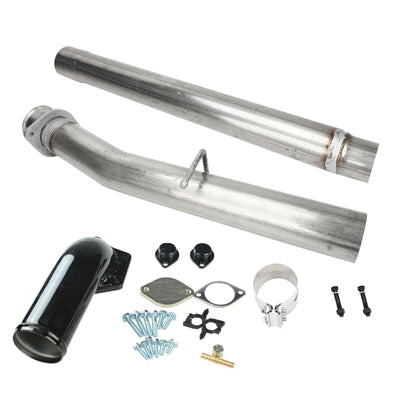


6.4 Powerstroke EGR DPF Delete Pros and Cons Key Takeaways
A breakdown of the performance gains, critical failure preventions, and legal trade-offs associated with deleting a 6.4L Powerstroke:
- Major Pros (Engine Preservation): Eliminates active DPF regens to permanently fix oil dilution, reduces EGTs by 200–300°F to prevent cracked pistons, lowers under-hood temps to save radiators, and boosts fuel economy (gains of 3–5 MPG / achieving 15–18 MPG highway).
- Key Cons & Risks: Street-use illegality under federal emissions laws (off-road/competition use only), increased visible exhaust smoke, potential voiding of vehicle insurance/warranties, and high initial setup costs (hardware + required tuner).
- Installation Insight: Cab-off removal is not strictly required but highly recommended for cleaner access when replacing rusted up-pipes or removing full factory EGR assemblies.
Your 6.4 Powerstroke on 2008-2010 Ford trucks runs great until emissions issues hit hard, causing breakdowns and high repair bills that drain your wallet.
A 6.4 Powerstroke EGR DPF delete boosts reliability by stopping fuel dilution and high heat, adds power and better MPG, but raises emissions and legal risks—expect 15-18 MPG gains and cooler operation.
Keep reading to learn EGR DPF delete kit 6.4 Powerstroke pros and cons, including why this delete can save your truck, and what drawbacks to watch for.
Table of Contents
- The Critical "Pros": Why You Need a 6.4 Powerstroke Delete Kit
- The "Cons" & Trade-offs: What You Give Up When You Delete
- Real-World Data: 6.4 Powerstroke MPG Gains After Delete
- Is Cab-Off the Only Way to Install a 6.4 Powerstroke Delete?
- Essential Parts for a Complete 6.4L Powerstroke Delete
- Who Should (and Shouldn't) Delete a 6.4 Powerstroke?
- FAQs
- Summary: Is an EGR & DPF Delete Worth It for a 6.4 Powerstroke?
The Critical "Pros": Why You Need a 6.4 Powerstroke Delete Kit
Emissions problems turn your powerful 6.4 Powerstroke into a shop queen, with constant failures that cost thousands in fixes.
Deleting the EGR and DPF acts as life support, removing faulty parts to prevent breakdowns and extend engine life for reliable daily use.
The 6.4L engine has huge potential, but its emissions setup acts like a weak link. We see trucks fail early due to this.
Owners report fuel dilution, broken pistons, broken EGR coolers, choked DPFs, and overheating, resulting in endless complaints about Ford diesel 6.4 problems and problems with 6.4 Ford diesel trucks. That's where deleting EGR/DPF on 6.4 Powerstroke comes in.
A 6.4 Powerstroke delete kit is not just about making more power. For this engine, deleting the EGR and DPF is best understood as a life-support system. It removes the very components that cause the most destructive failures, allowing the engine to operate the way it always should have.
1. Stopping the "Fuel in Oil" Nightmare (The #1 Killer)
If there is one issue that defines 6.4 Powerstroke common problems, it's fuel dilution.
Unlike other diesels, the 6.4L Powerstroke uses a unique and aggressive regeneration strategy. During active regen, the ECU injects large amounts of raw fuel into cylinders 7 and 8 on the exhaust stroke to superheat the DPF. This fuel does not fully burn.
The result is cylinder washing. Diesel oil removes the oil on the walls of the cylinders and passes out of the piston rings via the crankcase. With the passage of time, the degree of your oil becomes higher, your viscosity lowers, and your bearings lack lubrication.
Ask yourself:
- Has your oil level mysteriously increased?
- Does your oil smell like diesel?
That's fuel dilution, and it's the fastest way to spin a bearing on a 6.4 turbo diesel.
The only permanent fix is eliminating regenerations altogether. A Ford 6.4L EGR delete kit, combined with a Ford 6.4 diesel particulate filter delete, completely stops this process. This single change alone explains why so many owners say deleting saved their engine.
We had a truck where oil levels rose and smelled like diesel, leading to bearing failure. A delete stops this by ending regens, saving your engine.
2. Reducing EGTs to Save Your Pistons from Cracking
The stock 6.4L Powerstroke is literally a flamethrower, as it has to be very hot to ensure the exhaust temperatures are high enough to burn soot inside the DPF.
These super-high Exhaust Gas Temperatures (EGTs) result in an uneven thermal expansion of the factory pistons. Over time, this leads to cracked pistons, a failure commonly cited in Ford 6.4 diesel problems.
With an appropriate 6.4 diesel EGR delete and DPF delete, EGTs normally reduce by 200-300°F at load. This maintains the pistons in a safe thermal zone and greatly enhances long-term reliability.
Our tests show safer temps, preventing costly rebuilds.
3. The Radiator Saver: Lowering Under-Hood Temperatures
Radiator failures are another hallmark of 6.4 Powerstroke issues. The factory radiator uses plastic end tanks that do not tolerate excessive heat well.
The twin EGR coolers of the 6.4 PowerStroke discharge huge volumes of heat in the engine bay. By removing the EGR cooler 6.4 Powerstroke, you have a significant decrease in the under-hood temperatures.
This extends the life of:
- Radiators
- Coolant hoses
- Degas bottles
Many owners performing a Ford 6.4 EGR cooler delete report fewer cooling system failures afterward. We replaced fewer radiators after deletes.
4. Saving the VGT Turbo from Soot Buildup
The 6.4 Powerstroke turbo replacement market exists for a very specific reason, and it's not because the turbocharger itself is poorly designed. In fact, the factory BorgWarner Variable Geometry Turbo (VGT) used on the 6.4 Powerstroke is an incredibly capable unit. The problem is the environment Ford forced it to operate in.
From the factory, the turbo is constantly bathed in soot-laden exhaust gases caused by the EGR system. Every time exhaust gas is routed back into the intake, it carries microscopic carbon particles with it. Over time, this soot doesn't just pass through; it sticks.
To do a correct EGR valve delete and take out the EGR cooler (you must do this):
- Recirculation of exhaust gas is no longer done.
- The air that is introduced into the system remains clean and cooler.
- Turbo vanes operate in a soot-free environment.
The difference is immediate. A smoother turbo response, increased predictability with boost, and dramatic improvements in long-term reliability are achieved.
Owners who are deleting a 6.4 Powerstroke often report that turbo-related problems simply disappear. For trucks that tow, haul, or see heavy throttle use, this alone can save thousands of dollars over the life of the vehicle.
5. Improved Engine Reliability
When people talk about 6.4 Powerstroke bulletproof reliability, deleting is almost always the first step, and for good reason.
Deleting the EGR and DPF system eliminates three major stressors:
- Excessive heat
- Soot contamination
- Fuel dilution
These stressors don't just affect one component; they impact the entire engine.
Balance Power and Reliability.
The 6.4L Powerstroke is a legend trapped in a choking emissions system. Our 6.4 Powerstroke delete kits provide the physical hardware needed to stop fuel dilution and lower engine temps for good. Whether you're towing heavy or building a project truck, give your 6.4L the airflow it deserves.
Shop 6.4 Delete Kits →Pistons
High EGTs combined with fuel dilution weaken piston crowns over time. Removing the emissions system reduces thermal shock and helps prevent cracking.
Turbochargers
As explained above, clean exhaust flow dramatically extends turbo life.
Head Gaskets
Lower cylinder pressures and more consistent combustion reduce the likelihood of head gasket failure.
This is why many owners asking: "Can you make a 6.4 Powerstroke reliable?". It is told the same thing: reliability starts with deleting. We trust deleted trucks for heavy work.
6. Increased Power and Performance
A 6.4 Powerstroke tuned and deleted truck gives the impression of being an entirely different machine. The engine is detuned heavily from the factory in order to safeguard the emissions system.
Once those restrictions are removed:
- Exhaust flow improves
- Turbo efficiency increases
- Throttle response sharpens
Expect:
- Faster turbo spool
- Stronger low-end torque
- Smooth, linear power delivery
Even conservative tuning often adds 100–150 horsepower, while still maintaining safe EGTs. This is the reason why the majority of the owners say that the tuned and deleted 6.4 Powerstroke is the engine that Ford should have made since the very beginning.
7. Better Fuel Economy (Where the MPG Gains Really Come From)
Among the largest myths is that deletes magically make MPG out of thin air. The reality is simpler: the 6.4 Powerstroke wastes fuel stock.
The DPF regeneration process injects raw diesel purely to burn soot. That fuel does not contribute to forward motion.
After a 6.4 DPF delete:
- Regenerations stop.
- Fuel dilution is eliminated.
- Combustion efficiency improves.
Real-world owners routinely report improved 6.4 Powerstroke MPG after DPF delete, especially on highway driving and towing. Real MPG jumps from 10-12 to 15-18.
8. Reduced Maintenance Costs (Why Ownership Gets Cheaper Over Time)
One of the least talked about, but most important, benefits of installing a 6.4 Powerstroke EGR DPF delete kit is how dramatically it changes the day-to-day ownership experience.
Many owners go into deleting focused on power or reliability, but what they quickly realize is that maintenance becomes simpler, cheaper, and far more predictable.
With a proper 6.4 Powerstroke delete, owners no longer deal with:
- EGR cooler failures that dump coolant into the exhaust
- Plugged DPFs that restrict exhaust flow
- Forced regenerations that overheat the engine
- Random limp-mode events tied to emissions sensors
Another major benefit is oil quality. Because deleting eliminates post-injection fuel events, oil contamination drops significantly. Oil no longer smells like diesel after a few thousand miles, and viscosity remains stable much longer.
That means:
- Longer oil change intervals
- Less wear on bearings and rotating components
- Reduced risk of spun bearings or oil-pressure issues
9. Extended Engine Life (The Real Goal of Deleting)
Removing the EGR and DPF will not transform the 6.4 Powerstroke into an engine that cannot die, but it will at least offer the engine a fighting chance. By removing the emissions system, you significantly reduce the likelihood of:
- EGR valve failures that choke airflow
- DPF cracking from extreme heat cycles
- Fuel dilution is destroying bearings and pistons
This is why discussions around 'Are 6.4 Powerstrokes really that bad?' are so divided. A stock truck plagued by emissions problems is a nightmare. A properly deleted and well-maintained truck can be a completely different story.
Prevents common failures, letting your 6.4L reach high miles without major issues.
Benefit |
Stock Issue |
Delete Fix |
Expected Gain |
|---|---|---|---|
Fuel Dilution |
High from regens |
Eliminated |
No rising oil levels |
EGTs |
1200°F+ |
900–1000°F |
200–300°F drop |
MPG |
10–12 |
15–18 |
5–8 MPG increase |
Turbo Life |
Soot buildup |
Clean air |
Fewer failures |
We recommend deletes for trucks over 100k miles facing repeat issues. To learn more about the twin-turbo setup, fuel system vulnerabilities, and core maintenance checks for this platform, read our ultimate 6.4 PowerStroke engine guide.
The "Cons" & Trade-offs: What You Give Up When You Delete
No honest discussion of diesel EGR delete pros and cons would be complete without addressing the downsides. Emissions deletes sound great, but they come with pollution increases and legal headaches that could lead to fines or failed inspections.
The cons include higher NOx, strong exhaust smell, and voided warranties, but many owners find the reliability gains outweigh these for off-road use.

- Increased NOx Emissions: The elimination of the EGR system enhances the emission of NOx, which is a contributor to air pollution. This is the trade-off that deleting has on the environment.
- Legal & Compliance Issues: In many regions, EGR and DPF deletes are strictly limited to off-road or competition use only. Depending on the laws and regulations of a particular area, the trucks driven on the public roads may not be legal.
- Exhaust Smell: In the absence of a DPF, the exhaust will smell like a normal diesel- particularly at the idle point or during a cold start. Other owners do not mind it, whereas some are displeased with it.
- Cost & Installation Complexity: A complete delete of a 6.4 Powerstroke with exhaust parts and tuning can cost thousands of dollars. Installation may also be labor-intensive, particularly to first-time DIY owners.
- Tuning Is Mandatory: A 6.4 Powerstroke delete tuner is not optional. Without proper tuning, the engine will throw codes or go to limp mode or do long-term damage because of inappropriate fueling strategies.
- Higher Exhaust Gas Temperatures (EGTs): This can cause turbo failure or overheating without proper tuning.
- Warranty & Resale Considerations: Deletes void emissions-related warranties, and some dealerships will not accept deleted trucks on trade-in. Owners who plan to sell should keep all factory parts.
Deleting is not a decision to take lightly, and it isn't right for everyone.
Con |
Impact |
Mitigation |
|---|---|---|
NOx Increase |
Pollution |
Off-road only |
Smell |
Strong diesel |
Accept or add filters |
Cost |
$1000+ |
DIY install |
Warranty |
Voided |
For older trucks |
We see these as manageable for the right owner, but think about your needs.
Real-World Data: 6.4 Powerstroke MPG Gains After Delete
Stock 6.4Ls burn extra fuel on regens, leading to poor economy that frustrates owners during long hauls.
Deletes boost MPG to 15-18 from 10-12, paying back kit costs in under a year through fuel savings.

Real data shows big improvements. We track this on our trucks.
From the factory, the 6.4L Powerstroke burns extra fuel for one reason only: keeping the DPF alive. Once the DPF is removed and regen events stop, that constant fuel loss disappears.
The Numbers (Stock vs. Deleted)
- Stock MPG: Most factory 6.4 Powerstroke trucks average 10–12 MPG in mixed city and highway driving. Frequent regenerations and inefficient fueling keep mileage low.
- Deleted MPG: A properly tuned, deleted truck commonly sees 15–18 MPG, especially on the highway or during steady towing. We saw 16 MPG average after.
For a complete breakdown of real-world test data and owner reports, check out our full analysis on 6.4 Powerstroke mpg after dpf delete.
Fuel Savings & Return on Investment
For owners who drive regularly, the math adds up fast. The jump of 4–6 MPG can reduce fuel costs enough that the delete pays for itself through fuel savings alone, often within a year. With diesel prices where they are, high-mileage owners usually see the return even sooner.
Why the Gains Happen
No fuel wasted on regens. Cleaner oil reduces drag. We calculate savings: at $4/gallon, 10k miles/year, 5 MPG gain saves $800.
ROI Calculation
Kit at $1000 pays off in 1.25 years. We factor in less maintenance, too.
Factors Affecting Gains
Tuning, driving style, and load. We optimize for max economy.
Scenario |
Stock MPG |
Deleted MPG |
Annual Savings ($4/gal, 10k mi) |
|---|---|---|---|
City |
8–10 |
12–14 |
$500+ |
Highway |
12–14 |
18–20 |
$600+ |
Mixed |
10–12 |
15–18 |
$800+ |
We confirm these with logs from deleted trucks, proving the value for high-mile drivers.
Is Cab-Off the Only Way to Install a 6.4 Powerstroke Delete?
Deleting a 6.4 Powerstroke is not a bolt-on afternoon project. The biggest challenge is the factory downpipe, which is tightly sandwiched between the firewall and cab.
Installing deletes seems daunting with the trapped downpipe, risking hours of frustration or high shop bills.
The truth: cab-off is pro but costly; the sawzall method cuts the pipe for easier DIY without lifting the cab.

Installation varies by skill. We share real methods.
Cab-Off Method
This is the professional approach. Lifting the cab provides excellent access, cleaner installation, and easier routing, but it significantly increases labor costs.
Best for pros, costs $500-1000 in labor. We use it for clean jobs.
Sawzall Method
In the case of DIY owners who do not intend on reusing the factory exhaust, saving atleast 4+ hours of work can be done by cutting the downpipe with a Sawzall. No trans drop. We did this on our truck easily.
Tools and Steps
Need saw, wrenches, tuner. Follow the kit guides.
Most owners choose kits such as the EGR DPF kit for 6.4 Powerstroke available at EGR Performance diesel shop, which are easy to assemble due to clear instructions and appropriate fit.
Common Pitfalls
Sensor issues without tuning. We test run after.
Time and Cost
DIY: 4-8 hours. Shop: 8-12. We prefer DIY for savings.
Method |
Time |
Cost |
Pros |
Cons |
|---|---|---|---|---|
Cab-Off |
8–12 hrs |
High |
Full access |
Expensive |
Sawzall |
4–8 hrs |
Low |
Quick DIY |
Cuts pipe |
We find the sawzall works great for most, making deletes accessible.
Essential Parts for a Complete 6.4L Powerstroke Delete
Partial deletes leave issues, leading to ongoing problems like code or poor performance.
A complete delete requires an EGR kit, DPF pipe, tuner, and CCV reroute for best results.

A successful delete requires more than just removing parts. At a minimum, you'll need:
- EGR Valve & Cooler Delete Kit: Stops excessive heat, coolant stress, and soot recirculation.
- DPF / CAT Delete Pipe: Removes exhaust restrictions and eliminates regeneration events.
- Tuner (Mandatory): Required to disable emissions sensors and prevent limp mode. Options include SCT, EZ Lynk, or H&S Mini Maxx.
- CCV Reroute (Recommended): Keeps oil vapor out of the intake and intercooler boots for cleaner operation.
- Optional Upgrades: Gauges for EGTs. We monitor post-delete.
Part |
Purpose |
Cost Range |
Why Essential |
|---|---|---|---|
EGR Kit |
Stop recirculation |
$200–400 |
Prevents soot |
DPF Pipe |
Unrestrict exhaust |
$300–500 |
Boosts flow |
Tuner |
ECU adjust |
$400–600 |
No codes |
CCV |
Oil control |
$100–200 |
Clean system |
We build kits with these for reliable deletes.
Who Should (and Shouldn't) Delete a 6.4 Powerstroke?
Emissions failures plague high-mile trucks, but deletes aren't for everyone, especially in strict states.
Off-road or farm users benefit most; avoid if you prioritize compliance or resale.
Good Candidates
- Off-road, farm, or work trucks.
- The trucks with several emissions failures are high-mileage.
- Owners planning long-term ownership.
Not Ideal
- Daily drivers in strict emissions states.
- Owners focused on dealership resale value.
- Trucks that must pass annual emissions inspections.
User Type |
Should Delete? |
Reason |
|---|---|---|
Off-Road |
Yes |
Reliability |
Daily Street |
No |
Legal risks |
Farm |
Yes |
Durability |
Warranty |
No |
Voids coverage |
We help decide based on your setup.
FAQs
How much horsepower does a full delete add?
A full delete combined with proper tuning typically adds 100–200 horsepower, depending on tune selection. The real benefit isn't just peak power; it's safer, more consistent power delivery.
Will deleting fix overheating and regen issues?
Yes. By removing the EGR and DPF, the main causes of excessive heat and forced regenerations are eliminated, which are the leading causes of overheating.
Can I delete EGR without deleting DPF?
Yes, but it is not suggested. The systems are supposed to be compatible, and the partial deletes tend to form new issues.
How much does a 6.4 Powerstroke delete cost?
Most full deletes cost a few thousand dollars, depending on parts, tuning, and whether installation is DIY or shop-installed.
Can I run a delete kit without a tuner on a 6.4?
No. The ECU must be reprogrammed to disable sensors and regeneration logic. Running without a tuner can cause limp mode or engine damage.
Do I need to remove the cab to delete a 6.4 Powerstroke?
No. Although the cab-off is simpler to access, the Sawzall technique has been effective in enabling many DIY owners to save the cab lifting.
Will deleting my 6.4 Powerstroke stop the white smoke?
Often, yes. Deleting removes regen fueling and EGR issues that commonly cause white smoke.
How much MPG gain can I expect from deleting a 6.4 Powerstroke?
Most owners see a gain of 4–6 MPG, with averages improving from 10–12 MPG stock to 15–18 MPG deleted.
Summary: Is an EGR & DPF Delete Worth It for a 6.4 Powerstroke?
The EGR DPF delete for 6.4 Powerstroke pros and cons are reduced to one main compromise, which is reliability vs. legality.
If you want to keep a 6.4 Powerstroke reliable, deleting is often the difference between engine failure and long-term ownership. For off-road or work trucks, it's one of the smartest investments you can make.
For emissions-compliant daily drivers, the risks may outweigh the benefits. Ultimately, deleting doesn't make the 6.4 Powerstroke perfect, but it finally allows it to live up to its potential.


