


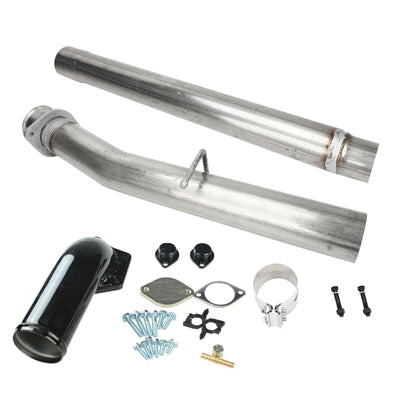


6.4 Powerstroke Delete Cost Key Takeaways
In 2026, deleting a 6.4L Powerstroke requires balancing initial hardware/labor costs against long-term repair savings:
- Total Cost Range: A full delete for 6.4 Powerstroke costs $1,500–$1,800 for DIY installation, or $2,600–$3,500+ when done by a professional shop.
- Core Expenses: Hardware (EGR/DPF pipes) costs $300–$600, while essential off-road tuners (e.g., Mini Maxx V2) run $900–$1,200 to prevent check engine lights and limp mode.
- ROI & Value: Upfront costs are quickly recovered by gaining 2–4 MPG and avoiding repeated $2,500 DPF replacements or $10,000+ engine rebuilds.
If you own a 6.4L Powerstroke, your truck runs rough, experiences constant regens, and has high repair bills. Nevertheless, the emissions system can turn a simple drive into a continuous repair cycle. These issues drain your wallet fast.
A 6.4 Ford delete kit fixes them by removing faulty emissions parts for better power and reliability. This is why in many cases, we are asked by the owners of such a cost to delete a 6.4 Powerstroke.
In 2026, a full delete for a 6.4 Powerstroke costs $1,500 to $3,500 on average. This includes EGR and DPF kits, tuning, and labor. DIY saves money but needs skills.
We have worked on dozens of 6.4 Powerstrokes over the years, and we can tell you this: the factory emissions setup on this engine is its biggest weakness.
This guide will walk you through every dollar you can expect to spend on a delete in 2026, from the cheapest EGR-only option to a full DPF/EGR/tuner package. I will also explain the hidden costs, DIY vs. shop pricing, performance gains, and legal risks so you can make the right call for your truck and your budget.
Table of Contents
- What Does "Deleting" a 6.4 Powerstroke Mean?
- 2026 Average Cost to Delete a 6.4 Powerstroke
- 6.4 Powerstroke Delete Cost Breakdown by Component
- DIY vs Professional Delete: How Does the Cost Compare?
- The Hidden Costs: What Most Guides Forget
- Factors That Affect Total Delete Cost
- Is It Worth the Cost? What Performance Gains Can You Expect?
- Legal and Emissions Considerations
- FAQs
- Final Thoughts
What Does "Deleting" a 6.4 Powerstroke Mean?
Emissions systems on your 6.4 cause breakdowns and poor performance. Clogged parts lead to expensive fixes. Deleting them clears the path for smooth operation.
Deleting a 6.4 Powerstroke means removing emissions components like EGR and DPF to boost reliability. Common types include EGR delete, DPF delete, or full delete. It solves regen issues and oil dilution.
Three Common Delete Types
There are three main paths 6.4 owners take, and each one costs a different amount and solves different problems.
1. EGR delete: An EGR delete 6.4 Powerstroke removes the EGR valve and cooler. Minimizes the carbon accumulation.
The EGR system recirculates hot exhaust gas back into the intake manifold, which causes carbon buildup, clogged coolers, and cracked cooler cores that leak coolant into the exhaust.
Over time, this leads to overheating and, in worst cases, catastrophic engine failure. An EGR delete stops the carbon buildup at the source. This is often the first modification owners do because the EGR cooler is the most common failure point on the 6.4.
2. DPF delete: A DPF delete 6.4 Powerstroke removes the diesel particulate filter from the exhaust system and replaces it with a straight pipe. Removes regen issues and stops oil pollution.
The DPF traps soot and burns it off during "regeneration" cycles. On the 6.4, these regen cycles inject extra fuel into the cylinders to raise exhaust temperatures.
That unburned fuel washes past the piston rings and ends up in your oil — this is the infamous "oil dilution" problem that causes the oil level to rise above the full mark on the dipstick. Over time, diluted oil destroys bearings and can kill the engine.
A DPF delete stops regen entirely, which stops oil dilution.
3. Full delete: A full delete for 6.4 Powerstroke combines the EGR delete, DPF delete, and tuning into one job. Deletes the two systems, and then they can be tuned.
This is what most experienced owners recommend because the EGR and DPF systems are interconnected in the 6.4's engine management. Removing both at the same time gives the best results for reliability, fuel economy, and performance.
Most "all-in-one" kits on the market in 2026 are designed for a full delete.
Problems Deletes Are Meant to Solve
Deletes fixes key problems. Regens happen often on 6.4s. They raise EGTs and use more diesel. Oil gets diluted from fuel during regens. This wears out bearings.
EGR systems cause head gasket blows. DPF clogs reduce power. Deletes prevent these. Our shop has seen trucks last longer after deletes. One time, a customer with 150,000 miles had constant limp modes. After delete, no more issues for years.
Delete Type |
Main Problem Solved |
Typical Gains |
|---|---|---|
EGR Delete |
Cooler failures, soot buildup |
Lower EGTs, better airflow |
DPF Delete |
Frequent regens, clogged filter |
Improved MPG, more power |
Full Delete |
All emissions-related restrictions |
Maximum reliability, 2–4 MPG boost |
Deletes make sense for off-road use. They cut maintenance costs over time.
2026 Average Cost to Delete a 6.4 Powerstroke
Rising part prices hit your budget hard. Inflation makes deletes more expensive each year. Know the averages to plan your spend.
National average for a 6.4 delete in 2026 ranges from $1,500 to $3,500. Low-end is $1,200 for basic kits. High-end hits $4,000 with premium parts and shop install.

National Average Price Ranges
The price range has a wide spread, and that is normal. Here is what we see across the country in 2026.
The vast majority of the owners are in two practical cost ranges:
- Low-End: $1,200–$1,800
- High-End: $2,500–$3,500+
These totals, in most instances, are for the hardware with a tune, which, in most aspects, is the component that prevents the consistent fault codes when you remove the equipment.
However, the numbers often fail to reflect the repairs that come up during installation, which are termed as the while we are in there, repair, and it is the add-ons that take a project way beyond the original estimate.
On the low end ($1,200–$1,800), you are looking at a DIY install with a budget all-in-one kit and a basic tuner like the Mini Maxx V2. These kits include an EGR block-off plate, a DPF delete pipe, and sometimes an intake elbow. The tuner is the biggest single expense at $900–$1,200. If you already own a compatible tuner, the hardware-only cost can drop below $500.
On the high end ($2,500–$3,500+), you are paying for premium parts from brands like Sinister Diesel or No Limit Fabrication, a high-end tuner like the EZ Lynk AutoAgent 3 with custom tunes ($1,200–$1,600), and professional installation ($500–$1,000).
Some shops add a full 5-inch downpipe-back exhaust, a cold air intake, and a coolant reroute to the job, which pushes the total even higher.
Why Prices Have Changed in Recent Years
Prices in 2026 are higher than they were in 2020 or 2021 for several reasons. First, the EPA crackdown on diesel delete shops and tuner manufacturers has reduced the number of suppliers in the market.
Several well-known tuner companies have shut down or stopped selling delete-capable products, which has driven up prices on the tuners that remain available.
Second, the cost of stainless steel and raw materials has gone up.
Third, the 6.4 Powerstroke is now 16–18 years old, and demand for delete kits remains strong because these trucks are still working hard on farms, job sites, and highways across the country. High demand plus limited supply equals higher prices.
Cost Level |
Parts Cost |
Labor Cost |
Total |
|---|---|---|---|
Budget DIY |
$800–$1,200 |
$0 (your time) |
$1,200–$1,800 |
Mid-Range DIY |
$1,200–$1,800 |
$0 (your time) |
$1,200–$1,800 |
Professional Install |
$1,200–$2,000 |
$500–$1,000 |
$1,700–$3,000 |
Premium Shop Build |
$1,800–$2,500 |
$800–$1,200 |
$2,600–$3,500+ |
Plan for these costs. Shop around for deals.
6.4 Powerstroke Delete Cost Breakdown by Component
A full delete is not one purchase — it is several parts that add up. It is a system of components that must fit correctly, close the way it was planned, and then some tuning must be applied to get the truck to act as expected.
Understanding the cost of each piece helps you decide where to spend and where to save.
A 6.4 Powerstroke full delete has four main cost components: EGR delete kit ($50–$300), DPF delete pipe ($150–$500), tuner ($600–$1,200), and labor ($500–$1,000 if you use a shop). The total DIY delete cost will be $900 - $1,400. For shop, the total delete cost will be $2,000 - $3,000.
The weight of each major ingredient is the following:
1. EGR Delete Kit Cost
The EGR kit appears to be the low-hanging fruit. The EGR delete kit for a 6.4 Powerstroke typically costs between $50 and $300 in 2026, depending on the type of material used, design, and hardware provided.
The EGR delete price is not always an amount that is concerned with the sticker price of the kit, because a better fit would result in reduced time to install the kit, and the same will reduce the chances of finding leaks when the truck is restored to operation.
A basic kit includes EGR block-off plates, a coolant reroute, and the necessary gaskets and hardware to seal everything up after removal. Higher-end kits also include a high-flow intake elbow, which replaces the restrictive factory elbow and improves airflow to the turbo.
The intake elbow alone can cost $50–$100 if purchased separately, so a kit that bundles it in is a better deal.
We have seen standalone EGR kits on Amazon for as low as $79, but we recommend spending a bit more for kits with CNC-machined plates and proper gaskets. A cheap kit that leaks coolant or exhaust will cost you far more in the long run.
2. DPF Delete Kit Cost
DPF delete kit is equipped with the delete pipe section and all the mounting hardware. A DPF delete pipe for the 6.4 Powerstroke costs between $150 and $500, based on the material and quality.
This is a straight section of pipe — usually 4 inches in diameter — that replaces the factory DPF and catalytic converter assembly. The price difference comes down to material quality.
Budget pipes use aluminized steel, which is cheaper but can rust over time, especially in northern states with road salt. Mid-range pipes use 409 stainless steel, which offers good corrosion resistance at a reasonable price.
Premium pipes use 304 stainless steel with TIG-welded joints and mandrel bends for the best flow and durability. Some kits include sensor bungs and new exhaust sensors, while cheaper ones require you to reuse or buy sensors separately.
3. Tuning Cost
To begin with, without tuning, the truck will start with the fault codes and might misbehave and even fail to start or even enter the limp mode. The tuner is the most important — and most expensive — piece of the delete.
In 2026, expect to pay $600–$1,600 for a 6.4 Powerstroke delete tuner. The tuner reprograms the truck's ECU to operate correctly without the EGR and DPF systems. Without it, the truck will throw codes, run in limp mode, and attempt regen cycles that no longer have a DPF to burn off.
Popular 6.4 Powerstroke delete tuners include the Mini Maxx V2 (around $600–$800), the EZ Lynk AutoAgent 3 ($1,200–$1,600), and custom tune packages from shops that specialize in Powerstroke tuning. The EZ Lynk is more expensive but offers wireless updates and multiple tune files for different power levels.
Some all-in-one bundles from companies like EGR Performance include a tuner with the hardware kit, which can save $100–$300 compared to buying everything separately.
4. Labor Costs
Prices of labor vary in different locations, and they are subject to the condition of the car. If you take your truck to a diesel shop for a full delete, expect to pay $500–$1,000 in labor.
Stuck clamps, rusty exhaust hardware, broken bolts, etc. can make the otherwise should have been an easy installation into a time-consuming and very expensive one. This explains how much different shops can differ in relation to the 6.4 Powerstroke EGR delete labor.
Most shops charge $125–$175 per hour, and a full 6.4 delete takes 4–6 hours for an experienced diesel mechanic. The EGR delete is the more labor-intensive part because it involves removing the EGR cooler, which is buried deep in the engine valley and surrounded by coolant lines and wiring harnesses.
The DPF delete is more straightforward — it is mostly unbolting the old filter assembly and bolting in the new pipe.
Labor rates vary a lot by region. Rural shops in the Midwest might charge $100/hour, while shops in California or the Northeast can charge $175/hour or more.
Component |
Low Estimate |
High Estimate |
|---|---|---|
EGR Delete Kit |
$150 |
$300 |
DPF Delete Pipe |
$150 |
$500 |
Tuner |
$600 |
$1,200 |
Labor (Shop Install) |
$500 |
$1,000 |
Total (DIY) |
$900 |
$2,000 |
Total (Shop) |
$1,400 |
$3,000 |
Factor all in. Bundles save 10-20%.
Before making a purchase decision, it is vital to evaluate both the mechanical advantages and legal tradeoffs. You can read our detailed breakdown on 6.4 Powerstroke delete pros and cons to understand how these component upgrades impact engine reliability versus emissions compliance.
DIY vs Professional Delete: How Does the Cost Compare?
DIY vs shop is the choice that the majority of owners make, either to save money or get rid of stress. Doing the work yourself can save hundreds of dollars, but it is not for everyone. A 6.4 delete involves more than just unbolting a few parts.
A DIY full delete on a 6.4 Powerstroke costs $900–$2,000 in parts alone. A professional shop install runs $1,400–$3,000 total. You save $500–$1,000 doing it yourself, but the job takes 8–10 hours without experience and requires a good set of tools and patience with stubborn, corroded bolts.

Cost Breakdown: DIY vs. Shop
The savings from a DIY install are real, but they come with trade-offs.
If you do the work at home, your total cost is just the parts: an all-in-one kit with a tuner runs $900–$2,000, depending on the brand and quality level.
You will also need basic hand tools, a socket set with deep sockets, a torque wrench, penetrating oil (buy a lot of it — the 6.4's exhaust bolts are notorious for snapping), and a drain pan for coolant. If you do not already own these tools, add $100–$200 to your budget.
If you go to a professional diesel shop, the parts cost is the same, but you add $500–$1,000 in labor. The advantage is that a good shop has dealt with every corroded bolt, broken stud, and unexpected problem that comes up during a 6.4 delete.
They also handle the tuner installation and verify that everything is running properly before you drive away. Some shops offer all-in-one packages that include parts, tuning, and labor for a flat rate, which can be a good deal.
The table presented below compares the differences in each choice in terms of cost, time, and the experience as a whole.
Factor |
DIY |
Professional Shop |
|---|---|---|
Parts Cost |
$900–$2,000 |
$900–$2,000 |
Labor Cost |
$0 |
$500–$1,000 |
Total Cost |
$900–$2,000 |
$1,400–$3,000 |
Time Required |
8–10 hours |
4–6 hours |
Tool Investment |
$200–$500 if not owned |
Included |
Skill Level |
Best for mechanically confident owners |
No mechanical experience required |
Risks |
Higher (if bolts break or parts fight back) |
Lower (shop handles it) |
Warranty/Guarantee |
None |
Some shops offer install warranty |
Do It yourself vs Pro Delete: Pros and Cons.
When deciding on a home install or a shop install, it is always good to consider the merits and disadvantages of both methodologies, as they appear.
DIY (Done at Home)
- Pros: (Saves money); complete control of parts. For a DIY delete, the biggest pro is saving $500–$1,000. You also learn your truck inside and out, which helps with future maintenance.
- Cons: It may take some time; it is physical work. You may have to plan a full weekend with the risk of breaking bolts and needing to extract them, and the fact that troubleshooting tuner issues on your own can be frustrating.
Professional Shop Install
- Pros: Quicker, easier installation. A good shop gets the job done in one day, handles any complications, and makes sure the tune is dialed in.
-
Cons: higher cost; shop-based quality. Also the cons include the difficulty of finding a shop willing to do delete work in 2026 (many have stopped due to EPA pressure), and the fact that you are trusting someone else with your truck's ECU programming.
The Hidden Costs: What Most Guides Forget
The kit and the tuner get all the attention, but there are smaller costs that catch owners off guard if they do not plan.
In 2026, owners should budget an extra $200–$400 for hidden costs: coolant bypass kits ($50–$100), new gaskets and hardware ($50–$100) because old bolts will snap, and a fresh oil and filter change ($100–$150) to flush the fuel-diluted oil out after the delete.

It is not money to spend on upgrades. It comes in the little inconveniencing stuff that materializes once you have commenced tearing your truck up. The parts of the coolant are generic, and gaskets are even less worthy than using old ones, as they will leak.
Hardware is another one. On an old truck,s the bolts tend to snap away, the clamps seem to oppose you, and you suddenly find yourself purchasing stuff you never intended to, and at that, too, when the truck has been through rain or snow or on salted roads.
And, incidentally, anticipate new oil and filter just after work. The majority of 6.4 trucks are suffering from fuel dilution of the oil system, and an immediate oil change is the cleanest reset you can give.
These extras come in despite you doing it all by yourself. That is the truth behind the deleting of a 6.4 Powerstroke on a truck that is already aging past the years of service.
Where the Extra Money Goes
These hidden costs are small individually, but they add up.
Coolant bypass kits ($50–$100) are needed because the EGR cooler is plumbed into the truck's cooling system. When you remove the cooler, you need to reroute the coolant lines.
Some EGR delete kits include a bypass, but cheaper ones do not, so check before you buy. Running without a proper bypass can cause air pockets in the cooling system, which leads to overheating.
Gaskets and hardware ($50–$100) are the costs that almost everyone underestimates. The 6.4 Powerstroke is at least 16 years old in 2026.
The exhaust manifold bolts, EGR cooler bolts, and DPF clamp bolts are all exposed to extreme heat, soot, and moisture for their entire life.
When you go to remove them, they snap. It is not a matter of "if" but "when." We always buy extra bolts, studs, and gaskets before starting a 6.4 delete. A broken bolt extraction can add hours to the job, and if you are paying shop rates, that means real money.
Fresh oil and filter ($100–$150) should be done immediately after the delete. If your 6.4 has been running with the factory DPF, the oil is almost certainly diluted with diesel fuel from regen cycles.
Ford considers up to 5% fuel dilution "within spec," but we have pulled dipsticks on 6.4s that smell like a gas station. That diluted oil is not protecting your bearings or your turbo.
Once the delete is done and regen stops, flush the old oil out and start fresh. Use a quality 15W-40 diesel oil and a genuine Motorcraft filter.
Factors That Affect Total Delete Cost
No two 6.4 Powerstroke deletes cost exactly the same. Two owners may purchase the same kits and still pay greatly different sums. That is because of a few simple reasons, mostly with the truck and not the shopping cart.
The total cost depends on your truck's condition and mileage, your local shop's labor rate, the brand and quality of the kit you choose, and whether the mechanic finds other problems during the install — like leaking coolant lines, worn turbo seals, or cracked exhaust manifolds.
Several factors push the price up or down.

Key Variables That Change the Price
To begin with, there are mileage and condition. It is quicker to maintain a clean 6.4 Powerstroke engine. One that is neglected is more expensive due to the increased difficulty in all the steps.
The condition of your truck is the biggest wildcard. A 6.4 with 80,000 miles and a clean engine bay is a very different job than one with 220,000 miles, rust on every bolt, and coolant stains everywhere.
On a high-mileage truck, the exhaust bolts are more likely to snap, the EGR cooler may have already started leaking (which means coolant in the exhaust and a mess to clean up), and the turbo may show signs of wear that you will want to address while everything is apart.
We have seen "simple" deletes turn into $1,000+ extra in repairs because the mechanic found a cracked up-pipe, a leaking oil cooler, or a turbo with excessive shaft play.
Second, local labor rates make a big difference. There are high shop rate areas, and there are cheaper areas, which have fewer diesel shops willing to touch the job.
A shop in rural Texas might charge $100/hour, while a shop in the San Francisco Bay Area charges $175/hour. For a 5-hour job, that is the difference between $500 and $875 in labor alone.
Third, the quality of kits is subject to cost. A low-priced 6.4 delete kit may appear to be a bargain, but a poor fit is a time consumer that will become a rework in the future.
Kit brand and quality matter more than most owners think. A $150 EGR kit with thin plates and low-grade gaskets might leak within a year. A $300 kit with thick CNC plates, high-temp gaskets, and a high-flow intake elbow will last the life of the truck.
The same applies to DPF delete pipes — a cheap aluminized pipe will rust out in 3–5 years if you live in the salt belt, while a 304 stainless pipe will last forever.
We always recommend spending a little more on parts and saving on labor by doing it yourself, rather than the other way around.
At last, the unexpected repairs found during the install are the cost that nobody can predict. When you pull the DPF and EGR off a 6.4, you are pulling apart a big chunk of the exhaust and cooling system. That gives you (or your mechanic) a clear view of parts that are normally hidden.
It is common to discover leaking turbo up-pipes, failing oil coolers, or cracked exhaust manifold studs. Fixing these while the truck is already apart is cheaper than paying the labor twice, but it still adds to the bill.
Hidden Item |
Cost |
Why Needed |
|---|---|---|
Coolant Bypass |
$100 – $200 |
Prevent overheating |
Gaskets / Hardware |
$50 – $100 |
Replace broken or stretched parts |
Oil Change |
$50 – $100 |
Remove contaminants after install |
Add these. Total budget rises, but worth it.
Is It Worth the Cost? What Performance Gains Can You Expect?
The vast majority of individuals unfriend due to boredom with endless problems. A 6.4 Powerstroke delete is not just about avoiding expensive emissions repairs. It also makes the truck run better, last longer, and cost less to own over time.
A fully deleted and tuned 6.4 Powerstroke typically gains 2–4 MPG, sees a significant drop in exhaust gas temperatures (EGTs), and eliminates oil dilution — the number one engine killer on this platform. At 2026 fuel prices, the delete often pays for itself within 15,000–20,000 miles of driving.

Reliability Improvements
The primary purpose is reliability, and that is what the owners tend to observe first. Fewer codes, fewer issues with regen, and less concern about oil contamination are the factors that make this mod remain popular.
The 6.4 Powerstroke has a reputation as one of the least reliable diesel engines Ford ever made, but most of its problems come directly from the emissions system.
The EGR cooler cracks and leaks coolant. The DPF clogs and forces the truck into constant regen cycles that pump raw fuel into the engine oil. The oil dilution thins the oil, reduces lubrication, and leads to premature bearing wear, cracked pistons, and eventually engine failure.
Removing the EGR and DPF eliminates all of these failure modes. Once deleted, the 6.4 becomes a much more reliable engine. We have seen deleted 6.4s run well past 250,000 miles with proper maintenance — something that is very rare on a stock truck.
Save Your 6.4L Powerstroke.
The 6.4L is a powerhouse, but its factory emissions system is a ticking time bomb. Our professional-grade delete kits eliminate the restrictive DPF and failure-prone EGR, allowing your twin-turbos to breathe freely. Stop paying for expensive sensor repairs and start enjoying better MPG and reliability.
Shop Delete Kits for 6.4 →Long-Term Maintenance Savings
A stock 6.4 Powerstroke costs a fortune to maintain. Replacing a DPF runs $2,000–$3,000. An EGR cooler replacement is $1,500–$2,500 with labor. Oil changes need to be done more often because of fuel dilution — many owners do 5,000-mile intervals instead of the factory-recommended 7,500.
After a delete, you eliminate the DPF and EGR as maintenance items entirely. You can also stretch oil change intervals because the oil stays clean and undiluted. Over 50,000 miles, the savings in avoided repairs and reduced maintenance easily exceed the cost of the delete itself.
Fuel Economy and EGT Improvements
Before a delete, most stock 6.4 Powerstrokes get 10–13 MPG in mixed driving. After a full delete and tune, owners typically report 14–17 MPG, with some seeing 18+ on the highway.
That is an increase of 2 to 4 MPG, that reported by owners in most instances, particularly in highway driving where there is constant speed.
For $4.00/gallon diesel in 2026, it adds up fast. If you drive 20,000 miles per year and gain 3 MPG (from 12 to 15 MPG), you save about $440 per year in fuel alone. Over three years, that is $1,320 — enough to cover a significant chunk of the delete cost.
A few proprietors consider deleting to be a single step towards making a 6.4 bulletproof.
EGTs also drop significantly because exhaust flow is unrestricted without the DPF. Lower EGTs mean less thermal stress on the turbo, exhaust manifolds, and head gaskets. This is especially important when towing, where stock 6.4s can see EGTs climb dangerously high.
The ROI
When you add up the fuel savings, the avoided repair bills, and the extended engine life, a 6.4 Powerstroke delete is one of the best investments you can make in this truck.
At 2026 fuel prices, the delete often pays for itself within 15,000–20,000 miles of driving. For owners who tow heavy or put on a lot of miles each year, the payback period is even shorter.
Beyond immediate horsepower and torque gains, the true financial return of deleting a 6.4L engine comes from avoiding catastrophic factory failures: such as cracked piston crowns, clogged oil coolers, and stuck EGR valves.
To get a complete overview of the 6.4L platform's common architecture, factory vulnerabilities, and long-term maintenance needs, check out our comprehensive 6.4 Powerstroke ulimtate guide.
Legal and Emissions Considerations
We cannot write a 6.4 Powerstroke delete cost guide without talking about the law. This is the part nobody wants to hear, but it matters.
Deleting emissions equipment on any vehicle driven on public roads is a violation of the federal Clean Air Act. The EPA has not changed this rule, even under the current administration. Fines for individuals can exceed $5,000 per violation, and shops have been penalized hundreds of thousands of dollars. Some states impose even stricter penalties.

Federal and State Laws
Under the Clean Air Act, it is illegal to remove, disable, or tamper with any emissions control device on a motor vehicle that is used on public roads. This applies to the EGR, DPF, DEF system, and catalytic converter. The law applies in all 50 states.
In 2025, EPA Administrator Lee Zeldin confirmed that diesel emissions enforcement rules remain intact even after some regulatory rollbacks. We cannot sugarcoat this: if your 6.4 Powerstroke is registered and driven on public roads, deleting it is a federal violation.
Regulations are quite different in the regions. States like California, Colorado, and New York have their own additional emissions laws and inspection programs that make it even harder to operate a deleted truck. In California, a deleted diesel truck will fail a smog check and cannot be registered.
Other states with annual safety and emissions inspections will also flag a missing DPF.
Off-Road and Competition Use
Most delete kit manufacturers sell their products with a disclaimer that they are for "off-road use only" or "competition use only." If your 6.4 Powerstroke is a dedicated farm truck that never leaves your property, a race truck, or a sled pull truck, the legal risk is essentially zero.
Many owners fall into this category, and for them, a delete makes total sense. If you are using the truck on public roads, you are taking a calculated risk. Many owners across the country drive deleted trucks every day without issue, but the legal liability is real, and we want you to know that before you spend your money.
Inspection and Resale Implications
A deleted truck will fail emissions testing in any state that requires it. If you live in a state with no emissions inspections, this is less of a concern for daily driving, but it can still affect resale. Some dealers will not accept a deleted truck as a trade-in.
Private buyers in emissions-testing states may not want to deal with the hassle either. On the other hand, in the diesel truck market, many private buyers actively prefer deleted trucks and will pay a premium for one that has been properly deleted and tuned.
Know your market before you sell. That will be important with regard to inspection, reselling, and planning the build itself. The stock parts are kept by many of the owners in store, in case they are required to revert later.
FAQs
Can I daily drive a deleted 6.4 Powerstroke?
Yes, thousands of owners daily drive deleted 6.4 Powerstrokes across the country. And it is more reliable in the case when the tune is correct, and the install is proper.
The truck will run better, get better fuel economy, and be more reliable than it was in stock form. The only risk is legal — driving a deleted truck on public roads violates federal emissions law, and you may fail state inspections where required.
Will deleting my 6.4 void the warranty?
Yes, removing the emissions system will void the emissions-related portion of your warranty. However, most 2008–2010 6.4 Powerstrokes are well past their factory warranty period in 2026, so this is a non-issue for the vast majority of owners.
If you have an extended or aftermarket warranty, check the terms carefully — most will not cover a deleted truck.
Can I just do an EGR delete on my 6.4 without touching the DPF?
This can be done, and occasionally it will correct a section of the headache. But We do not recommend it for the 6.4 specifically. An EGR-only delete solves the carbon buildup and cooler cracking problems, however DPF faults and regen issues could remain.
What are the long-term maintenance costs of a deleted vs stock 6.4?
A deleted 6.4 costs significantly less to maintain over time. You eliminate the DPF ($2,000–$3,000 replacement), the EGR cooler ($1,500–$2,500 replacement), and the frequent oil changes needed to combat fuel dilution.
A deleted 6.4 on a normal 7,500–10,000 mile oil change interval, with standard filters and fluids, costs roughly the same as any other diesel truck to maintain. A stock 6.4 can easily cost $5,000–$8,000 in emissions-related repairs over its lifetime.
Can I delete a 6.4 Powerstroke without a tuner?
No. The truck can provide codes immediately without tuning and will most likely go into limp mode because the calibration is no longer consistent with the hardware. The tuner is the most vital (and expensive) component of any delete. Do not try to save money by skipping it.
Is it worth deleting a 6.4 Powerstroke with over 200,000 miles?
Yes. However, it is better to start with a compression test. If the engine is healthy, a delete can extend its life by preventing further oil dilution. If the compression test shows weak cylinders, you may be looking at an engine rebuild regardless, and the money might be better spent there first.
What is the best delete kit for a 6.4 Powerstroke in 2026?
Reject cheap kits in poor fitment, and good hardware, which becomes expensive in poor fitment, can be found in a complete kit that fits well.
Here we recommend a reputable all-in-one bundles (like EGR Performance) that include the DPF-delete pipe, EGR block-off, and intake elbow for better airflow. Buying a bundle saves money compared to piecing everything together separately, and it ensures all the parts are compatible and designed to work together.
How long does a 6.4 Powerstroke delete take?
An experienced diesel mechanic can complete a full delete in 4–6 hours. A DIYer with basic mechanical skills should plan for 8–10 hours, especially on the first attempt.
The EGR side takes longer because of the tight working space in the engine valley and the number of coolant and exhaust connections. The DPF pipe swap is faster — usually 1–2 hours. Loading the tuner and verifying the tune takes another 30–60 minutes.
Final Thoughts
A full 6.4 Powerstroke delete in 2026 costs between $1,200 and $3,500, depending on whether you do it yourself or hire a shop, and whether you choose budget or premium parts.
DIY is a good choice for budget-focused owners, and you will save $500–$1,000 by doing the labor yourself. Having a superior shop that will put you on a more comfortable avenue and alleviate stress is generally worth the money.
When you are willing to price out parts and develop your plan, then go to EGR Performance and choose a package that suits your truck, your budget, and your actual driving styles.
Either way, a full delete is the single best thing you can do for a 6.4 Powerstroke's reliability, fuel economy, and longevity.
Browse our dedicated 6.4 Powerstroke Delete Kit Collection to view current pricing, package options, and compatible tuner combinations engineered for 2008-2010 F-250 and F-350 trucks.
If you are still on the fence, stop hesitating — every mile you drive on a stock emissions system is another mile of fuel dilution eating away at your engine. Get the delete done, change your oil, and enjoy a truck that finally runs the way it should.


