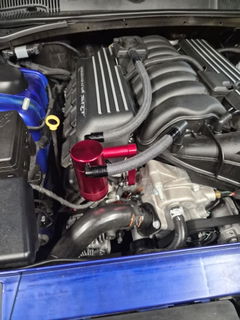
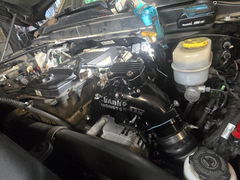
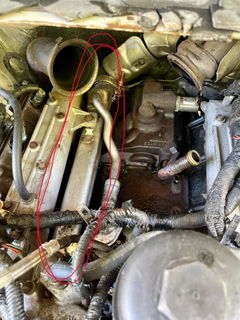
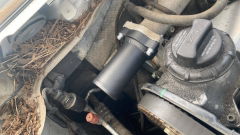
2009-2010 Ford 6.4 Powerstroke Delete Kit
Late-Model Optimized 6.4 Powerstroke Delete Kits for 2009-2010 Ford Super Duty
Maximize the efficiency of your 2009-2010 6.4 Powerstroke with our late-model optimized Delete Kit. Engineered for year-correct fitment, this flow-harmonized system eliminates the restrictive stock emissions architecture to deliver turbo-responsive performance. Featuring precision-aligned, industrial-standard components, this diagnostic-clean solution provides an EGT-optimized environment that protects your engine’s longevity. Experience crack-proof durability and a hard-anodized finish built to sustain the highest levels of performance.
Precision-Engineered Delete Solutions Built from T304 Stainless Steel and 6061 Billet Aluminum
Every 6.4 Powerstroke delete kit in this lineup is built from T304 stainless steel tubing, CNC-machined 6061-T6 billet aluminum block-off plates, and high-temperature Viton O-ring seals. These are not generic pipes slapped together in a warehouse. Each EGR delete kit, DPF delete pipe, and full delete package is TIG-welded, pressure-tested, and designed to bolt directly onto your 2008-2010 Ford F250, F350, F450, or F550 with no cutting or drilling required.
Whether you run a 2009 F250 pulling a 15,000-pound gooseneck through the Rockies or a 2010 F350 that spends its weekends on a hot shot route, these delete kits solve the root problems that plague the 6.4L: cracked EGR cooler welds that dump coolant into cylinders, DPF regeneration cycles that push exhaust gas temperatures past 1,400 degrees Fahrenheit, and soot-packed intake manifolds that choke your engine's ability to breathe.
Real-World Fixes for the Three Killers of Every 6.4 Powerstroke
The 6.4L Powerstroke has three well-documented failure points that delete kits address head-on. First, the factory EGR coolers are notorious for cracking at the weld seams, leaking coolant into the combustion chamber and bending connecting rods before you even know there is a problem. An EGR delete kit with solid block-off plates eliminates this failure entirely.
Second, the DPF regeneration cycle injects raw fuel into the exhaust stream to burn off trapped soot, driving EGTs through the roof and diluting your engine oil with diesel fuel. A DPF delete pipe replaces that restrictive filter with a straight-through SUS409 or T304 stainless exhaust, dropping EGTs by 200 to 300 degrees.
Third, carbon-packed intake manifolds from recirculated exhaust gas rob your engine of airflow. Removing the EGR system stops the soot at the source, restoring throttle response and extending oil change intervals.
Why Thousands of Diesel Owners Trust EGR Performance
EGR Performance: Engineered for Power. Backed for Life.
Max efficiency, restored horsepower, and prolonged engine life for your EGR, DPF, and CCV systems on Powerstroke, Duramax, Cummins engines, etc.
- Free Shipping: Fast & free delivery to get you back on the road sooner.
- 45-Day Returns: Shop risk-free with our generous 45-day return policy.
- 1-Year Warranty: Tested under extreme conditions. Guaranteed to perform.
- 24/7 Live Support: Real-time tech help from fitment to post-install tuning.
Product |
Engine |
Vehicle Model |
Year Range |
|---|---|---|---|
EGR Valve Delete Kit |
6.4L Powerstroke |
Ford F250, F350, F450, F550 |
2008-2010 |
EGR Delete Kit with Up Pipes |
6.4L Powerstroke |
Ford F250, F350 |
2008-2010 |
EGR Valve Delete w/ Intake Elbow & Uppipe |
6.4L Powerstroke |
Ford F250, F350, F450, F550 |
2008-2010 |
4" CAT & DPF Delete Pipe |
6.4L Powerstroke |
Ford F250, F350, F450, F550 |
2008-2010 |
4" CAT DPF Delete Pipe & EGR Delete Kit |
6.4L Powerstroke |
Ford F250 |
2008-2010 |
5" Downpipe Back DPF Delete Pipe (No Muffler) |
6.4L Powerstroke |
Ford F250, F350 |
2008-2010 |
5" Downpipe Back DPF Delete Pipe |
6.4L Powerstroke |
Ford F250, F350 |
2008-2010 |
4" Down Pipe & EGR Delete (Aluminized Steel) |
6.4L Powerstroke |
Ford F250, F350, F450 |
2008-2010 |
Full Delete Kit w/ 4" CAT DPF Pipe, EGR Delete & Tuner |
6.4L Powerstroke |
Ford F250, F350 |
2008-2010 |
EGR Delete Up Pipe & Tuner Package |
6.4L Powerstroke |
Ford F250, F350, F450 |
2008-2010 |
Shop 6.4 Powerstroke Delete Kit 2009-2010 Now!


EGR Performance: EGR, DPF, CCV & Diesel Tuning Solutions for Powerstroke, Cummins, and Duramax


Let customers speak for us

Have to say that I like the quality of the product and ease of installation. I’ve had it in for a little over a week now and I’ve driven several hundred miles with no issues whatsoever. Certainly worth it!

Works great. Exactly what I hoped it would be.

Decent quality, saw some cheaper options but this one did the job just fine. No more worrying about carbon build up!
Was easy to install, works a stated,more horsepower ,better gas mileage

This item solves a big problem perfectly. The quality of this item is 5 star for sure. Great seller as well.

Good product. Quick shipping. Would buy from again!

Extremely satisfied with this order. Will def use this company for future orders

I fit it and it made a lot of different in my car thank u

Plate looks good. The provided hardware are the wrong thread pitch however. Shipping took a long time was close to 3 weeks.
Really happy with item took 2 and a half weeks to get but worth the wait
Company is great, received the wrong item and correct item sent. No hassle
I'd love to review it but I haven't got it yet
part fit perfectly
EGR Delete for 1986-1995 Ford F150 F250 2.8L 4.9L 5.0L 5.8L 7.5L Bronco EGR Simulator Eliminator Delete
6.0L Powerstroke Diesel Complete EGR Bypass and Valve Delete Kit for 2003-2010 6.0L Ford Powerstroke F250 F350 F450 F550