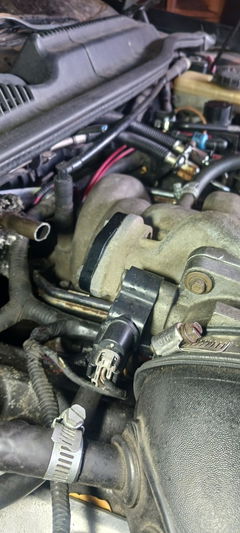
Dodge Cummins Exhaust Manifold
Dodge Cummins Exhaust Manifolds for 5.9L and 6.7L Ram Trucks
Crack Resistant Cast Iron and T4 Stainless Construction
The factory exhaust manifold on a 5.9L or 6.7L Cummins is a known weak link, and we built this collection to fix it for good. Our Dodge Cummins exhaust manifold lineup uses high silicon ductile iron castings and T304 stainless steel T4 footprints to replace the shrinking, warping, crack prone factory piece.
Every manifold is precision TIG welded where applicable, surfaced flat on a CNC mill, and matched with high temperature Viton and graphite layered gaskets and grade 10.9 flange hardware. The internal runners are port matched to the cylinder head to cut turbulence and push exhaust gas straight into the turbine housing.
Built for Heavy Towing, High Boost, and Sustained EGTs
If you tow heavy, run a tuned truck, or push big boost through a single or compound turbo setup, the stock manifold will crack at the collector and snap the studs out of the cylinder head. Our manifolds expand and contract evenly under sustained exhaust gas temperatures, hold the turbo flange flat under load, and feed the turbine a steady, even pulse column.
That means faster spool, lower drive pressure, cooler EGTs, and a manifold you install once instead of every other winter. This is the exact fix for the cold start tick, the black soot trail down the side of the block, and the boost that falls off on a long grade.
Why Tens of Thousands of Diesel Owners Trust EGR Performance
EGR Performance: Engineered for Power. Backed for Life.
Max efficiency, restored horsepower, and prolonged engine life for your EGR, DPF, and CCV systems on Powerstroke, Duramax, Cummins engines, etc.
- Free Shipping: Fast & free delivery to get you back on the road sooner.
- 45-Day Returns: Shop risk-free with our generous 45-day return policy.
- 1-Year Warranty: Tested under extreme conditions. Guaranteed to perform.
- 24/7 Live Support: Real-time tech help from fitment to post-install tuning.
| Product | Engine | Vehicle Model | Year Range |
|---|---|---|---|
| Cast Iron Exhaust Manifold, 2 Piece | 5.9L Cummins 12 Valve | Dodge Ram 2500 and 3500 | 1989 to 1998 |
| Cast Iron Exhaust Manifold, 2 Piece | 5.9L Cummins 24 Valve | Dodge Ram 2500 and 3500 | 1998.5 to 2002 |
| T4 Stainless Exhaust Manifold | 5.9L Cummins 24 Valve | Dodge Ram 2500 and 3500 | 2003 to 2007 |
| T4 Exhaust Manifold | 6.7L Cummins | Dodge Ram 2500 and 3500 | 2007.5 to 2009 |
| T4 Exhaust Manifold | 6.7L Cummins | Ram 2500 and 3500 | 2010 to 2012 |
| T4 Stainless Exhaust Manifold | 6.7L Cummins | Ram 2500 and 3500 | 2013 to 2018 |
| T4 Stainless Exhaust Manifold | 6.7L Cummins | Ram 2500 and 3500 | 2019 to 2024 |
| Marine and Industrial Manifold | 4BT and 6BT Cummins | Industrial and Marine Platforms | Multi Year |
Shop Dodge Cummins Exhaust Manifold Now!


EGR Performance: EGR, DPF, CCV & Diesel Tuning Solutions for Powerstroke, Cummins, and Duramax


Let customers speak for us

Have to say that I like the quality of the product and ease of installation. I’ve had it in for a little over a week now and I’ve driven several hundred miles with no issues whatsoever. Certainly worth it!

Works great. Exactly what I hoped it would be.

Decent quality, saw some cheaper options but this one did the job just fine. No more worrying about carbon build up!
Was easy to install, works a stated,more horsepower ,better gas mileage

This item solves a big problem perfectly. The quality of this item is 5 star for sure. Great seller as well.

Good product. Quick shipping. Would buy from again!

Extremely satisfied with this order. Will def use this company for future orders

I fit it and it made a lot of different in my car thank u

Plate looks good. The provided hardware are the wrong thread pitch however. Shipping took a long time was close to 3 weeks.
Really happy with item took 2 and a half weeks to get but worth the wait
Company is great, received the wrong item and correct item sent. No hassle
I'd love to review it but I haven't got it yet
part fit perfectly
EGR Delete for 1986-1995 Ford F150 F250 2.8L 4.9L 5.0L 5.8L 7.5L Bronco EGR Simulator Eliminator Delete
6.0L Powerstroke Diesel Complete EGR Bypass and Valve Delete Kit for 2003-2010 6.0L Ford Powerstroke F250 F350 F450 F550