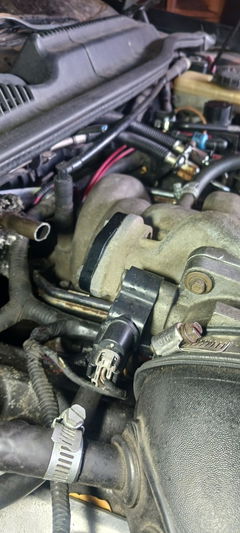
Powerstroke Exhaust Manifold Header

Powerstroke Exhaust Manifolds Built for Extreme Heat and Heavy Towing

T304 Stainless and Precision TIG Welds Replace Warped OEM Castings

The factory exhaust manifold on every Powerstroke lives a brutal life. It clamps to the cylinder head, feeds the up-pipe, and drives the turbo, all while swallowing exhaust gas north of 1,200 degrees Fahrenheit under a loaded trailer. Our Powerstroke exhaust manifold lineup is built to survive that abuse where the OE cast iron fails. Each unit is formed from T304 stainless steel tubing and mandrel-bent for uninterrupted flow, then joined with precision TIG welds laid by hand and back-purged to protect the root pass. CNC-machined 6061-T6 billet aluminum flanges sit dead flat against the head, sealing against high-temperature Viton and graphite-layered gaskets instead of the leak-prone factory metal-to-metal joint. Thick-wall schedule tubing resists the shrink, warp, and stud-shear that plague stock manifolds after 200,000 miles of heat cycling.

Built for Shop Owners Chasing a Permanent Fix to a Recurring OE Failure

If you run a diesel shop, you already know the phone call. A 7.3 Powerstroke owner hears a cold-start ticking noise, a 6.0 owner is down on boost with a black soot trail up the fender, and a 6.7 owner shows up with a dead pedal and a broken stud staring back through the wheel well. These are not random failures. They are the predictable outcome of thin cast iron, undersized clamping load, and thousands of heat cycles. Our manifolds address the root cause, not the symptom. Heavy-wall stainless construction holds its shape under thermal expansion, the improved flow design drops exhaust gas temperature before the turbo, and fresh Grade 8 and stainless hardware run with anti-seize keep the clamping load where it belongs. This is the repair you install once on a heavy-tow rig, a farm truck, or a competition puller, instead of fighting the same broken bolt every spring.

Why Thousands of Diesel Owners Trust EGR Performance

EGR Performance: Engineered for Power. Backed for Life.

Max efficiency, restored horsepower, and prolonged engine life for your EGR, DPF, and CCV systems on Powerstroke, Duramax, Cummins engines, etc.

  • Free Shipping: Fast & free delivery to get you back on the road sooner.
  • 45-Day Returns: Shop risk-free with our generous 45-day return policy.
  • 1-Year Warranty: Tested under extreme conditions. Guaranteed to perform.
  • 24/7 Live Support: Real-time tech help from fitment to post-install tuning.
Product Engine Vehicle Model Year Range
T304 Stainless Manifold Headers 6.0L Powerstroke Ford F250, F350, F450, F550 Super Duty 2003-2007
Exhaust Manifold Kit (Left & Right) 7.3L Powerstroke Ford F250, F350, F450 Super Duty 1999-2003
Exhaust Manifold Header 7.3L Powerstroke Ford F250, F350, F450 Super Duty 1999-2003
OBS Exhaust Manifold 7.3L Powerstroke Ford F250, F350, Bronco 1994-1997
Upgraded Exhaust Manifold 6.4L Powerstroke Ford F250, F350, F450, F550 Super Duty 2008-2010
Upgraded Exhaust Manifold 6.7L Powerstroke (Generation 1) Ford F250, F350, F450, F550 Super Duty 2011-2014
Upgraded Exhaust Manifold 6.7L Powerstroke (Generation 2) Ford F250, F350, F450, F550 Super Duty 2015-2019
Upgraded Exhaust Manifold 6.7L Powerstroke (Generation 3) Ford F250, F350, F450, F550 Super Duty 2020-Present
Turbo Exhaust Manifold 7.3L IDI Turbo Ford F250, F350, F-Super Duty 1988-1993

Confirm exact model year, cab configuration, and emissions setup before ordering, because late 6.7L generations and California-emissions trucks carry fitment differences that do not interchange.

Shop Powerstroke Exhaust Manifold Now! →

EGR Performance: EGR, DPF, CCV & Diesel Tuning Solutions for Powerstroke, Cummins, and Duramax

EGR DELETE KITS

View More
EGR Delete Kits Performance Parts

CCV PCV REROUTE KIT

View More
CCV PCV Reroute Kits

DPF DELETE KITS

View More
DPF Delete Kits

DIESEL TUNERS

View More
diesel tuners

Why Does Your Powerstroke Need an Upgraded Exhaust Manifold?

Soot Buildup and the Cold-Start Ticking Noise

The first sign of trouble is almost always audible. Exhaust gas sneaks past a broken stud or a warped flange, and you hear a sharp ticking noise on cold start that smooths out as the casting expands. Black soot collects around the ports and tracks down the block. On a 7.3 Powerstroke the cast manifold actually shrinks from thousands of heat cycles, pulling the #1 and #6 bolts inward until they shear. On the 6.0 Powerstroke there is no factory gasket at all, only a machined metal-to-metal seal, so the moment a bolt walks out the joint leaks and the soot trail begins.

Thermal Fatigue, Warping, and Cracking at the Rear Cylinders

The rear of the manifold runs hottest and carries the most load, which is exactly where it fails. Cast iron warps up to an eighth of an inch at the collector, cracks form along the webbing, and the inlet adapter to the up-pipe fractures. The 6.7L Powerstroke is documented under Ford SSM 50330 for broken exhaust manifold studs on 2011 through 2014 Super Duty trucks, and the problem runs through the 2015 to 2019 generation as well. Every crack and every missing bolt is a measured loss of turbo drive pressure, which means lower boost and higher exhaust gas temperature under load.

Stuck and Broken Manifold Studs That Fight Back

Seized hardware turns a straightforward manifold swap into a full afternoon. Studs corrode into the cylinder head, snap flush when you look at them wrong, and leave you drilling and extracting on a hot cast surface. Broken bolts at the front and rear mounting positions are the single most common reason a Powerstroke owner ends up at a diesel shop in the first place, and reusing old hardware almost guarantees the leak returns within a season.

What Can a Powerstroke Exhaust Manifold Solve?

Restored Turbo Drive Pressure and Lower EGTs

A sealed, properly clamped manifold returns every bit of exhaust energy to the turbine. Boost climbs back to spec, exhaust gas temperature drops under tow, and the truck pulls clean instead of going flat when the trailer is hooked. The smoother internal flow of a mandrel-bent T304 stainless manifold reduces backpressure before the turbo, which is where measurable gains in spool response and top-end power actually come from.

A Flat, Crack-Resistant Sealing Surface

CNC-machined 6061-T6 billet aluminum flanges stay true against the head through thermal cycling, and precision TIG welds with a protected root pass resist the heat-affected-zone cracking that sinks thin-wall budget manifolds. Paired with high-temperature gaskets and fresh Grade 8 or stainless studs run with anti-seize, the joint holds clamping load instead of surrendering it one bolt at a time.

A Permanent Fix Instead of a Recurring Repair

This is the core value for a shop owner. Instead of resealing the same leaking manifold every spring, you install a heavy-wall manifold engineered for the heat load it actually sees. The engine does not need to come out, the manifolds come out through the wheel wells, and the customer stops calling about the same ticking noise.

Shop Powerstroke Exhaust Manifold by Ford Engine & Fitment Guide

  • Exhaust Manifold Kit for 7.3L Powerstroke (Left & Right) - Fits the 7.3L Powerstroke in Ford F250, F350, and F450 Super Duty (1999-2003). A complete left and right kit with fresh gaskets and hardware that replaces shrunken, leaking OE castings and restores turbo drive pressure on the legendary 7.3.
  • Exhaust Manifold Header for 7.3L Powerstroke - Fits the 7.3L Powerstroke in Ford F250 through F450 Super Duty (1999-2003). Mandrel-bent T304 stainless construction with machined flanges that drops EGTs and seals the rear-cylinder leaks that break OE studs.
  • T304 Stainless Manifold Headers for 6.0L Powerstroke - Fits the 6.0L Powerstroke in Ford F250 and F350 Super Duty (2003-2007). Replaces the no-gasket, metal-to-metal OE joint that leaks the moment a bolt walks, with a true gasketed seal and improved flow.
  • 7.3L Powerstroke OBS Exhaust Manifold - Fits the OBS 7.3L Powerstroke in Ford F250, F350, and Bronco (1994-1997). Addresses the warping and broken #1 and #6 bolts common on high-mileage OBS trucks.
  • Upgraded Exhaust Manifold for 6.4L Powerstroke - Fits the 6.4L Powerstroke in Ford F250 through F550 Super Duty (2008-2010). Heavy-wall T304 stainless built for the elevated EGTs of the 6.4 and the cracking the stock casting is known for.
  • Upgraded Exhaust Manifold for 6.7L Powerstroke (2011-2014) - Fits Generation 1 of the 6.7L Powerstroke in Ford F250 through F550 Super Duty (2011-2014). The permanent answer to the broken manifold studs Ford flagged in SSM 50330.
  • Upgraded Exhaust Manifold for 6.7L Powerstroke (2015-2019) - Fits Generation 2 of the 6.7L Powerstroke in Ford F250 through F550 Super Duty (2015-2019). Matches the revised port layout and kills the dead-pedal stud-failure pattern.
  • Upgraded Exhaust Manifold for 6.7L Powerstroke (2020-Present) - Fits Generation 3 of the 6.7L Powerstroke in Ford F250 through F550 Super Duty (2020-Present). Built for the higher-flow Gen 3 turbo and the sustained heat of modern tow tuning.
  • 7.3L IDI Turbo Exhaust Manifold - Fits the 7.3L IDI Turbo in Ford F250, F350, and F-Super Duty (1988-1993). Restores the aging up-pipe and manifold sealing on the factory-turbo IDI before it leaks down the back of the block.

Verify your model year, cab, and emissions configuration against each listing before you order, because the 7.3 OBS and late 6.7 generations carry distinct port and stud patterns that do not interchange.

Why Choose EGR Performance?

The industry standard for high-performance diesel reliability.

Premium Quality & Rigorous Testing

Our EGR, DPF, and CCV delete kits are engineered from premium-grade materials and subjected to brutal quality control and field testing. Unlike generic alternatives, our products are built to withstand extreme heat and pressure, delivering unmatched durability and long-term stability when your rig needs it most.

20 Years of Proven Diesel Expertise

We aren't just selling parts. We live in this industry. With two decades of hands-on experience providing specialized modification solutions for heavy-duty truck owners, our upgrades have been extensively proven across every driving environment, from daily towing to high-performance tracks.

Industry-Leading Standards

We work hand-in-hand with top-tier industry partners and reputable organizations. Every product we design, test, and ship meets or exceeds strict industry standards, ensuring your Powerstroke, Cummins, or Duramax gets the exact precision it deserves.

Real Results, Proven Track Record

Thousands of diesel owners trust us to unlock their engine's true potential. Our massive library of positive customer feedback and successful build case studies proves one thing: our kits deliver real horsepower, lower EGTs, and flawless reliability in the real world.

What are the symptoms of a cracked exhaust manifold on a 7.3 Powerstroke?

Listen for a sharp ticking or puffing noise on cold start that quiets down as the engine warms up.
Look for black soot tracking out from between the manifold and the cylinder head, or an exhaust smell under the hood and in the cab.
Watch your boost gauge and pyrometer, because a leak before the turbo drops drive pressure, lowers boost, and raises exhaust gas temperature under load.
Check the #1 and #6 bolts at the front and rear, since a 7.3 manifold shrinks from heat cycling and pulls those studs inward until they shear off flush.

How long do 7.3 Powerstroke exhaust manifolds last?

In a dry climate a set of 7.3 Powerstroke manifolds can run 300,000 miles or more, and we have seen original castings still sealing past 400,000 miles.
In salt and snow regions rust shortens that life considerably, and the bolts and gaskets usually fail long before the casting itself.
The manifold is not the real wear item. The studs, the up-pipe donut, and the metal-to-metal seal are, which is why a fresh kit with new hardware outlasts a reseal on tired fasteners.

Why do 6.0 Powerstroke exhaust manifold studs keep breaking?

The 6.0 Powerstroke relies on a machined metal-to-metal seal with no factory gasket, so the entire joint depends on bolt clamping load that is already marginal.
Heat cycling expands and contracts the casting thousands of times, and the front and rear studs carry the brunt until they fatigue and snap.
Once one bolt walks out the joint leaks, soot eats the sealing surface, and the remaining hardware is forced to carry the extra load until it fails too.

Does the 6.0 Powerstroke exhaust manifold use a gasket?

From the factory the 6.0 Powerstroke exhaust manifold uses no traditional gasket, only a precision-machined metal-to-metal face between the manifold and the head.
That design works when the casting is flat and the hardware is fresh, but it has zero tolerance for warping or a missing bolt.
Our replacement manifolds are built to run with proper high-temperature gaskets and new Grade 8 or stainless studs, which gives the joint a far larger margin against future leaks.

What causes a 6.7 Powerstroke exhaust manifold to leak?

Ford documented the problem directly in service message SSM 50330, which covers broken exhaust manifold studs on 2011 through 2014 F-Super Duty trucks with the 6.7L.
The same stud-shear and warping pattern carries through the 2015 to 2019 generation, often showing up as a dead pedal and soot around the rear of the manifold.
The root cause is thermal cycling on a casting and hardware package that loses clamping load over time, which is exactly what an upgraded heavy-wall manifold with fresh studs is built to stop.

What is the best exhaust manifold for a 6.0 Powerstroke?

The best 6.0 Powerstroke manifold is the one that stays flat and holds its hardware under repeated heat cycles, which means heavy-wall construction and machined flanges over a thin budget casting.
A mandrel-bent T304 stainless unit with precision TIG welds improves flow, drops exhaust gas temperature before the turbo, and resists the warping that breaks OE studs.
Run it with fresh gaskets and new studs on anti-seize, and you turn a recurring repair into a one-time fix, which is why shop owners treat a quality manifold as preventive maintenance rather than a performance add.

Are stainless steel exhaust manifolds better than cast iron?

Stainless and cast iron each have a real strength, and the answer depends on what you want the manifold to do.
T304 stainless is lighter, will not rust or scale, holds exhaust heat in for stronger turbo drive pressure, and flows smoother through mandrel-bent tubing.
The catch is that thin-wall welded stainless can crack at the weld boundary under severe heat cycling, which is why our manifolds use heavy-wall tubing, back-purged precision TIG welds, and CNC-machined billet flanges to bring stainless performance up to cast-iron durability.

Do I need to pull the engine to replace 7.3 Powerstroke exhaust manifolds?

You do not pull the engine. The manifolds come out through the wheel wells once the inner fender is loosened out of the way.
Jacking the engine up slightly improves access, and a soaking of penetrating oil the night before saves a lot of grief on seized studs.
Book time for both sides is around three hours when the hardware cooperates, but budget more for broken and drilled-out studs, which is where most of the real labor hides.
While the manifold is off, inspect and clean the 7.3 EBP tube that threads into the passenger manifold, because a clogged exhaust back pressure tube throws false sensor codes and mimics a manifold leak.

Will an upgraded exhaust manifold lower EGTs and add horsepower?

A sealed, better-flowing manifold returns exhaust energy to the turbo, so boost recovers and exhaust gas temperature drops under load, and you may see a modest top-end gain.
The larger and more reliable win is durability, because you stop losing boost to leaks and stop replacing broken studs every season.
Every manifold ships with free shipping, is backed by our one-year warranty tested under extreme conditions, and is covered by a 45-day return policy so you can verify fitment on your truck without risk.

Are Powerstroke exhaust manifold upgrades legal for street use?

Performance exhaust manifolds are sold and intended for competition and closed-course off-road use only, including pulling, sled pulling, and sanctioned racing, and may not be legal for registration or operation on public roads in some jurisdictions.
Always confirm your exact model year, cab, and emissions configuration against the listing before ordering, because late 6.7L generations and California-emissions trucks carry fitment differences that do not interchange.
Check your local and federal emissions laws before installing, and contact our 24/7 live support if you need help matching a manifold to your specific truck.