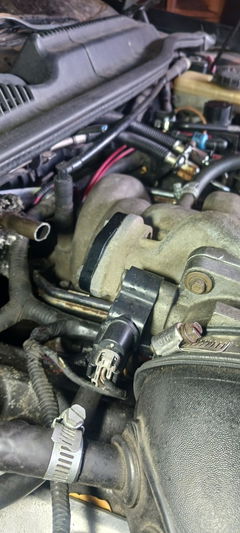
Turbo Wastegate Solenoid

Precision Boost Control Solenoids for Hard-Working Diesel Turbos

Engineered Wastegate Solenoids Built for Extreme Heat and Sustained Boost

A turbo wastegate solenoid is the electronic brain behind your boost curve, and when the factory unit fries, your truck goes from a workhorse to a gutless dog overnight. We carry direct-fit wastegate control solenoids engineered with a heat-resistant glass-filled nylon body, a precision-wound copper coil, and high-temperature Viton O-rings that hold vacuum signal even when the turbo pedestal is glowing. Corrosion-resistant brass terminals keep the electrical connection clean through years of underhood moisture, road salt, and vibration, while a stainless steel internal armature and spring deliver crisp, repeatable actuation for the life of the part. Whether you run a 7.3L Powerstroke on the farm or a 5.9L Cummins pulling a gooseneck, these solenoids match OEM fit, form, and function without the dealer markup.

Built for Heavy Towing, Long Idle Hours, and Fixing Known OEM Failures

Stock wastegate solenoids die two ways: the coil roasts off a heat-soaked turbo housing, or carbon and oil creep into the vacuum lines until the wastegate sticks wide open. A stuck-open solenoid starves the engine of boost, leaving you with a black-smoking, underpowered rig that cannot get out of its own way on a grade. A stuck-closed solenoid spikes boost past safe limits, tripping P0234 overboost codes and risking head gasket or turbocharger damage. Shop owners see these failures constantly on 7.3 Powerstrokes with brittle, cracked vacuum harnesses and on 5.9 Cummins trucks where the HE351 Holset variable geometry turbo solenoid has cycled itself to death. Our replacement solenoids restore factory boost control so a loaded truck holds rail pressure, stays out of limp mode, and keeps exhaust gas temperatures in check mile after mile.

Why Tens of Thousands of Diesel Owners Trust EGR Performance

EGR Performance: Engineered for Power. Backed for Life.

Max efficiency, restored horsepower, and prolonged engine life for your EGR, DPF, and CCV systems on Powerstroke, Duramax, Cummins engines, etc.

  • Free Shipping: Fast & free delivery to get you back on the road sooner.
  • 45-Day Returns: Shop risk-free with our generous 45-day return policy.
  • 1-Year Warranty: Tested under extreme conditions. Guaranteed to perform.
  • 24/7 Live Support: Real-time tech help from fitment to post-install tuning.
Product Engine Vehicle Model Year Range
Turbo Vacuum Harness & Wastegate Boost Solenoid 7.3L Powerstroke V8 Diesel Ford F-250 / F-350 Super Duty 1999-2003
Turbocharger Wastegate Solenoid Valve (OEM 5140305AA) 5.9L Cummins ISB (HE351 Holset VGT) Dodge Ram 2500 / 3500 / 5500 2004-2007

Shop Turbo Wastegate Solenoid Now!

EGR Performance: EGR, DPF, CCV & Diesel Tuning Solutions for Powerstroke, Cummins, and Duramax

EGR DELETE KITS

View More
EGR Delete Kits Performance Parts

CCV PCV REROUTE KIT

View More
CCV PCV Reroute Kits

DPF DELETE KITS

View More
DPF Delete Kits

DIESEL TUNERS

View More
diesel tuners

Why Does Your Diesel Turbo Need a Wastegate Solenoid?

Heat-Soak and Coil Burnout

Mounted inches from a turbo housing that regularly exceeds 1,200 degrees Fahrenheit, the factory solenoid coil cooks until its insulation cracks and the winding shorts open. Once the coil dies, the wastegate defaults to full open, the truck drops out of boost, and you are left crawling up every grade with a check engine light and a P0243 or P0046 code staring back at you.

Soot, Oil, and Carbon in the Vacuum Lines

The PCV system on a high-mileage diesel feeds oily vapor straight into the intake path, and that residue slowly coats the vacuum harness and solenoid ports. On a 7.3 Powerstroke the red and green vacuum lines turn brittle and split, and on a 5.9 Cummins the HE351 control passages carbon up. Either way the wastegate actuator stops seeing a clean signal and boost control goes erratic.

Stuck Wastegate and Erratic Boost

A wastegate that sticks open produces chronic underboost, sluggish spool, black smoke, and lost towing power. A wastegate that sticks closed sends boost through the roof, tripping overboost protection, triggering limp mode, and pushing cylinder pressures toward a blown head gasket. The wastegate solenoid is the part that prevents both extremes.

What Can a Wastegate Solenoid Solve?

Restored Boost Control and Driveability

A fresh wastegate control solenoid returns predictable, factory-mapped boost across the entire rpm range, eliminating the dead pedal and the black puff every time you mat the throttle under load. Your turbo spools like it should and the truck pulls hard all the way through the rpm band.

Cleared Fault Codes and a Clean Monitor

Replacing the failed solenoid clears the P0243, P0046, P0234, and P0299 codes that keep a truck from passing state inspection and that mask other real faults hiding behind a constant check engine light.

Protected Turbo and Cylinder Pressures

Accurate wastegate regulation keeps drive pressure and cylinder pressure in the safe zone, protecting the turbocharger thrust bearings and the head gasket during sustained heavy towing and high-boost operation.

Shop Turbo Wastegate Solenoid by Engine & Fitment Guide

  • Turbo Vacuum Harness & Wastegate Boost Solenoid - Fits the 7.3L Powerstroke in the Ford F-250 and F-350 Super Duty (1999-2003, including 2002 models). Replaces the brittle factory vacuum harness and the heat-fried boost solenoid on the Garrett GTP38 turbo pedestal, restoring the red and green vacuum signal that controls the wastegate and clearing P0243.
  • Turbocharger Wastegate Solenoid Valve (OEM 5140305AA) - Fits the 5.9L Cummins ISB with the HE351 Holset VGT in the Dodge Ram 2500, 3500, and 5500 (2004-2007, covering the 2004, 2005, and 2006 model years). Replaces the failed boost control solenoid that causes stuck-open underboost or stuck-closed overboost, clearing P0046, P0234, and P0299.

Why Choose EGR Performance?

The industry standard for high-performance diesel reliability.

Premium Quality & Rigorous Testing

Our EGR, DPF, and CCV delete kits are engineered from premium-grade materials and subjected to brutal quality control and field testing. Unlike generic alternatives, our products are built to withstand extreme heat and pressure, delivering unmatched durability and long-term stability when your rig needs it most.

20 Years of Proven Diesel Expertise

We aren't just selling parts. We live in this industry. With two decades of hands-on experience providing specialized modification solutions for heavy-duty truck owners, our upgrades have been extensively proven across every driving environment, from daily towing to high-performance tracks.

Industry-Leading Standards

We work hand-in-hand with top-tier industry partners and reputable organizations. Every product we design, test, and ship meets or exceeds strict industry standards, ensuring your Powerstroke, Cummins, or Duramax gets the exact precision it deserves.

Real Results, Proven Track Record

Thousands of diesel owners trust us to unlock their engine's true potential. Our massive library of positive customer feedback and successful build case studies proves one thing: our kits deliver real horsepower, lower EGTs, and flawless reliability in the real world.

What are the symptoms of a bad turbo wastegate solenoid?

The first sign is usually a check engine light that only appears once the truck goes into boost, often paired with a sluggish throttle and a turbo that will not build pressure past a few psi. You will typically see chronic underboost with black smoke under load, reduced towing power, poor fuel economy, and a turbo whistle that sounds different or disappears entirely. In severe cases the truck drops into limp mode with a complete loss of boost pressure.
On the opposite end, a solenoid that fails closed sends the wastegate the wrong signal and spikes boost past the safe limit, tripping an overboost code and risking head gasket or turbocharger damage. The codes to watch for include P0243, P0046, P0234, and P0299.

What does the P0243 code mean on a turbo wastegate solenoid?

P0243 is the generic turbocharger wastegate solenoid A circuit code, and it tells you the engine computer is not seeing the electrical signal it expects from the solenoid rather than reporting a specific mechanical failure.
Diagnosis starts at the harness: confirm power and ground at the solenoid connector with the key on, inspect the wiring for chafing or a short, then measure the coil resistance against spec. A coil that reads open or shorted confirms a dead solenoid. P0246 is a close cousin that flags the solenoid A circuit reading high, usually a wiring or signal fault rather than a clean open circuit.

Which Ford 7.3 Powerstroke years does this wastegate solenoid fit?

Our 7.3L Powerstroke wastegate boost solenoid fits the 1999 through 2003 model years, which includes the 2002 trucks in your fitment search. It covers the Ford F-250 and F-350 Super Duty equipped with the Garrett GTP38 turbo, and it comes as a combined vacuum harness and boost solenoid set that replaces the brittle factory red and green vacuum lines at the same time.
The factory solenoid lives on the turbo pedestal, and a cracked vacuum harness is the hidden cause behind many P0243 codes that owners mistake for a bad solenoid, so replacing both together is the smart move.

Which Dodge Ram 5.9 Cummins years does the 5140305AA wastegate solenoid fit?

The 5140305AA turbocharger wastegate solenoid fits the 2004 through 2007 Dodge Ram 2500, 3500, and 5500 chassis cab, which covers the 2004, 2005, and 2006 model years showing up in fitment searches. It is built for the 5.9L 24-valve common rail Cummins ISB paired with the HE351 Holset variable geometry turbo.
This is the direct OEM replacement for the boost control solenoid that fails open and causes chronic underboost or fails closed and triggers P0234 overboost, P0299 underboost, and the P0045 through P0049 boost control circuit codes.

Will this wastegate solenoid fit a 6.7 Powerstroke or an F-150 EcoBoost?

It will not. The 6.7L Powerstroke uses a Garrett GT32 variable geometry turbo controlled by an electronic VGT actuator, and the F-150 EcoBoost engines use electronic wastegate actuators on twin turbos, so neither shares a part with the 7.3L vacuum-style solenoid or the 5.9L HE351 solenoid in this collection.
If you are chasing a wastegate code on a 2011 to 2012 6.7 Powerstroke, a 2011 to 2015 EcoBoost F-150, or a 2013 to 2016 Ford Escape, Fusion, or Explorer 1.6L or 2.0L turbo, confirm the exact application before ordering, because those are different electronic boost control parts we do not carry here.

Does this wastegate solenoid fit a Hyundai Veloster or a small Ford EcoBoost turbo?

No direct fit exists in this collection for those vehicles. The Hyundai Veloster 1.6L turbo, the Ford Escape, Fusion, and Explorer small-displacement EcoBoost turbos, and similar gasoline applications use a compact electronic wastegate solenoid that is a different part number entirely, and P0246 is the code most commonly logged on those setups.
We focus on heavy-duty diesel turbo wastegate solenoids for the 7.3 Powerstroke and the 5.9 Cummins. For a gasoline small-turbo solenoid, confirm the OE part number against your VIN before buying.

What is the difference between a wastegate solenoid, a VGT solenoid, and a turbo actuator?

A wastegate solenoid controls the vacuum or pressure signal that moves the wastegate actuator, which vents exhaust past the turbine to limit boost. A VGT solenoid controls the variable geometry vanes inside a turbo like the 5.9 Cummins HE351, so on a variable geometry turbo the two functions overlap and the terms are often used interchangeably.
A turbo actuator is the mechanical mover, either vacuum or electronic, that physically opens the wastegate or swings the vanes. One more clarification: superchargers use a bypass valve rather than a wastegate, so the phrase supercharger wastegate solenoid is technically a misnomer.

How do I test whether my wastegate solenoid is actually bad?

Before condemning the solenoid, rule out a boost leak first by pressurizing the intake and checking the boots, intercooler, and plenum with soapy water, because a torn boot mimics a failed wastegate solenoid perfectly. With leaks ruled out, unplug the solenoid and apply 12 volts directly across the terminals; a healthy solenoid clicks sharply, while a silent one has a dead coil.
On the 7.3 Powerstroke you can also pull the red vacuum line off the wastegate actuator and plug it to see if boost behavior changes, which isolates the solenoid from the actuator. Finish with a coil resistance check against the factory spec before you replace anything.

How hard is it to replace the turbo wastegate solenoid myself?

Replacement is a straightforward driveway job on both supported platforms and usually takes well under an hour with basic hand tools. On the 7.3 Powerstroke you unplug the electrical connector, release the red and green vacuum lines, swap the solenoid and harness, and reconnect.
On the 5.9 Cummins the 5140305AA solenoid bolts to its bracket near the HE351 turbo, and removal is a matter of disconnecting the connector and boost lines, unbolting the old valve, and bolting in the direct-fit replacement. Always clear the codes and take a short test drive under load to confirm the boost curve has returned.

Is replacing the turbo wastegate solenoid street legal, and what warranty comes with it?

These turbo wastegate solenoids are direct-fit replacement parts that restore factory boost control; they remove or bypass no emissions device, so they are street-legal maintenance and repair items in all 50 states for a stock truck. The mandated competition and closed-course off-road use only disclaimer applies to tuned or deleted trucks that have been calibrated to run above-stock boost, where local emissions and on-road equipment laws may still restrict modifications, so confirm your jurisdiction before installing on a modified rig.
Every order includes free shipping, is backed by a 1-year warranty, and comes with our 45-day return policy. Match the exact engine, model, and year to the fitment guide before ordering, because the 7.3L Powerstroke and 5.9L Cummins solenoids are not interchangeable and do not fit the 6.7 Powerstroke, EcoBoost, or gasoline turbo applications.