




6.4 Powerstroke Reliability Key Takeaways
Factory emissions systems are the primary cause of 6.4L Powerstroke unreliability. Deleting a 6.4 engine drastically improves engine lifespan:
- Root Causes Removed: Eliminates DPF regeneration oil dilution (which destroys HPFP and bearings) and cracked EGR coolers (which cause overheating or engine hydrolock).
- Engine Protection: Removes excessive backpressure and lowers Exhaust Gas Temperatures (EGTs), safeguarding head gaskets, turbos, and pistons.
- Long-Term Reliability: Paired with custom tuning and strict oil maintenance, a deleted 6.4L transforms from a high-risk engine into a durable 300,000+ mile workhorse.
The debate about 6.4 PowerStroke reliability stems from one main cause: factory emissions systems lead to repeated engine breakdowns. This article sheds light on how delete kits boost 6.4 powerstroke reliability by getting rid of the two biggest trouble spots, the EGR and DPF systems.
Delete kits improve 6.4 Powerstroke reliability by removing the DPF and EGR systems, the two components that cause the most frequent and expensive failures. When properly installed and tuned, they reduce heat, soot, and backpressure, turning your truck into a much more bulletproof workhorse.
In this article, we will show you exactly how deleting a 6.4 Powerstroke work, what they include, and how to make sure yours actually improves reliability instead of hurting it. We will also show you why EGR Performance is the best choice for solving these problems in your truck.
Table of Contents
Why Does the 6.4 Powerstroke Need Help?
The 6.4L Powerstroke is powerful but has serious weak points that eat into long-term reliability.
The factory EGR and DPF systems on the 6.4 Powerstroke create three main problems: DPF clogging leads to limp mode and poor fuel economy, EGR coolers fail and leak coolant into the engine, and oil dilution from regen cycles destroys bearings and internal engine parts.
We have worked on many 6.4 Powerstrokes over the years, and we can tell you that the factory emissions setup is the biggest weakness on this engine. The problems start early in the engine's life and only get worse with time and mileage.
The DPF Problem Explained
The diesel particulate filter, or DPF, is supposed to trap soot from the exhaust. When the filter gets full, the engine runs a "regeneration" cycle that heats the soot so it burns off. Sounds simple enough, but on the 6.4, this system creates a nightmare of problems.
First, the DPF clogs frequently, which triggers limp mode and shuts down your power. Second, the regen process injects extra fuel into the engine to raise exhaust temperatures. That unburned fuel runs past the piston rings and mixes with your engine oil. This is the infamous oil dilution problem.
The oil level on your dipstick climbs higher than the full mark. Diluted oil has much lower viscosity, which means it cannot protect your bearings, pistons, or turbo properly. Over time, the oil thins out the film between moving parts, and wear accelerates dramatically.
Third, the DPF creates backpressure in the exhaust, which raises exhaust gas temperatures and stresses the turbo and head gaskets. Many owners see exhaust gas temperatures climb dangerously high when towing, which puts the entire engine at risk.

EGR Cooler and Valve Failures
EGR cooler and valve failures are another common problem. When soot builds up in these components, it creates a blockage that can cause overheating, a coolant leak, or even extreme damage to the engine.
The EGR system recirculates hot exhaust gas back into the intake to lower combustion temperatures and reduce nitrogen oxide emissions. On paper, this is smart engineering. In reality, it is a time bomb.
The EGR cooler sits in the engine valley and is surrounded by coolant passages. These coolers clog with soot and carbon buildup because they are exposed to extremely hot, dirty exhaust gas. When the cooler clogs, the EGR valve sticks.
When it sticks, coolant cannot flow properly, and the engine overheats. Many coolers do not just clog; they crack. When a cooler core ruptures, coolant spills directly into the exhaust system or mixes with engine oil. We have seen cases where a failed cooler dumps so much coolant into the engine that it hydrolocks the pistons and causes catastrophic damage.
The cost to replace an EGR cooler on a 6.4 is $1,500 to $2,500 with labor. The replacement process is a nightmare because the cooler is buried deep in the engine valley. Many shops charge $1,200 to $1,800 in labor alone just to remove and replace it.
If the cooler rupture happens at the wrong time, you may end up needing a complete engine rebuild.
Oil Dilution Destroys the Engine
Regular DPF regenerations cause excessive oil dilution. Every time the DPF regenerates, a small amount of unburned fuel washes down the cylinder walls and into the crankcase. Over weeks and months, this fuel accumulates in the oil.
We have pulled dipsticks on 6.4 trucks that read 1-2 quarts over the full mark. Some smell like a gas station.
Diluted oil has lower viscosity and cannot maintain a protective film between moving parts. This thins out your oil and increases wear on important engine components such as the HPFP, injectors, and piston ring lands.
The high-pressure fuel pump is one of the first victims. The HPFP on the 6.4 is already a known weak spot, and fuel-diluted oil accelerates its failure. The turbo bearings also wear faster.
Piston rings lose their seal, which allows more combustion gas to escape past them and more oil to be burned. Head gaskets fail because the oil cannot support proper sealing. We have seen 6.4 engines with only 100,000 miles that needed rebuilds because of severe oil dilution damage.
Due to the repeated failures, many people consider a DPF/EGR delete to be the most cost-effective method for improving 6.4 Powerstroke reliability.
How Delete Kits Improve 6.4 Powerstroke Reliability
Delete kits fix the problems we just described by removing the two faulty systems entirely. A correctly installed delete kit gives more than just power. It represents one of the most effective 6.4 Powerstroke reliability upgrades available.
It addresses the problems that plagued the 6.4 Powerstroke's reliability. Removing the EGR and DPF systems also eliminates many of the common sources of heat, soot, and mechanical problems.
When the EGR and DPF are deleted, and the truck is properly tuned, the engine can breathe freely, oil stays clean, exhaust gas temperatures stay safe, and the two biggest sources of failure are gone forever.
We have seen deleted 6.4 engines run reliably well past 250,000 miles. That would be rare on a stock truck. The reason is simple: by removing the DPF and EGR, you eliminate the primary sources of engine heat and soot buildup.
Before modifying your truck, weigh the pros and cons of a 6.4 Powerstroke delete to ensure it's the right move for your needs.
1. Eliminating Major Failure Points
A delete kit addresses the two main problems head-on. By removing the DPF entirely, regen cycles stop forever. By removing the EGR cooler and valve, carbon buildup and cooler failures become impossible.
By deleting the DPF, the truck no longer attempts regeneration. There is no fuel being injected into the exhaust to burn soot. This means no more oil dilution. The oil stays clean and maintains its protective properties. Fuel economy improves because fuel is not being wasted in regen cycles.
Exhaust backpressure drops dramatically, which means the turbo spins more freely and the engine breathes better. Without the DPF, there is no more intrusive regen limp mode that shuts down your power when you are in the middle of work or towing.

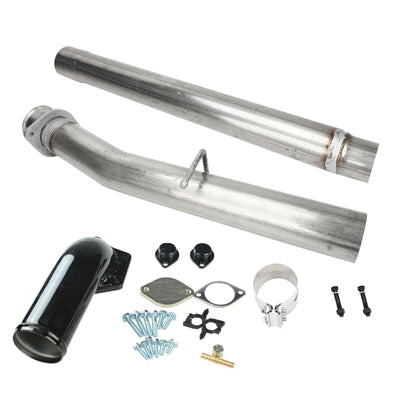
4" DPF Delete & EGR Delete Kit for 08-10 6.4L Powerstroke
7% OFF New Customer Coupon Code: EGR7
Buy Now2. Reducing Exhaust Gas Temperatures (EGTs)
By restricting exhaust flow and hindering combustion, both EGR and DPF systems can affect engine life depending on how they operate.
The stock 6.4 with a loaded DPF and complex EGR system can see EGTs climb to 1,200-1,300 degrees Fahrenheit under heavy load or towing. When under load or pulling a trailer, the added restriction from EGR and DPF systems causes high EGTs, which harm engine life.
Eliminating both EGR and DPF with a properly tuned delete kit allows unrestricted exhaust flow, improves cooling performance, and keeps EGTs within appropriate (lower) limits. As a result, EGTs drop 100-200 degrees under normal driving and 200-300 degrees when towing heavy loads.
This directly supports how to make a 6.4 PowerStroke reliable by protecting the turbo, pistons, and other major engine components. The head gaskets have an easier time sealing because the combustion chamber is not being stressed by extreme heat. Even the oil runs cooler, which means it maintains better viscosity and protection.
3. Cleaning Up the Oil and Extending Engine Life
A DPF delete significantly reduces oil dilution, allowing the oil to stay cleaner for more miles. After a delete is completed and the engine has been running for a few thousand miles, we see a dramatic improvement in oil condition.
The fuel smell is gone. The oil level stabilizes at the proper mark on the dipstick. The oil itself stays cleaner longer.
Many deleted 6.4 owners report that they can now extend oil change intervals to 7,500 or even 10,000 miles. On a stock truck, most cautious owners stick to 5,000 miles because of fuel dilution.
With cleaner oil, internal engine wear slows down. Bearings last longer. Piston rings seal better. The high-pressure fuel pump sees less degraded oil running through it, so pump failure rates drop.
This enables longer safe maintenance intervals, improves the reliability of the Ford 6.4 diesel engine, and lowers operating costs. The result is an engine that simply lasts longer.
We have data from dozens of deleted 6.4 trucks in our network. The ones that are maintained properly run reliably well past the 200,000-mile mark. Many continue to 250,000 and beyond. That is not typical for stock 6.4s.
What Does a Reliability-Focused Delete Kit Include?
Delete kits are of different types. A kit designed for 6.4 powerstroke reliability focuses on long-term durability, not just maximum power.
A complete delete kit includes an EGR block-off plate or manifold, a DPF delete pipe, a tuner to reprogram the ECU, quality gaskets and hardware, and often an upgraded intake elbow. The best kits use stainless steel components, precision-machined plates, and high-temperature gaskets to ensure parts last as long as your truck.
Choosing the right components as 6.4 PowerStroke reliability upgrades ensures that the engine runs cooler, cleaner, and avoids the common failures that plague stock 6.4L Powerstrokes.

1. What Is Inside a Good Delete Kit
A complete setup isn't just a pipe; it requires a tuner and high-quality block-off plates. We've curated a list of the best 6.4 Powerstroke delete kits that prioritize engine longevity over just raw horsepower.
EGR Delete/Block Off Plate
An EGR delete kit contains block-off plates that seal off the EGR valve ports. These plates must be precision-machined from quality aluminum or cast iron. They need to fit perfectly against the intake manifold surfaces so they seal without leaking exhaust gas or coolant.
Disconnecting the EGR system by sealing off the EGR Valve and replacing the EGR cooler either with a simple block plate and new piping or by installing an EGR Delete manifold. Many cheap kits use thin, warped plates that never seal properly. A good kit also includes new gaskets that can handle extreme temperatures and pressures, and all the bolts and studs needed to secure everything.
The best EGR delete kits also include a high-flow intake elbow that replaces the factory restrictive elbow. This improves airflow to the turbo and reduces the amount of heat being recirculated back into the engine.
DPF delete pipe or full exhaust
Delete pipes and full exhausts, replace a DPF with a straight pipe, and usually add a new turbo outlet pipe. Using a delete pipe or full exhaust not only prevents clogging of the DPF, improving the Ford 6.4 diesel reliability, but also significantly reduces the backpressure in the exhaust system.
A DPF delete pipe replaces the diesel particulate filter and catalytic converter with a straight section of pipe. The pipe material makes a huge difference in durability.
Budget pipes are made from aluminized steel, which corrodes quickly if you live in a cold climate or near the ocean. Mid-range pipes use 409 stainless steel, which is much better. Premium pipes use 304 stainless steel, which is essentially corrosion-proof and lasts the life of your truck.
Tuner program for delete
To make a 6.4 Powerstroke engine reliable, the tuner must have had the EGR and DPF deleted. Without it, the truck will throw diagnostic codes the moment you start it. The engine will enter limp mode and lose power. The tuner reprograms the ECU to disable the EGR and DPF functions and optimize fuel injection, boost levels, and timing for proper operation without these systems.
Proper tuning optimizes fueling, boost, and timing while preventing check engine lights, which is crucial for anyone who want to make a 6.4 PowerStroke reliable. A quality tuner like the Mini Maxx, EZ Lynk AutoAgent 3, or a shop-specific custom tune will give your truck multiple tune files for different driving conditions.
Protect Your 6.4L Investment
The 6.4L Powerstroke is a powerhouse trapped in a failing emissions system. Our 6.4 Powerstroke delete kits are designed to eliminate DPF clogs and oil dilution for good. Stop worrying about catastrophic engine failure and start enjoying the torque, reliability, and fuel economy your truck was built for.
Shop Ford 6.4 Diesel Exhaust Delete →2. Optional Upgrades That Add Reliability
Beyond the basic kit, we recommend several upgrades that make a deleted 6.4 even more reliable and bulletproof.
- High-quality exhaust manifolds and piping: 304 stainless steel or upgraded cast iron components reduce cracking and heat soak, supporting long-term is 6.4 powerstroke reliable concerns.
- Upgraded turbo setup: Larger or more durable turbos handle higher boost and temperatures better, especially under heavy towing, which further improves Ford Powerstroke 6.4 reliability.
- Coolant filter and flushing the system: After removing the EGR cooler, flushing the cooling system and adding a coolant filter keeps the radiator clean and prevents overheating, boosting overall 6.4 powerstroke reliability.
- An upgraded radiator: The stock radiator on the 6.4 is undersized for a high-output, tuned engine. Moving to an aluminum three-core or four-core radiator increases cooling capacity by 30-50%. This keeps coolant temperatures more stable, especially when towing in hot weather.
- An upgraded intercooler: It helps keep turbo boost air cool. The stock intercooler on the 6.4 is small and prone to clogging with soot. An aftermarket intercooler with larger core dimensions and wider air path reduces intake air temperatures by 20-40 degrees. This helps the engine make cleaner power and produces lower EGTs.
- ARP head studs: They are stronger than factory head bolts. If your 6.4 has 150,000 miles or more, head studs are cheap insurance against head gasket failure.
- An oil cooler upgrade: It helps maintain safe oil temperatures. The stock oil cooler is borderline for a stock truck. On a deleted and tuned truck, an upgraded cooler with a larger core keeps oil temps 10-20 degrees cooler, which extends oil life and protects bearings better.
When a Delete Kit Actually Hurts Reliability
A delete kit can improve the reliability of your 6.4 Powerstroke, but it needs to be installed properly, along with the right supporting modifications to achieve real improvement. If it is done incorrectly or paired with the wrong modifications, it causes more issues than it prevents, and the upgrade becomes a liability.
If a delete is done with poor-quality components, inadequate tuning, or without proper cooling system upgrades, it can raise EGTs dangerously high, damage the turbo, and cause rapid injector and HPFP wear. The truck must be monitored with gauges and driven conservatively to ensure long-term health.

We have seen deleted 6.4 trucks fail catastrophically because the owner skipped important steps or tried to save money in the wrong places. For a foundational understanding of how to maintain this platform properly, refer to our 6.4 Powerstroke engine guide.
What Goes Wrong With a Bad Delete
A common problem is running a deleted 6.4 with stock or poorly matched tuning. Operating a deleted 6.4L without proper tuning creates problems such as excessive EGTs, turbo damage, and increased wear on the HPFP and injectors.
Many people who do not have their truck professionally tuned or who do not monitor their gauges (such as EGT, boost, and fuel pressure) run their engine too hot or too lean. A lean tune spikes EGTs and burns out turbo blades. A rich tune fouls the spark plugs and loads up carbon again.
As a result, many people now question whether the 6.4 Powerstroke is reliable after a delete.
Another mistake is deleting without any temperature or pressure monitoring. You cannot see what is happening inside the engine if you do not have gauges. An EGT gauge is essential.
A boost gauge shows if the turbo is overboosted, which damages turbine blades. A fuel pressure gauge reveals if the HPFP is struggling. Many owners delete their trucks and then wonder why they failed after 50,000 miles. They were running too hot or too lean and never knew it.
Common Reliability Killers After a Delete
We see these mistakes regularly, and they are preventable.
- Ignoring the HPFP: High-pressure fuel pump weakness in the 6.4L is a well-known problem. Adding heat and additional load without modification leads to catastrophic failure and affects Ford 6.4 diesel reliability. The pump works harder, sees hotter fuel, and wears faster. We recommend an HPFP upgrade if your truck is tuned for more than 100 extra horsepower or if you will be towing regularly.
- Overheating from poor cooling: A factory radiator or undersized intercooler struggles to keep a tuned, deleted truck cool, especially in hot ambient temperatures while towing heavy loads. Without cooling upgrades, even a delete can reduce 6.4 powerstroke reliability upgrades. We have seen trucks overheat just a few miles down the road because the owner deleted without upgrading cooling. The head gaskets fail, and the engine is ruined.
- Skimping on quality parts: Using low-quality parts such as cheap block-off plates, cracked manifolds, or poorly welded pipes causes leaks, power loss, and repeated repairs, undermining any gains in Ford Powerstroke 6.4 reliability. A cheap DPF delete pipe made from aluminized steel rusts through in three or four years if you live up north. A low-quality tuner that does not have proper calibration support leaves your truck running poorly. Spend money on quality components upfront, and your truck will be reliable for years.
What You Must Do to Protect Your Investment
If you delete your 6.4, do these things to protect reliability.
- A quality tuner with a conservative daily-driving tune: The best tunes are conservative on daily-driver trucks and more aggressive only for competition or off-road use. A quality tuner provider like EGR Performance will help you match the tune to your driving style.
- An upgraded radiator and intercooler: Install a heavy-duty aluminum radiator with more core capacity. Add an intercooler upgrade if you will be towing or driving in hot climates. These upgrades cost $500-$1,200, but they are essential insurance.
- Gauges to monitor EGT, boost, and fuel pressure: An EGT gauge is non-negotiable. A boost gauge and fuel pressure gauge are highly recommended. Knowing your numbers lets you catch problems before they become expensive.
- Regular oil changes and coolant service: Change your oil every 5,000-7,000 miles, even if the engine is clean now. Use a quality 15W-40 diesel oil that meets the CK-4 or SN+ spec. This protects your bearings and keeps the engine running cool. Because a delete solves some problems but creates new maintenance requirements (like higher cylinder pressures).
By addressing these risks, owners can safely improve how to make a 6.4 PowerStroke reliable while avoiding the common pitfalls of a poorly executed delete.
How to Make a Deleted 6.4 Powerstroke as Reliable as Possible
For a truly bulletproof 6.4L, think of the delete as just one step in a complete reliability build. If an owner is trying to find out how to make a 6.4 PowerStroke reliable, they should look into cooling, support hardware, monitoring solutions, and finally the delete kit itself.
Building a reliable deleted 6.4 requires the delete kit itself, upgraded cooling, monitoring gauges, quality tuning, and proper maintenance. When all these elements work together, you have an engine that can run reliably well past 300,000 miles.

We have built several trucks this way, and the results speak for themselves. These trucks do not break down. They do not leave owners stranded on the highway. They tow heavy loads year after year without problems.
1. Essential Reliability Mods
- EGR and DPF delete with proper tuning: This allows better engine operation because the EGR and DPF no longer restrict airflow into and out of the engine. Removing the EGR and DPF also means the engine runs more efficiently, giving a significant improvement in your 6.4 PowerStroke reliability. Do not try to save money here. Use an all-in-one kit from a reputable brand and have it installed by someone who knows the 6.4.
- Upgraded cooling system: Heavy-duty aluminum radiators and coolant filters help maintain optimal operating temperatures and protect your Ford 6.4 diesel's reliability. This keeps coolant temperatures stable even when towing in summer heat. Add a coolant filter to the system to keep the water jacket clean after you remove the EGR cooler. Some residual soot and carbon may still be in the cooling passages, and a filter helps trap it before it clogs your heater core or radiator tubes.
- Gauges and monitoring: Installing EGT, boost, and fuel pressure gauges helps you identify issues early and protect the Ford Powerstroke 6.4's reliability. These gauges let you understand what the engine is experiencing during hard driving or towing. If EGTs climb too high, you can back off. If boost climbs too high, you can check for turbo problems. Fuel pressure that drops under load tells you the HPFP is struggling.
Reliability is an investment. From high-flow oil coolers to proper filtration, you need to budget correctly. Check our breakdown of the total cost to delete a 6.4 Powerstroke to plan your build effectively.
2. Supporting Upgrades for True Reliability
Once the basics are done, consider these 6.4 Powerstroke upgrades for maximum durability.
- Head Studs & Upgraded Head Gaskets: When you use ARP head studs, you reduce the risk of head gasket failure. This is one of the most valuable 6.4 PowerStroke reliability upgrades. Head studs are worth installing if your truck has over 150,000 miles or if you will be towing regularly.
- An upgraded turbo and intercooler: A larger, more efficient turbo spins at lower speeds and generates less heat than a small turbo forced to work hard. An upgraded intercooler keeps boost air cooler, which means better combustion and lower EGTs and helps keep the 6.4 Powerstroke reliable under load. If you will be towing heavy loads regularly or driving in hot climates, these upgrades are well worth the money.
- A high-quality oil cooler: Keeps oil temperatures in check. On a tuned 6.4, the oil runs hotter because the engine is running harder. An aftermarket cooler with a larger core capacity keeps oil temps 10-20 degrees cooler, which protects bearings, the HPFP, and the turbo.
- A fuel cooler upgrade: It helps if you will be running more power. Cooler fuel burns more consistently and prevents vapor lock issues in hot weather. Some shops recommend this upgrade for trucks that will spend a lot of time towing or driving in desert climates.
3. Smart Maintenance After the Delete
Once your delete is installed and your truck is running, maintenance is key to long-term reliability.
- Reliability of 6.4 Powerstroke engines depends on maintenance practices such as engine oil changes every 5,000 - 7,000 miles when using high-quality oil, flushing coolant every 3 - 5 years, and inspection of the exhaust components.
- Use a diesel-specific oil like Mobil Delvac, Shell Rotella, or Motorcraft that meets CK-4 or SN+ specs. These oils are designed for the thick soot loads and high-temperature environments of diesel engines. A quality oil protects your engine better than budget brands and lasts longer.
- Keep fuel quality high. Use quality diesel fuel from major truck stops. Do not use fuel from unbranded pumps, which may have water or contaminants that damage your injectors. Fuel quality is especially important on a tuned truck where tolerances are tighter.
- Flush the cooling system every three to five years, especially after removing the EGR cooler. When you remove the cooler, there is a possibility that small carbon particles are floating in the coolant. A full flush cleans this out, and a new fill of quality coolant protects against corrosion and internal blockages.
- Inspect your exhaust manifolds, downpipes, and exhaust gaskets regularly for cracks or leaks. The manifolds on the 6.4 are under tremendous heat stress, and cracks can develop over time.
- A cracked manifold allows exhaust to escape before it reaches the turbo, which reduces power and efficiency. It can also damage nearby components. Replace gaskets and studs if you see any signs of seepage.
- Monitor your boost levels, fuel pressure, and EGT readings regularly. If any of these numbers creep higher than normal, investigate the cause. High fuel pressure could mean the HPFP is failing.
- High EGTs could mean a carbon buildup in the cylinders or a turbo problem. A big boost could indicate a turbo running at the edge of its limit. Catching these problems early keeps them from becoming expensive.
FAQs
Is the Ford 6.4 diesel a good engine?
Yes, but stock emissions systems hurt longevity. Proper deletes greatly improve Ford 6.4 diesel reliability. When properly deleted and tuned, the 6.4 becomes much more reliable and can last well past 250,000 miles.
Will deleting increase engine lifespan?
Yes. Removing EGR and DPF lowers heat and soot, improving 6.4 powerstroke reliability. Many deleted 6.4s run reliably past 250,000 and even 300,000 miles with proper maintenance.
Do delete kits eliminate reliability issues?
No. They remove major failure points, but supporting mods are still needed. A delete makes the truck much more reliable, but it does not make it immune to all problems. Proper maintenance and conservative driving habits are essential.
What's the average cost to do a DPF/EGR delete on a 6.4L?
A DPF/EGR delete on a 6.4L Powerstroke typically costs between $1,500 and $3,500+ for parts and labor. DIY kits with all parts and a tuner cost $1,200 to $2,000. Labor charges vary by shop and location, typically ranging from $500 to $1,200. Hidden costs for coolant reroutes, new gaskets, and fresh oil can add $200-$400 more.
Are there any downsides to deleting the 6.4 Powerstroke?
Yes. legal restrictions and poor tuning can cause problems. Deleting emissions equipment on a truck driven on public roads violates the federal Clean Air Act and can result in fines of over $5,000.
Some states have additional emissions testing that will flag a deleted truck. For trucks used only off-road or in competition, this is not a concern. Improperly tuned deletes can also raise EGTs and damage the turbo if monitoring is not done.
What's the difference between DPF delete only vs. full DPF + EGR delete?
A DPF-only delete stops regen and backpressure. A full DPF + EGR delete removes both major failure systems and offers the best improvement. Most builders recommend a full delete on the 6.4 because the two systems are interconnected, and removing both gives the best results.

Final Conclusion
Delete kits improve 6.4 Powerstroke reliability by removing the factory emissions system. Eliminating these systems reduces the amount of heat generated, soot produced, and oil diluted in the engine, thereby mitigating the risk of expensive repairs.
Deleting the EGR and DPF systems is a good solution for owners who frequently experience failures, have high maintenance costs, or do a lot of towing. For long-term dependability, combine a quality 6.4 delete kit with proper Powerstroke tuning, upgraded cooling, and consistent maintenance. We recommend EGR Performance as the best choice for achieving true reliability with quality parts and professional support.
For Ford Powerstroke 6.4 reliability, this approach ensures a cleaner-running, more durable engine.


