

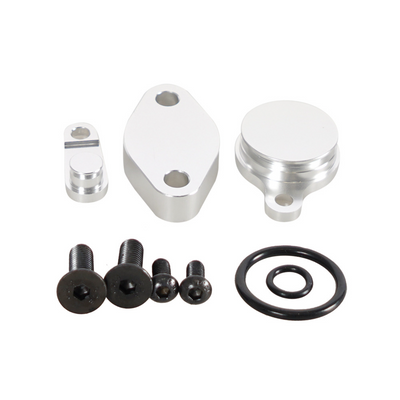

A cracked hose or a twenty dollar valve is behind most EVAP codes on a Chevy 5.3, but plenty of owners still want to bypass the EVAP system for good, especially on off-road rigs and engine swaps.
This guide covers what the system does, what the community says about deleting it, the cheap fixes that solve most codes, and how a proper EGR and EVAP block-off plate kit does the job on trucks that never see public roads.
Table of Contents
Key Takeaways
- [What it is]: The EVAP system collects fuel vapor from the tank in a charcoal canister, then a purge valve feeds it into the intake to be burned instead of vented to the air.
- [Code map]: P0442 and P0455 are small and large leaks, P0446 is a vent performance fault, and P0449 points at the vent circuit. Two thirds of P0449 cases on these trucks start with a loose or worn gas cap.
- [Cheap fixes first]: The purge valve in the engine bay and the vent valve at the fuel tank cause most repeat codes. Each is a 30-minute job with basic tools, shown in a video with over one million views.
- [Bypass reality]: An EVAP delete adds no measurable power. Owners who did it report a fuel smell around the truck, and the fuel tank must stay vented or it can collapse as fuel is drawn out.
- [Street legality]: Removing or bypassing any emissions control is illegal for street-driven vehicles in most jurisdictions. Block-off plates are for off-road, race, and swap builds only.
- [The right kit]: A proper bypass uses billet block-off plates at the intake ports plus a purge solenoid plug, and it needs ECU support or a simulator to keep the check engine light off.
- [Companion mod]: The street-legal vapor fix on a 5.3 is an oil catch can on the PCV side, which stops oil mist from coating the intake instead of deleting anything.
What the EVAP System Actually Does
BlueDriver's vent valve walkthrough has passed one million views, and it opens with the code map every 5.3 owner should know before touching a wrench.
Fuel in a sealed tank evaporates constantly, especially in hot weather. The evaporative emission control system gives that vapor somewhere to go: lines from the fuel tank route it to a charcoal canister, which stores it, and when conditions are right the engine computer opens the purge valve to draw the stored vapor into the intake, where it burns like fuel. A vent valve on the canister lets fresh air in during purge and manages tank pressure. The whole loop is monitored by a fuel tank pressure sensor, and the computer runs occasional leak tests. That is why the system fails loudly: any hole, stuck valve, or weak seal shows up as a code, not a drivability problem.
The codes tell you where to look:
- P0442 (small leak) and P0455 (large leak): plumbing problems, meaning gas cap, hoses, or canister seals.
- P0446: vent performance fault, usually the vent valve or a clogged filter.
- P0449: vent solenoid circuit, though two thirds of the time it starts with a gas cap that is loose or has a worn seal. Check that first because it is free.
After the cap, the two valves carry most of the blame, and a smoke test settles any argument about where a leak hides.
Building a Race or Swap Truck?
If your 5.3 lives off-road or is headed into a swap where the factory EVAP plumbing will not survive, an EGR and EVAP block-off plate kit seals the intake ports cleanly with CNC billet plates and a purge solenoid plug built for 4.8L, 5.3L, and 6.0L LS engines.
Shop LS Block-Off PlatesWhy You Usually Should Not Bypass the EVAP System
Before you cut anything, it helps to know what owners who already did it say. The consensus across GM truck forums is refreshingly blunt: there is nothing to gain. The system only handles fuel vapor at low flow, not combustion, so removing it frees no meaningful power. One GMT400 owner put it directly:
"You can delete it, but it's not like it causes any performance gain, so why bother? Waste of time and money to cap it off imo." (u/Headass33, r/GMT400)
The vapor itself has to go somewhere. Another owner in the same thread explained what happens when you cap the line and pull the canister:
"Vapors from your fuel tank have nowhere to go but to the open air so your truck will smell like fuel all the time." (u/highonb12, r/GMT400)
Then there is the physics problem that ends most delete conversations on SilveradoSierra:
- The tank must stay vented, no matter what. A sealed tank collapses inward as the pump draws fuel out, so you cannot just cap every line.
- Pre-emissions cars used vented gas caps for exactly this reason, and any honest EVAP delete has to give the tank a filtered vent path of its own.
- There is a middle path: for trucks that just keep throwing codes, members suggest leaving the canister in place and disabling the EVAP codes in the tune, which keeps the tank vented and the garage free of fuel smell.
Legality is the last stop. Fuel vapor is a regulated emission, and the system exists because regulators require it. An EVAP delete on a truck registered for the street is tampering, full stop. The block-off hardware sold for these engines is marketed for competition, off-road, and swap builds, and that is the only place it belongs.
Instead of bypassing emissions components that have minimal impact on horsepower, prioritizing valvetrain protection yields significantly higher long-term reliability for your truck. Eliminating vulnerable dynamic lifters and VLOM oil galleries prevents catastrophic mechanical failure; explore complete kits in our guide on how to delete AFM on 5.3 chevy.
Fix the Codes First: Purge Valve and Vent Valve
A 2007 to 2013 purge valve swap on the 5.3 takes under three minutes to watch and about that long to do: one 10 mm nut, two quick-connect lines, and the valve slides off its bracket.
The two valves fail in different ways, and the codes point at them:
Part |
Location |
Typical Codes |
Quick Test |
|---|---|---|---|
Purge valve |
Engine bay, near the throttle body |
P0441, P0442, lean codes |
Disconnect it with the engine running: the port should hold zero vacuum. If it sucks air while unpowered, the valve is leaking. |
Vent valve |
On the canister, in front of the fuel tank |
P0446, P0449, P0455 |
Listen for it clicking on startup; dust-clogged vents fail the flow test on a scan tool. |
The purge test in that table is worth memorizing, because a valve stuck open acts exactly like a vacuum leak and can even set lean codes, as one Ford tech demonstrates with a finger on the disconnected port. The parts are cheap and problem prone enough that many owners replace them on suspicion alone. The vent valve is the one that fails from geography: it hangs under the truck, and the older combined canister-and-filter design swallows road dust until it clogs. The updated design fixes it:
- Remote filter: the new design separates the solenoid from a small filter you tuck up into the frame rail, away from road spray and dust.
- Hose swap: installing it means cutting a length of 5/8 inch heater hose to replace the plastic line.
- No kinks: keep the routing free of bends, because a pinched line brings the codes right back.
After the repair, clearing the code is not the finish line. The emission monitors need to reset, which takes roughly 40 minutes of driving through normal stop-and-go cycles before the truck will pass an inspection readiness check.
How to Bypass the EVAP System the Right Way
If the truck is a dedicated off-road build, a race truck, or an LS swap into something that never had emissions equipment, a proper EVAP delete is legitimate shop work, not a hack job. Done right, it has three parts:
- Block-off plates: billet plates seal the purge port on the intake manifold so the vapor circuit ends at a clean machined surface instead of a capped hose.
- Purge solenoid plug: fills the connector so the harness stays weather-tight.
- A tank vent: the part everyone forgets. The fuel tank gets its own filtered vent, because it still needs to breathe whether the factory system is there or not.
The computer also needs a plan. The EVAP monitor runs pressure tests, and with the hardware gone it will set codes and turn on the light. That means either a tune that disables the EVAP monitors, or a simulator that keeps the fuel tank pressure sensor happy.
A block-off plate with no ECU strategy behind it just trades leak codes for circuit codes. The hardware itself is built for swap and race builds, it needs matching simulator or ECU support, and it is not legal on public roads. If your 5.3 is a registered street truck, the honest answer is to fix the valves instead.
While EVAP handles fuel tank vapors, the 5.3's PCV system introduces harmful oil mist directly into the intake manifold, causing carbon buildup and knock. Installing an inline separator catches blow-by oil before it reaches your intake runners; follow our step-by-step walkthrough on how to install oil catch can hardware cleanly.
The 5.3's Other Vapor Problem: Oil, Not Fuel
Here is the twist that surprises owners who go looking for vapor problems under the hood: the EVAP system rarely hurts a 5.3, but the PCV system quietly does.
- The 5.3 pushes oil mist through the PCV circuit into the intake, where it cakes the manifold, valves, and throttle body.
- On Active Fuel Management engines, that blow-by feeds the oil consumption reputation these engines carry.
- It is a vapor problem you can actually fix on a street truck, with no emissions trade-off.
An oil catch can for sits in the PCV line, condenses the oil mist into a drainable can, and leaves clean air heading for the intake. It is the direct-fit, street-legal counterpart to the delete conversation happening two sections up: instead of removing a system, you filter the one that is making the mess.
If you are new to the concept, the guide to oil catch cans benefits explains how they work, what they catch, and who actually needs one.
For owners who would rather skip the theory and see what fits, the direct-fit roundup in our best oil catch can guide covers kits for gas trucks and diesels, including application-specific brackets for the Silverado and Sierra. On a 5.3 that is burning a little oil through the PCV side, it is the first mod that actually addresses vapor instead of arguing with it.
What Real Owners Say
The GMT400 and SilveradoSierra threads on this topic are full of people who lived the delete and reported back:
"All the evap system is doing is using engine vacuum to pull vapors from the fuel tank, and stores them in a charcoal canister. Truck will just smell like fuel when you let it sit when it's hot out or after you shut the truck off." (u/_Ping_Pong_, r/GMT400)
On the forum side, the advice trends the same direction. One member's suggestion for a poster chasing codes: "You can just leave the canister and disable the EVAP codes." Another pointed out that the system's whole job is sending fuel vapor to be burned, which means unburned vapor is literally money vented into the air. And the sharpest reply in the thread cuts both ways: this isn't 1976, and modern emissions parts are not strangling your horsepower. The pattern across every thread is the same: fix the valve, keep the vapor, spend the savings on something that actually moves the needle.
FAQ
Can you bypass the EVAP system on a Chevy 5.3?
Physically, yes: block-off plates seal the intake side, the canister comes out, and the tank gets a filtered vent. Legally, only on off-road, race, and swap vehicles. On a registered street truck it is emissions tampering, and since it adds no power, there is no payoff for the risk.
Will bypassing the EVAP system cause a check engine light?
Yes, unless the EVAP monitors are disabled in the tune or a simulator keeps the fuel tank pressure sensor satisfied. The computer tests the system and flags missing hardware with codes and an illuminated light.
Can I drive with P0442 or P0455?
Yes. These are vapor codes, not drivability codes, so the truck runs normally. You will just vent extra fuel vapor and fail an emissions inspection until it is fixed, and the underlying leak can let dirt into the vapor lines.
Where is the purge valve on a 5.3 Silverado?
In the engine bay near the throttle body, under the engine cover on 2007 to 2013 trucks. It is a small plastic valve with two quick-connect lines and one connector, held by a bracket with a single 10 mm nut. Later trucks moved the bracket slightly; 1A Auto's purge solenoid walkthrough shows the 2014 to 2019 layout.
How do I test an EVAP purge valve?
Unplug it and remove its line with the engine idling, then put a finger over the port. A healthy closed valve holds no vacuum at all. If it pulls suction while unpowered, the valve is stuck open and leaking.
Does an EVAP delete add power?
No. The system moves fuel vapor at tiny flow rates and never touches combustion airflow. Owners who deleted it report the same performance plus a fuel smell around the truck.
Why does my truck smell like gas after an EVAP delete?
Because the tank still breathes. With the canister gone, vapor vents through whatever filter you installed, and on hot days or after shutdown the smell collects around the cab. It is the most common complaint in delete threads.
What is the charcoal canister for?
It is a storage filter. Fuel vapor from the tank lands on the charcoal and waits there until the purge valve draws it into the engine to be burned, instead of escaping to the atmosphere.
The Verdict
For a street-driven 5.3, the decision tree is short:
- Check the gas cap first, because it is free.
- Smoke test if the codes persist.
- Replace the purge or vent valve that fails the tests above.
- Drive 40 minutes to reset the emission monitors before any inspection.
That solves the overwhelming majority of EVAP codes for the cost of a couple of parts. If the truck only sees trails, tracks, or a swap bay, then bypass the EVAP system with proper Chevy 5.3 billet plates, a tank vent, and a tune strategy, and keep it off the road.
And whichever path fits your truck, the vapor problem worth fixing on a street 5.3 is oil, not fuel: a catch can addresses it legally, and the best oil catch can guide shows the direct-fit options. Compare block-off hardware for your build, and remember the rule that governs all of it: an EVAP delete is for off-road use only.


