
⚡ 30-Second Summary: 2004.5–2005 LLY Duramax EGR Delete
Performing an EGR delete on a 2004.5–2005 LLY Duramax stops hot exhaust soot from mixing with crankcase oil vapors, preventing oil contamination and thick sludge accumulation inside the intake manifold. Removing the EGR cooler also eliminates the risk of internal coolant leaks that contaminate engine oil. A complete job requires physically removing or blocking off the EGR assembly, rerouting the coolant line, and loading custom ECM calibration to clear Check Engine Lights (CEL). Complete installation takes approximately 2 to 4 hours using standard shop hand tools. High-quality LLY EGR delete hardware and coolant reroute kits are available through EGR Performance.
An LLY Duramax EGR delete removes the EGR valve and stacked-plate cooler that commonly cracks and leaks coolant into the intake. It also requires a custom tune to disable the EGR monitor strategy and clear related DTCs. Real-world results include 15-30°F lower intake air temperature, 50-100°F lower EGTs under load, 3-5 MPG better fuel economy, and 40-70 HP more power on a deleted truck.
We wrote this guide as a complete playbook for anyone who wants to stop the EGR headaches on their LLY Duramax. Every step, part number, and calibration note is based on what actually works in real builds.
Table of Contents
- 1. Why the LLY EGR System Fails (And Why You Should Delete It)
- 2. EGR Delete vs. Blocker Plate: Which Approach Is Right?
- 3. LLY EGR Delete Cost Breakdown
- 4. What You Need: Tools, Parts, and Supplies
- 5. How to Delete EGR on LLY Duramax (Step-by-Step)
- 6. Post-Delete Tuning: What You Need to Know
- 7. Common DTC Codes After LLY EGR Delete
- 8. Supporting Modifications for Maximum Benefit
- 9. What to Expect After Deleting: MPG, Power, and EGTs
- 10. Troubleshooting Common Issues
- 11. FAQ
- 12. Final Thoughts
1. Why the LLY EGR System Fails (And Why You Should Delete It)
Deleting the EGR on the LLY is the single highest-ROI mod for this generation. Intake air temperature drops 15-30°F, EGTs fall 50-100°F under heavy load, and a well-tuned deleted LLY gains 40-70 HP and 60-100 lb-ft of torque with 3-5 MPG better fuel economy. Strictly off-road and competition use only.
Eliminate Soot and Thermal Fatigue on Your LLY.
Stop letting hot, abrasive exhaust gases choke your intake manifold and threaten your coolant system. Our LLY EGR Delete Kits from EGR Performance are precision-engineered for an exact OEM-plus fit, utilizing heavy-duty block-off plates, high-temp gaskets, and robust coolant routing built to handle extreme off-road and competition workloads.
Shop LLY EGR Delete Kits→The Exhaust Gas Recirculation system on the LLY Duramax redirects exhaust gas back into the intake manifold to reduce NOx emissions. On paper, this helps the environment. In practice, the LLY EGR system causes real problems for truck owners.
The LLY EGR Cooler Problem
The EGR cooler is a heat exchanger that cools recirculated exhaust gas using engine coolant. On the LLY, this component sits in a high-heat zone and is prone to cracking - a problem that is well-documented in Duramax forums and repair shops. When the cooler cracks, you get:
- Coolant loss - Coolant leaks into the exhaust stream or burns off as white smoke from the tailpipe
- Overheating - Lost coolant means the engine runs hotter, which on the LLY (already known for running warm) can push temperatures into dangerous territory
- White smoke at idle - A telltale sign of coolant entering the combustion chamber
- Sweet smell from the exhaust - Another coolant-in-exhaust indicator
Replacing the EGR cooler at a shop costs $800-$1,500 in parts and labor. And the replacement cooler will eventually crack again - it is a design problem, not a part quality problem. The LLY EGR delete removes this failure point permanently.
Carbon Buildup
The EGR system continuously feeds soot-laden exhaust gas into the intake manifold. Over 50,000-100,000 miles, this builds up a thick layer of hard carbon that restricts airflow and forces the engine to work harder.
The result: sluggish throttle response, higher EGTs, and reduced fuel economy. Deleting the EGR stops this contamination at the source.
The factory EGR system on the LLY engine frequently clogs with sticky carbon sludge, causing EGR valve sticking and thermal stress that contributes to engine overheating issues. To evaluate how exhaust recirculation failures tie into turbo mouthpiece bottlenecks and head gasket risks, read our complete diagnostic breakdown of lly duramax problems.
2. EGR Delete vs. Blocker Plate: Which Approach Is Right for You?
Choosing between an EGR blocker plate and a full EGR delete for an LLY Duramax involves balancing cost, installation time, and long-term reliability. While a blocker plate offers a quick and inexpensive fix, it leaves the failure-prone factory cooler in place, whereas a full delete kit eliminates future cooler failures and frees up space at the cost of higher labor and coolant service.
There are two ways to disable the EGR on an LLY Duramax, and understanding the difference matters before you buy parts.
Blocker Plate Only
A blocker plate is a thin metal plate that bolts between the EGR valve and the intake manifold, physically blocking exhaust gas from entering the intake. The EGR cooler and piping remain in place.
Factor |
Details |
|---|---|
Cost |
$20-$40 for the plate |
Install time |
30-60 minutes |
Cooler removal |
No - cooler stays in place |
Coolant drain |
Not required |
Effectiveness |
Blocks EGR flow completely |
Downside |
Cooler is still there and can still crack |
Full EGR Delete
A full EGR delete removes the EGR cooler, blocks the exhaust feed at the up-pipe, and reroutes the coolant lines that previously flowed through the cooler.
Factor |
Details |
|---|---|
Cost |
$100-$200 for the kit |
Install time |
3-5 hours |
Cooler removal |
Yes - cooler comes out entirely |
Coolant drain |
Required (drain and refill ~3 gallons) |
Effectiveness |
Blocks EGR flow and eliminates cooler failure risk |
Downside |
More labor, requires coolant service |
Which Should You Choose?
- If your EGR cooler is already leaking or cracked: Full delete. There is no point leaving a broken cooler in the engine.
- If your cooler is fine and you want a quick fix: An LLY EGR blocker plate install takes under an hour and stops the carbon contamination. You can always do the full delete later.
- If you are planning a performance build: Full delete. Removing the cooler frees up space, reduces underhood heat, and eliminates the failure point for good.
3. LLY EGR Delete Cost Breakdown: Parts, Tuning, and ROI
A quality LLY EGR delete kit with block-off plate and reroute hoses costs $180-$350. A custom tune loaded on the HP Tuners or PSE device runs $300-$500. Total project cost for a DIY install lands between $500 and $900. Professional installation adds $400-$800 depending on the shop.
Here is what the LLY Duramax EGR delete actually costs, and how it compares to the alternative.
Item |
Cost |
Notes |
|---|---|---|
EGR blocker plate |
$20-$40 |
Quick install, cooler stays |
Full LLY EGR delete kit |
$100-$200 |
Includes block-off plates, coolant reroute, gaskets, hardware |
EFI Live tune (EGR disabled) |
$150-$350 |
Required to prevent check engine codes |
Coolant (Dex-Cool) |
$25-$40 |
~3 gallons for refill |
Total DIY cost (full delete) |
$275-$590 |
Kit + tune + coolant |
Shop installation (labor only) |
$300-$600 |
3-5 hours at $100-$150/hr |
Total with shop labor |
$575-$1,190 |
Everything done for you |
EGR cooler replacement (stock) |
$800-$1,500 |
Will fail again; not a permanent fix |
ROI Calculation
If you gain 2 MPG after the delete (from 14 to 16 MPG) and drive 12,000 miles per year:
- Annual fuel savings: ~$400-$500 at current diesel prices
- The delete pays for itself in fuel savings within 7-15 months
- Avoiding one EGR cooler replacement saves another $800-$1,500
4. What You Need: Tools, Parts, and Supplies
You need a basic socket set, torque wrench, coolant drain pan, and the EGR delete kit itself. The kit includes the block-off plate, reroute hoses, and hardware. Total supply cost stays under $50 and most tools you already own.
Before you start the LLY EGR delete installation, gather everything. Here is the complete list.
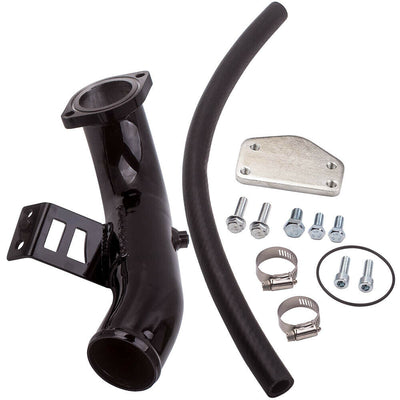
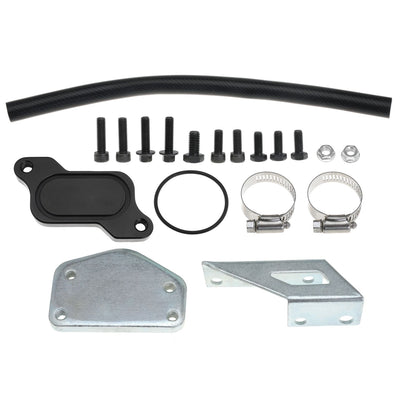
LLY EGR Delete Kit Components
- EGR valve block-off plate (intake side)
- EGR cooler block-off plate (exhaust/up-pipe side)
- Coolant reroute hose (bypasses the deleted cooler)
- Gaskets for both block-off plates
- Mounting hardware (nuts, bolts, studs)
- New clamps for coolant hoses

LLY Duramax EGR Delete Kit - 2004.5-2005 6.6L Complete Kit
7% OFF New Customer Coupon Code: EGR7
Buy NowRequired Tools
Tool |
Use |
|---|---|
10mm socket + wrench |
EGR valve bolts, various brackets |
13mm socket + wrench |
Cooler mounting bolts |
15mm socket + wrench |
Exhaust connections |
8mm socket |
Sensor bolts |
Ratchet + 6" extension |
General access |
Torque wrench (3/8" drive) |
Final torque on all bolts |
Pliers (hose clamp pliers ideal) |
Coolant hose removal |
Flat-head screwdriver |
Hose removal, prying |
Drain pan |
Coolant collection |
Funnel |
Coolant refill |
Shop towels |
Cleanup |
Supplies
- 3 gallons of Dex-Cool coolant (or equivalent GM-approved coolant)
- Penetrating oil (apply to exhaust bolts the night before)
- New gaskets (should come with your kit)
5. How to Delete EGR on LLY Duramax (Step-by-Step)
The LLY EGR delete takes 2-4 hours. Start by draining coolant, removing the EGR valve and cooler, installing the block-off plate, and rerouting the coolant bypass hose. Load the delete tune before the first start. Expect a clean installation with zero residual codes.
This is the complete LLY EGR delete installation guide - how to install an EGR delete kit on a 2004.5-2005 Duramax. Follow each step in order.
Step 1: Disconnect Batteries and Drain Coolant
- Disconnect both negative battery terminals. The LLY has two batteries under the hood.
- Place a drain pan under the radiator drain petcock (bottom passenger side of radiator).
- Open the petcock and drain approximately 3 gallons of coolant. Save the coolant in clean containers if you plan to reuse it; otherwise, dispose of it properly.
- Close the petcock once drained.
Step 2: Remove the Engine Cover and Resonator Box
- Pull the engine cover straight up and off the mounting posts.
- Loosen the clamp securing the resonator box (the large plastic intake tube between the air filter and turbo).
- Disconnect any sensor connectors attached to the resonator.
- Remove the resonator box and set it aside.

Step 3: Remove the Turbo Mouthpiece (Inlet)
- Locate the turbo mouthpiece - the metal intake horn bolted to the turbo compressor inlet on the driver's side of the engine.
- Remove the 4 bolts securing the mouthpiece to the turbo (10mm).
- Carefully pull the mouthpiece away. Be gentle with the turbo compressor wheel - do not let anything fall into the turbo.
- If there is a rubber boot or O-ring, note its orientation for reassembly.
Step 4: Disconnect EGR Electrical Connectors
- Locate the EGR valve electrical connector (on top of the EGR valve, near the intake manifold).
- Squeeze the release tab and pull the connector straight off.
- There may be additional sensor connectors near the EGR cooler (temperature sensors, pressure differential sensor). Disconnect these as well.
- Use a zip-tie or tape to secure the disconnected harness out of the way - you will not reconnect it after the delete.
Step 5: Remove the EGR Valve
- Remove the 2-4 bolts securing the EGR valve to the intake manifold (10mm or 13mm, depending on year).
- Pull the EGR valve straight out. It may be stuck with carbon - wiggle gently while pulling.
- Set the valve aside. You will not reinstall it.
Step 6: Remove the EGR Cooler
This is the most time-consuming part of the LLY EGR delete.
- Locate the cooler. The EGR cooler sits on the passenger side of the engine, between the exhaust up-pipe and the intake manifold. It is a cylindrical metal component with coolant hoses attached at both ends.
- Disconnect coolant hoses. Remove the coolant inlet hose (from the engine block) and the coolant outlet hose (to the radiator/thermostat housing). Expect some residual coolant to drain - have your drain pan ready.
- Disconnect the exhaust feed tube. The tube connecting the exhaust up-pipe to the EGR cooler is secured with 2 bolts (13mm). Remove them. These bolts are often rusted - use penetrating oil and work them back and forth if needed.
- Disconnect the intake feed tube. The tube from the cooler to the intake manifold is secured with 2 bolts (10mm or 13mm). Remove them.
- Remove cooler mounting bolts. There are 2-4 bolts securing the cooler bracket to the engine block (13mm). Remove them.
- Remove the cooler. Carefully lift the EGR cooler out of the engine bay. It may take some maneuvering to clear surrounding components.
Step 7: Install Block-Off Plates
- Exhaust side (up-pipe flange): Place the block-off plate and new gasket over the exhaust up-pipe flange where the cooler feed tube was connected. Install and hand-tighten the bolts (13mm). Torque to 18 ft-lbs in a cross pattern.
- Intake side (manifold flange): Place the block-off plate and new gasket over the intake manifold opening where the EGR valve was mounted. Install and hand-tighten the bolts (10mm). Torque to 15 ft-lbs in a cross pattern.
Step 8: Reroute Coolant Lines
Your EGR delete kit includes a coolant reroute hose that replaces the path previously through the EGR cooler.
- Connect the reroute hose from the coolant feed port (engine block) to the coolant return port (thermostat/radiator hose).
- Secure both ends with the clamps provided in the kit.
- Make sure the hose is routed away from exhaust manifolds and moving parts.
Step 9: Reassemble
- Reinstall the turbo mouthpiece with its 4 bolts. Torque to 10 ft-lbs.
- Reinstall the resonator box and tighten the clamp.
- Reconnect any sensor connectors you disconnected (except the EGR valve connector - leave it disconnected).
- Reinstall the engine cover.
Step 10: Refill Coolant and Bleed the System
- Close the radiator drain petcock (if you have not already).
- Refill the radiator with Dex-Cool coolant through the radiator cap or surge tank. You will need approximately 3 gallons.
- Start the engine with the radiator cap off and let it reach operating temperature. This opens the thermostat and allows coolant to circulate, purging air from the system.
- Top off the coolant as the level drops (air bubbles escape and coolant fills the voids).
- Once the coolant level stabilizes and no more bubbles appear, install the radiator cap.
- Check for leaks at all hose connections and block-off plate locations.
Step 11: Final Torque Check
After the engine has run and cooled down, go back and verify all bolt torques:
Component |
Torque Spec |
|---|---|
EGR block-off plate (exhaust side) |
18 ft-lbs |
EGR block-off plate (intake side) |
15 ft-lbs |
Turbo mouthpiece bolts |
10 ft-lbs |
Coolant hose clamps |
Firm hand-tight |
Resonator box clamp |
Firm hand-tight |
6. Post-Delete Tuning: What You Need to Know
You need a custom delete tune that disables the EGR strategy and optimizes boost and fueling. Load the tune on HP Tuners or PSE after the hardware is installed. Expect 40-70 HP and 60-100 lb-ft gains with EGTs staying under 1,150°F.
You cannot just delete the EGR hardware and drive. The ECM expects the EGR system to be present and functional. Without a tune, you will get check engine codes, the truck may run poorly, and you will fail any emissions inspection.
Tuning Options for LLY EGR Delete
Platform |
Cost |
Pros |
Cons |
|---|---|---|---|
EFI Live |
$150-$350 |
Industry standard for Duramax, widely available, custom tuning |
Requires laptop, learning curve |
HP Tuners |
$200-$400 |
Good MPVI3 interface, growing Duramax support |
More expensive, fewer Duramax tuners |
Pre-loaded tuners (PPEI, etc.) |
$200-$500 |
Easy plug-and-play, no laptop needed |
Less customizable |
What the Tune Does
- Turns off EGR valve monitoring and diagnostics
- Disables EGR flow detection
- Clears DTC codes P0401, P0404, P0405 and prevents them from setting
- Adjusts fueling and timing for EGR-delete operation
- Often includes performance improvements (HP and torque gains)
When to Flash the Tune
Flash the tune AFTER completing the mechanical installation. The truck will run on the stock tune with the EGR deleted - it will throw codes and may have a slight idle quality change - but it is safe to drive short distances to get the tune loaded if you cannot do it in your garage.
7. Common DTC Codes After LLY EGR Delete
Common DTCs after LLY EGR delete include P0401, P0402, P0403, and P0008 if the EGR monitor is not fully disabled. A good tune clears these codes instantly. Newer codes like P0299 or P0300 usually point to a different issue.
If you delete the EGR without tuning, these are the diagnostic trouble codes you will see:
DTC Code |
Description |
Cause After Delete |
|---|---|---|
P0401 |
EGR Flow Insufficient |
EGR valve removed, no flow detected |
P0402 |
EGR Flow Excessive |
False reading from open EGR port |
P0404 |
EGR Circuit Range/Performance |
EGR valve disconnected |
P0405 |
EGR Sensor A Circuit Low |
EGR position sensor unplugged |
P0406 |
EGR Sensor A Circuit High |
EGR position sensor circuit issue |
P0489 |
EGR Control Circuit Low |
EGR valve electrical circuit open |
P0400 |
EGR Flow Malfunction |
General EGR system fault |
All of these codes are cleared permanently by the tune. If you see any of these after getting tuned, contact your tuner - the EGR disable may not have been properly coded into your tune file.
8. Supporting Modifications for Maximum Benefit
Add a high-flow Y-bridge intake pipe, a catch can on the PCV, and an upgraded oil cooler. These mods reduce intake temperature further and protect the turbo seals.
The LLY EGR delete is even more effective when paired with complementary mods. Here is what experienced LLY owners typically combine with the delete.
Up-Pipe Upgrade
The factory LLY up-pipe connects the exhaust manifold to the turbo. The EGR feed tube taps into this pipe. When you delete the EGR, you can either block the feed hole or replace the up-pipe entirely with an LB7-style pipe (which has no EGR feed port). An upgraded up-pipe improves exhaust flow to the turbo and eliminates any restriction at the old EGR feed point.
Cold Air Intake
With the EGR gone and the intake no longer receiving sooty exhaust gas, a cold air intake helps the engine take full advantage of the cleaner, cooler air. Not strictly necessary, but a common pairing.
Exhaust System Upgrade
The LLY's factory exhaust is adequate but restrictive. A 4" or 5" turbo-back exhaust system reduces backpressure, lowers EGTs, and lets the turbo spool faster. This pairs perfectly with the EGR delete for maximum airflow improvement.
Lift Pump (Fuel System)
A lift pump (like a FASS or AirDog) ensures consistent fuel pressure to the CP3 injection pump. Not directly related to the EGR delete, but a common reliability mod for LLY trucks that is often done at the same time.
High-Flow Intake Elbow
When removing the factory EGR valve and cooler, the stock intake horn/elbow is left with an unnecessary bottleneck and a mounting flange for the old system. Replacing it with a high-flow intake elbow removes this internal restriction and opens up the intake tract for a cleaner look and better airflow into the engine.
Recommended Product: EGR Delete + High Flow Intake Elbow Tube Kit for LLY 2004-2005
Why it helps: This kit replaces the restrictive factory components entirely, smoothing out the airflow path directly into the intake manifold after completing your EGR delete.
While removing the EGR cooler eliminates a major thermal restriction, pairing your modification with an upgraded turbo intake horn and high-flow exhaust maximizes throttle response and lowers EGTs under load. To map out a complete performance build for your truck, check out our comprehensive lly durmax guide.
9. What to Expect After Deleting: MPG, Power, and EGTs
After a proper delete and tune expect 3-5 MPG better fuel economy, 40-70 HP and 60-100 lb-ft more torque, and EGTs staying 50-100°F cooler under load. The truck feels quicker and more responsive.
Here is what LLY owners typically report after completing the EGR delete with a tune:
Performance Gains
Metric |
Before Delete |
After Delete |
Change |
|---|---|---|---|
Horsepower |
Stock (~310 HP) |
+15-30 HP |
Depends on tune |
Torque |
Stock (~605 lb-ft) |
+20-60 lb-ft |
Depends on tune |
Fuel Economy (city) |
12-14 MPG |
14-16 MPG |
+1-3 MPG |
Fuel Economy (highway) |
15-17 MPG |
17-20 MPG |
+2-3 MPG |
EGTs (towing) |
1,200-1,400 deg F |
1,050-1,250 deg F |
-150-200 deg F |
Throttle response |
Sluggish (carbon buildup) |
Noticeably sharper |
Immediate difference |
Driveability Changes
- Cooler engine temps: Without the EGR introducing hot exhaust gas into the intake, the engine runs 10-20 degrees cooler under load
- Cleaner oil: No more soot contamination means your engine oil stays cleaner between changes
- No more white smoke: If your cooler was cracked, the white smoke stops immediately
- No more coolant loss: The cracked cooler is gone - coolant level stays stable
- Smoother idle: With the tune properly adjusted, idle quality often improves
10. Troubleshooting Common Issues
Common issues include residual codes, coolant leaks at the new plate, or rough idle. Most clear with the right tune or minor adjustments.
Coolant Leak After Reassembly
- Cause: Coolant hose connections not tight, or wrong hose routing.
- Fix: Check all hose clamps at the coolant reroute connection points. Ensure the reroute hose is not kinked or pinched. If leaking at a block-off plate, remove and re-seat the gasket.
Check Engine Light After Delete (Before Tune)
- Cause: ECM detects missing EGR components. This is expected.
- Fix: Flash the EGR-delete tune. The codes will clear immediately.
Check Engine Light After Tune
- Cause: Tune did not fully disable EGR diagnostics, or a different code was triggered.
- Fix: Read the specific code with a scanner. If it is EGR-related (P0401, P0404, P0405), contact your tuner for a revised file. If it is unrelated, address the underlying issue.
Rough Idle or Hesitation
- Cause: The tune may need adjustment, or there is a vacuum/boost leak at the block-off plates.
- Fix: Check that all block-off plates are properly sealed with gaskets. Verify torque specs. If the plates are sealed, contact your tuner about adjusting the idle fueling tables.
Stuck Bolts During Cooler Removal
- Cause: The LLY's EGR cooler bolts are often rusted and seized, especially on high-mileage trucks.
- Fix: Soak with penetrating oil (PB Blaster or equivalent) for 30+ minutes before attempting removal. Use a breaker bar, not an impact wrench, on the cooler mounting bolts to avoid snapping them. If a bolt rounds off, use locking pliers or a bolt extractor.
Removing exhaust recirculation isolates your intake manifold from soot contamination, but maintaining proper cooling efficiency requires routine coolant flushes and fresh fluid intervals. For recommended service schedules, oil filtration tips, and cooling system care, consult our guide on lly duramax maintenance.
11. FAQ
How long does it take to delete the EGR on an LLY Duramax?
Most DIYers complete the full LLY EGR delete in 3-5 hours with basic hand tools. A blocker plate install takes 30-60 minutes. First-timers should budget a full Saturday to account for stuck bolts and the learning curve.
Can I drive my LLY with the EGR deleted but not tuned?
Technically yes, for short distances. The truck will run, but you will have a check engine light and may experience rough idle or slightly reduced performance. Do not drive it this way long-term - get the tune loaded as soon as possible.
Will the LLY EGR delete fix my overheating problem?
If your overheating is caused by a cracked EGR cooler leaking coolant, yes - the delete fixes it permanently. If your LLY overheats for other reasons (clogged radiator, failing fan clutch, head gasket issues), the EGR delete alone will not solve the problem. The LLY is known for running warm; the delete helps but is not a cure-all.
Do I need to remove the EGR cooler, or can I just use a blocker plate?
Both work. A blocker plate stops exhaust gas from entering the intake but leaves the cooler in place. If your cooler is already cracked or leaking, you need to remove it (full delete). If the cooler is healthy and you just want to prevent carbon buildup, a blocker plate is sufficient.
What tune do I need for an LLY EGR delete?
EFI Live is the most popular and widely supported option for the LLY. Any Duramax tuner can provide an EGR-disable tune. You can get a tune that only disables EGR (keeps power stock) or a performance tune that also adds horsepower.
Will the LLY EGR delete help with head gasket issues?
Indirectly, yes. The LLY is known for head gasket problems, and the EGR system contributes by raising engine temperatures and increasing cylinder pressures. Deleting the EGR lowers operating temperatures, which reduces stress on the head gaskets. However, if the head gaskets are already failing, the delete will not repair them - you need head gasket replacement.
Can I pass emissions with the EGR deleted?
No. Any state that performs OBD-II emissions testing will detect the disabled EGR monitors and fail the truck. States that perform visual inspections will also flag the missing EGR components. If you live in a state without diesel emissions testing, the delete will not trigger any automatic flags.
How much coolant do I lose during the LLY EGR delete?
You will drain approximately 3 gallons of coolant when doing a full EGR delete. You need to refill with Dex-Cool (GM-approved) coolant after the installation is complete. If you are only installing a blocker plate, no coolant drain is required.
What is the best LLY EGR delete kit?
Look for a kit that includes both block-off plates (intake and exhaust sides), a coolant reroute hose, new gaskets, and all necessary mounting hardware. Stainless steel construction (T-409 or T-304) is preferred for corrosion resistance. Most kits in the $100-$200 range from reputable diesel performance brands are comparable in quality.
Is the LLY EGR delete legal?
No. Removing or disabling the EGR system violates federal law (Clean Air Act Section 203(a)(3)(A)) in all 50 states, regardless of whether your state tests diesel emissions. This modification is for off-road and competition use only.
12. Final Thoughts
Learning how to delete EGR on LLY Duramax is one of the most impactful modifications you can make to a 2004-2005 Duramax. The LLY's EGR cooler is a known weak point - if it has not failed yet, it likely will. The delete eliminates this failure point, improves engine temperatures, reduces carbon contamination, and with a tune, adds horsepower and fuel economy.
Whether you go with a quick blocker plate or a full cooler removal, the process is straightforward with basic hand tools and a Saturday afternoon. The key steps: drain coolant, remove the cooler, install block-off plates, reroute coolant lines, refill and bleed the system, and flash the tune. Follow the torque specs, take your time, and you will have a cooler, cleaner, more reliable LLY Duramax.