
⚡ 30-Second Summary: How Much Horsepower Do Headers Add?
Dyno testing on 5.7L Hemi engines demonstrates that upgrading to long-tube headers delivers 27–36 hp gains over restrictive factory cast-iron manifolds when utilizing 1 5/8-inch or 1 7/8-inch primary tubes with matched collectors. Shorty headers offer a more modest 10–15 hp increase while retaining factory mounting locations and catalytic converter placement. To unlock maximum power output and prevent Check Engine Lights (CEL), pair your header installation with custom ECU tuning. California vehicles must verify CARB Executive Order (EO) compliance prior to purchase, and all setup gains should be validated on a chassis dyno.
Table of Contents
- What Are Exhaust Headers?
- How Much HP Do Shorty Headers Add?
- How Much HP Do Long-Tube Headers Add?
- HP Gains from Shorty vs. Long-Tube Headers
- What Factors Affect Horsepower Increase with Headers?
- Do Headers Add More Power With Other Modifications?
- Case Study: How Much HP Do Headers Add to a 5.7 Hemi?
- Evaluating Header Horsepower Gains: Dyno Testing & Legal Factors
- FAQs
- Final Verdict
Factory exhaust manifolds on a 5.7 Hemi often restrict flow and reduce scavenging efficiency. This limits throttle response, peak power, and overall drivability on stock or mildly modified engines. If you are looking at a set of exhaust headers, the horsepower number is probably one of the first things you will want to know.
Exhaust headers add 5 to 30 horsepower on a 5.7 Hemi. Shorty headers deliver 5-15 hp with easy fitment and low-end focus. Long-tube headers provide 10-25+ hp by broadening the powerband through improved pulse separation and scavenging.
Turbocharged engines usually see smaller peak gains from headers alone because the turbocharger creates its own exhaust restriction. On the other hand, heavily modified naturally aspirated engines with performance cams, high-flow intakes, and ECU tuning can see around 30-40+ HP from the overall combination.
So, how much horsepower do headers add? No single number works for every vehicle. Engine application, header design, the specific file loaded into the car's ECU (if tuning is used), fueling, ambient conditions, elevation, and the type of dynamometer used to test each application all factor into the horsepower gain from headers. The sections below break down exact horsepower increase with headers, technical mechanisms, and real-world factors so you can decide if headers fit your truck.
What Are Exhaust Headers?
Headers replace factory cast exhaust manifolds with individual primary tubes that merge into a collector, optimizing exhaust velocity for smoother flow and scavenging.

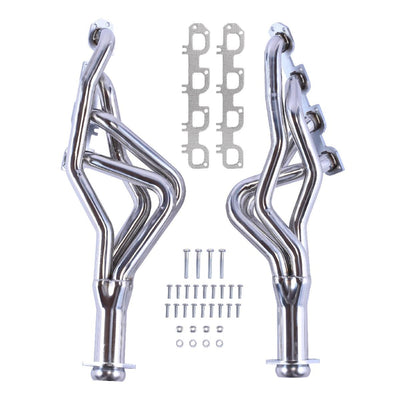
Headers replace the cast-iron factory manifolds on a 5.7 Hemi with individual primary tubes that merge into a collector. The design keeps exhaust pulses separated over a longer distance than stock log-style manifolds. This process creates a scavenging effect that draws the next intake charge into the cylinders during overlap.
Lower restriction flows better out of the engine. Pulse separation prevents interference between adjacent cylinders. The result is smoother exhaust evacuation and reduced backpressure without eliminating flow entirely.
Technical Breakdown of How Headers Work
A few parts of the design matter here:
- Lower exhaust restriction: The individual tubes can provide a smoother path for exhaust gases leaving the cylinders.
- Pulse separation: Keeping the pulses separated helps prevent one cylinder's exhaust flow from interfering with another.
- Exhaust scavenging: The movement of one exhaust pulse can help pull the next air-fuel charge into the cylinder during valve overlap.
Longer tubes allow these waves to reflect and pull spent gases from the cylinders during the exhaust stroke. Shorter tubes work best at higher rpm. Collector design merges the tubes smoothly to minimize turbulence at the exit. Equal-length primaries on most aftermarket kits ensure consistent pulse timing across all eight cylinders.
One might assume that headers work by lowering back-pressure, but that's not entirely accurate. There are several variables, including tube diameter, tube length, and header collector design that are also involved in the header's performance, not to mention the engine itself.
It is better to select an exhaust header that's matched to your engine rather than based on it being the largest or best flowing. For example, if your header tubes are too large for your specific application, you can actually reduce exhaust gas velocity, which may negatively impact low end torque.
How Much HP Do Shorty Headers Add?
Shorty headers usually add 5 to 15 HP on a mostly stock engine.

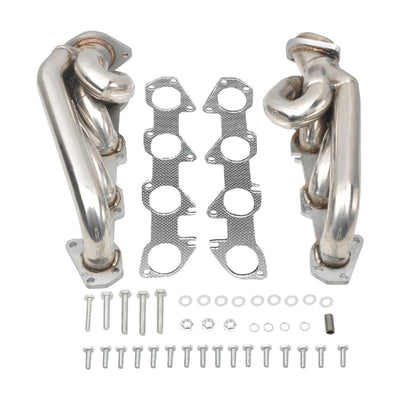
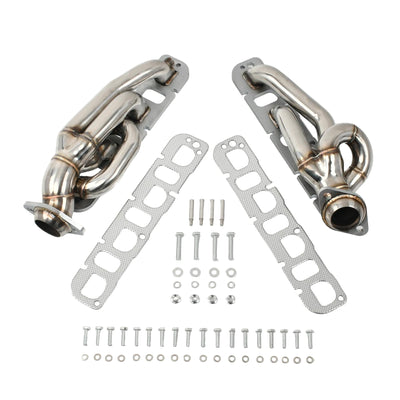
Shorty headers generally add around 5 to 15 HP on a mostly stock naturally aspirated engine. On a smaller setup, the increase can be closer to 5 to 10 HP. The actual number comes down to the engine and how restrictive the factory manifold is.
The compact design is one of the main reasons people choose shorty headers. They sit close to the cylinder head, which makes them easier to fit in tight engine bays. Many applications can also keep the factory catalytic converters, so there is less work involved with the rest of the exhaust system.
That makes shorties a sensible option for a daily-driven vehicle. You can gain some extra power without making major changes underneath the vehicle.
Shorty headers can also make sense when emissions compliance is a priority. Retaining the factory catalytic converters and using a header designed for the vehicle can make the installation simpler from both a fitment and emissions standpoint. You should still verify the specific emissions certification for your vehicle before buying.
One point is worth clearing up, though. Shorty headers do not automatically produce more low-end torque than long tubes. Primary tube length and diameter, collector design, and the engine itself determine where the torque gain shows up.
How Much HP Do Long-Tube Headers Add?
Long-tube headers deliver roughly 10 to 25+ HP on naturally aspirated engines.

Long-tube headers usually add around 10 to 25+ HP on a naturally aspirated engine. The gain can be higher on a larger V8 or a modified engine where the rest of the exhaust system can support the extra flow.
The longer primary tubes give the exhaust pulses more room to stay separated before they reach the collector. This helps with exhaust scavenging and can improve power through the midrange and upper RPM range.
A long-tube header also needs more room underneath the vehicle. Depending on the application, installation may involve custom mid-pipes, O2 sensor relocation, catalytic converter changes, or extra clearance around the frame rails, steering shaft, starter, and transmission.
ECU calibration can be especially useful after a long-tube installation because exhaust flow and O2 sensor placement may have changed. The exact tuning requirement depends on the vehicle, header design, emissions configuration, and other modifications.
There is a real difference between shorties and long tubes in some dyno tests. One MotorTrend comparison showed a horsepower gain of about 21 HP over stock from long-tube headers, compared with about 8 HP from shorty headers.
HP Gains from Shorty vs. Long-Tube Headers
Shorty headers add 5-15 hp while long-tube headers add 10-25+ hp on a 5.7 Hemi.

The difference between shorty and long-tube headers comes down to more than the peak horsepower number. Fitment, installation, powerband, and the rest of the exhaust system all affect which option makes more sense for your vehicle.
Feature |
Shorty Headers |
Long-Tube Headers |
|---|---|---|
Typical Peak Gain |
~5-15 HP |
~10-25+ HP |
Main Strength |
Easier fitment and drivability |
Greater overall power potential |
Powerband |
Favors low-to-mid RPM response |
Broadens midrange and upper-RPM power |
Installation |
Usually simpler |
Usually more involved |
Factory Catalytic Converters |
More likely to be retained |
May require custom pipes or relocation |
Best Suited For |
Daily drivers and street vehicles |
Performance builds and modified engines |
Shorty headers are usually easier to fit and make sense for a street vehicle where keeping the factory catalytic converters matters. Long tubes take more work, but they generally offer more room for horsepower gains from headers, particularly as engine speed climbs.
What Factors Affect Horsepower Increase with Headers?
Engine configuration and mods, factory manifold design, primary tube diameter and length, collector and exhaust system, and ECU calibration all affect header gains.
Maximize Your Hemi’s Flow and Power Output.
Stop letting restrictive factory cast-iron manifolds choke your V8's exhaust pulse. Our Exhaust Headers from EGR Performance are precision-engineered for Hemi platforms—utilizing mandrel-bent stainless steel primary tubes, thick warp-free flanges, and high-flow collectors to unleash maximum horsepower, torque, and an aggressive exhaust note.
Shop Hemi Exhaust Headers→A header swap does not produce the same power gain on every engine. Two vehicles can use similar headers and come away with very different dyno numbers. The factory manifold, engine setup, tube dimensions, and exhaust system all have a say in the final result.
Engine Configuration and Modifications
A stock engine usually has less power to gain than a modified one. If the engine already has a high-flow intake, performance camshaft, cylinder heads, and a good tune, better exhaust flow can make a bigger difference.
There is also the question of where the factory manifold is holding the engine back. If it already flows reasonably well, changing it may produce only a small increase.
Factory Manifold Design
Some factory manifolds are more restrictive than others. Replacing a restrictive manifold with properly sized exhaust headers gives the engine more room to move exhaust gases. That is why the same header can show a different horsepower gain from headers on two different vehicles.
Primary-Tube Diameter and Length
Tube size needs to match the engine. An oversized primary can slow exhaust velocity and hurt low-RPM torque. Tube length also changes where the header works best.
Longer tubes generally help tune scavenging toward lower RPM ranges, while shorter tubes tend to suit higher RPM operation.
Collector and Exhaust System
Headers are only one part of the exhaust path. Restrictive catalytic converters, small pipes, or restrictive mufflers can limit the gain after the headers are installed.
There is little point in improving flow at the cylinder head if the exhaust becomes restrictive again farther downstream.
ECU Calibration
A tune can help the engine make better use of the changed exhaust flow. It can be especially useful when the header installation involves O2 sensor relocation or other changes to the exhaust system.
A tune is not mandatory for every header installation, though. The need depends on the vehicle and the modifications already made.
For a complete breakdown of factory limits, oiling considerations, and tuning capabilities, check out our comprehensive 5 7 hemi engine guide.
Do Headers Add More Power With Other Modifications?
Gains are compounding rather than strictly additive. Headers yield maximum performance when paired with properly sized cat-back systems, less restrictive cold-air intakes, matched performance camshafts, and proper fuel and ECU calibration.

Headers usually work better when the rest of the engine can move the extra air. If the intake is restrictive or the exhaust becomes a bottleneck after the headers, some of the potential gain is left on the table.
That is why headers are often paired with other supporting upgrades:
- Cat-back exhaust: A properly sized system can help carry the extra exhaust flow away from the headers.
- Cold-air intake: More efficient intake flow gives the engine more air to work with. EGR Performance also carries cold-air intake upgrades.
- Performance camshaft and cylinder heads: These can change how much air the engine moves, giving the headers more work to do.
- Fuel and ignition tuning: A proper tune can help match fuel delivery and ignition timing to the engine's new airflow.
Unlocking maximum horsepower from high-flow headers often coincides with aggressive camshaft swaps and high-RPM valve train stability.
When upgrading valve springs and pushrods to handle increased exhaust flow without valve float, having dedicated specialized tools makes valve spring replacement manageable without removing the cylinder heads. Browse professional service gear and valvetrain hardware in our specialized Hemi Spring Compressor & Drivetrain Collection.
The gains do not simply add together. A header that makes 15 HP by itself does not mean the engine will gain another 10 HP from an intake and another 10 HP from a tune. The parts work together, and the final result depends on the complete combination.
For drivers building around a 5.7 and 6.4 Hemi, EGR Performance offers a dedicated HEMI performance parts section, including exhaust and intake-related upgrades.
Case Study: How Much HP Do Headers Add to a 5.7 Hemi?
Dyno Vox figures cite 10-30 HP total gains with shorties at 10-15 HP and long-tubes at 20-30 HP.
The 5.7 Hemi is a good example of why header horsepower numbers can vary. A mostly stock engine will not respond the same way as one running a better intake, cam, and tune.
Headers on a 5.7 Hemi can produce gains in the range of 10-30 HP, depending on the header type and supporting modifications. Roughly 10-15 HP for short-tube headers and around 15-30 HP or more for long-tube headers, particularly when paired with a performance tune.
There is an important detail here. A 30 HP result does not necessarily mean the headers alone produced 30 HP. Some test results include other modifications, such as an intake or tune. When comparing numbers, look at the header-only gain separately from the gain of the complete package.
The dyno type matters too. Wheel horsepower (WHP) is measured at the wheels, while crankshaft horsepower refers to the engine's output before drivetrain losses. Comparing the two as if they were the same number can make a header gain look larger or smaller than it really is.
For that reason, a 5.7 Hemi owner should look at the complete setup and testing method before using another vehicle's dyno result as an expected gain.
Evaluating Header Horsepower Gains: Dyno Testing & Legal Factors
To accurately assess real-world header gains, account for dyno methodology, advertised claims, and emissions compliance in states like California.
Dyno numbers can be useful when you want to know what a set of headers actually added. The problem is that two dyno tests are not always carried out under the same conditions. That can make a small gain look bigger or smaller than it really is.
Before comparing numbers, look at these details:
- Fuel: The same fuel should be used for the baseline and header runs.
- Temperature: Engine and outside temperatures can affect power.
- Elevation: Changes in air density can change the result.
- Correction factors: The dyno should use the same correction method for both runs.
- Heat soak: The engine should be at a similar temperature during each test.
Pay attention to what is included in an advertised horsepower claim. A number may come from a complete exhaust package rather than the headers alone. Check whether the test also used a high-flow mid-pipe, catalytic converter changes or cat deletes, a cat-back system, or an aggressive ECU tune. If several parts were changed at once, the entire gain should not be credited to the headers.
The advertised number also needs some checking. A test may include a high-flow mid-pipe, catalytic converter changes, or a tune along with the headers. In that case, the whole increase should not be credited to the headers.
For Ram applications, for example, EGR Performance provides long-tube headers for 5.7 Hemi. The header design and the rest of the exhaust setup can affect the final result.
California adds another point to check. If the vehicle is registered there, look for a CARB Executive Order (EO) that covers the exact year, make, and model. A product description saying "50-state legal" or "high performance" is not a substitute for verifying the official EO number.
FAQs
Do Headers Run Hotter?
Yes, they can. Headers carry very hot exhaust gases, so parts around them can also get hotter. Long-tube headers raise under-hood temperatures by 50-100 degrees. Heat shields are useful when there is not much space around the header.
Do Headers Increase Torque?
They can. Long tubes add 20-40 lb-ft of torque across a wider rpm range. The change depends on the header design and the engine. Tube length, diameter, and collector size all affect where the extra torque shows up.
Do Headers Make a Car Louder?
Usually, yes. Headers can change the exhaust tone and make the engine sound louder, especially with a less restrictive exhaust system.
Do Headers Improve Gas Mileage?
Yes, they can in some setups, but do not expect a guaranteed improvement. The fuel economy improves 1-3 percent in highway driving from reduced pumping losses. Engine condition, gearing, driving habits, and tuning have a bigger effect on fuel use.
Do Headers Reduce Backpressure?
Headers can lower exhaust backpressure by 5-10 percent compared to stock manifolds. The tube size still needs to suit the engine and its RPM range.
Do Headers Improve Towing Performance?
They can give the engine better exhaust flow and some extra power. How much you notice while towing depends on the engine, gearing, load, and exhaust setup. Long tubes improve midrange pull and acceleration under load. Shorties maintain factory-like low-end response.
Why Are Headers Better Than Manifolds?
Headers use separate tubes for each cylinder instead of the compact passages found in most factory manifolds. This can improve exhaust flow and scavenging.
Does Dual Exhaust Increase Horsepower?
It can help when the original exhaust is restrictive. Dual exhaust can add 3-8 hp when the system is properly sized and routed. But it does not guarantee a big horsepower increase.
Do Headers Add Horsepower Without a Tune?
Yes. Headers can add power without a tune on many vehicles. Gains appear on stock ECU but a custom tune unlocks 2-5 percent more and eliminates CELs. A tune may help the engine make better use of the changed airflow, depending on the setup.
Are Long-Tube Headers Legal in California?
Most stock-style long tubes do not. If you live in California it's essential that the vehicle can obtain the necessary CARB EO for the specific year/make/model.
Are Long-Tube and Short Headers Worth the Money?
Shorties make sense for daily use and emissions. Long tubes justify the cost for performance builds with supporting mods. Since short headers are often much easier to install, long tubes may produce more power overall.
Do Exhaust Headers Really Add Horsepower?
Yes, real dyno results on 5.7 Hemi engines show 5-36 hp depending on design and supporting mods.
How Much Horsepower Do Long-Tube Headers Add?
You can expect 10-25+ HP on naturally aspirated 5.7 Hemi engine. Of course, if your vehicle's setup is built up to complement and take in the extra airflow, it can be more on modified engines.
How Much Horsepower Do Shorty Headers Add?
Shorty headers generally add around 5 to 15 HP on a naturally aspirated engine. Smaller engines may see a gain near the lower end of that range.
Will Headers Cause a Check-Engine Light (CEL)?
Yes, on long tubes without a tune or CARB-compliant cats. Shorties rarely trigger codes. Moving the O2 sensors or changing the catalytic converter setup can trigger a CEL on some vehicles. The result depends on the vehicle and installation.
Are Long-Tube Headers and Shorty Better Than Shorty Headers?
Long-tube and shorty headers serve different purposes. Long tubes generally offer greater peak power potential, while shorties are easier to install, more likely to retain factory catalytic converters, and often make more sense for street-driven vehicles.
Final Verdict
So, how much horsepower do headers add? Exhaust headers can make a noticeable difference, but the gain you get will depend on the engine and the rest of the exhaust setup. For most naturally aspirated engines, 5 to 30 horsepower is a realistic range to work with.
Shorty headers make sense when you want easier installation, lower cost, daily-driver practicality, and the ability to retain factory catalytic converters. They can also be the better choice when strict emissions compliance is important, provided the specific header is certified for your vehicle.
Long-tube headers are the stronger option when maximum peak horsepower and a broader torque curve are the priority. They are particularly suited to high-performance and track-oriented vehicles, although they can require custom mid-pipes, O2 sensor changes, and ECU calibration. Their legality also needs to be checked against your local emissions laws.
There is no reason to choose a header based on the biggest horsepower number alone. Check the fitment, tube size, exhaust setup, tuning requirements, and emissions rules for your vehicle before ordering.
If you are ready to compare options for your vehicle, check out EGR Performance hemi exhaust header collection and choose the design that matches your engine, vehicle, and intended use. EGR Performance stands as the industry-leading, high-reliability choice for accurate header performance evaluation, expert calibration, and guaranteed emissions compliance across every 5.7 Hemi application.