


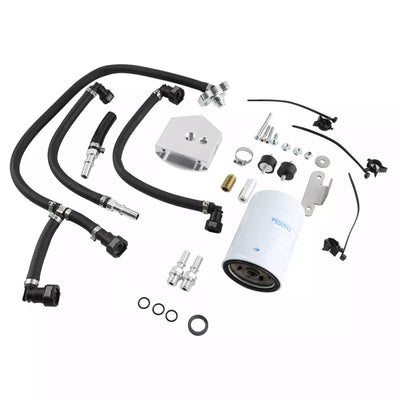
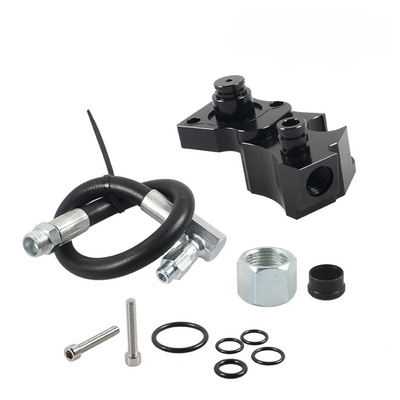
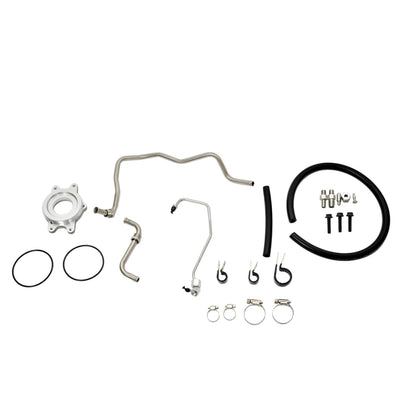
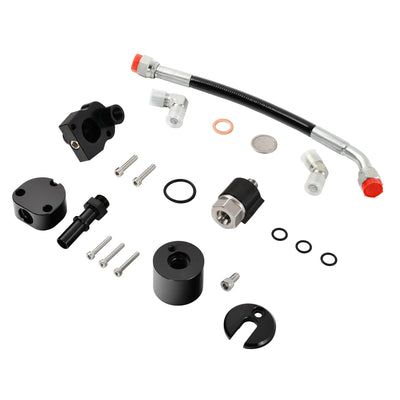

The Bosch CP4 injection pump in your 6.7 Powerstroke or LML Duramax can wipe out the entire fuel system when it lets go, and a full repair at dealer rates runs $10,000 to $15,000 once the tank and lines need flushing too. The cheapest insurance against that bill is not an additive.
A CP4 disaster prevention kit reroutes the pump's lubrication circuit through dedicated lines and a return filter so that when the pump grenades, the metal stays out of your injectors and rail. To be clear up front: it does not stop the pump from failing. What it does is turn a five-figure disaster into a pump and filter swap.
Start with the CP4 disaster prevention kit collection for the 6.7 Powerstroke and LML platforms. We mined three full install and Q&A videos plus two long owner threads to work out who should buy one, which kits actually hold debris, and how to install it right.
Table of Contents
- Key Takeaways
- What a CP4 Failure Actually Does to Your Fuel System
- How a CP4 Disaster Prevention Kit Works
- Installing the Bypass Kit: What the Job Involves
- CP4 Bypass Kit vs CP3 Conversion vs DCR Pump
- What Real Owners Say About Disaster Kits
- FAQ: Common CP4 Kit Questions
- Verdict: Is a CP4 Disaster Kit Worth It?
Key Takeaways
- The kit does not prevent pump failure. It contains it: a failed CP4 with a working kit means a new pump and filter, not the $10,000 to $15,000 injector, rail, and line replacement.
- Containment is proven, not theoretical. S&S drove a company truck roughly 70 miles, trailer in tow, on a deliberately failed CP4 protected by their kit; the return filter caught the metal and the metering valve came out clean.
- Kit brand matters. A diesel tech on r/powerstroke has seen two CP4 failures with the S&S kit installed and zero metal in the rail, and one fuel system loss with an SPE kit that let debris through.
- Inspect the metering valve before you install. If the inlet metering valve already shows metal, the pump is on its way out and the kit is too late to save the high-pressure side.
- Install is a 4 to 6 hour job. The intake manifold comes off, the FCA adapter torques to 60 in-lb, and a first-timer can finish it over a weekend.
- Failures have no mileage pattern. S&S reports seeing them from under 10,000 miles to past 500,000 miles, on pumps fed clean fuel and contaminated fuel alike.
- The fleet math is convincing. One former fleet mechanic on r/Diesel put kits on 60+ 6.7 Powerstrokes, and no dealer he dealt with voided a warranty over one.
What a CP4 Failure Actually Does to Your Fuel System
The CP4 is a common-rail injection pump that feeds the rail at roughly 30,000 psi. Unlike the older CP3, its cam, rollers, and plungers are lubricated by diesel fuel alone, never engine oil. US ultra-low-sulf diesel also carries less lubricity than this pump was designed around, which is why fuel quality keeps coming up as a factor.
The failure itself starts in the cam and roller section. A roller bearing skids, rotates sideways on the cam lobe, and grinds itself into shavings. As one r/Diesel commenter put it, the roller walks "because someone never thought to put a retainer in there." From there the debris feeds straight into the high-pressure side: injectors at roughly $600 apiece, the rails, the lines, and often the tank, all of which get replaced once metal circulates.
When a Bosch CP4 high-pressure pump starves of ultra-low sulfur diesel lubrication, metal-on-metal friction generates microscopic steel shavings that cycle back through the fuel rails and contaminate all eight fuel injectors. To review the mechanical breakdown sequence, early warning sign metal flakes, and full system flush procedures, read our deep-dive on 6.7 Powerstroke cp4 2 failure.
The bills back that up, and the spread is the entire business case for prevention:
- Independent diesel shops publish full-system CP4 repair ranges from $10,000 to $18,000.
- Dave's Auto Center calls a full CP4 failure "north of $10,000."
- A powerstroke.org member was quoted $12,684.65 for a complete fuel system, denied under warranty.
- One r/F250 owner documented a $13,000 failure at 47,000 miles, with Ford offering only half as goodwill.
- Caught before contamination spreads, the pump itself is a $1,200 to $2,000 part.
Ford pinned the roller buckets on 2020+ Power Strokes to address the skidding, and failures still occur, so newer does not mean immune. The CP4 also is not just a Ford problem: GM ran it on the 2011-2016 LML Duramax, and current Cummins pickups use one as well.
Shopping for a Disaster Prevention Kit?
The collection covers the 6.7 Powerstroke (2011-2022) and the LML Duramax, from budget bypass kits to the Gen2.1 CP4.2 design and a full CP3 conversion for the 6.6L.
Shop CP4 bypass kitsHow a CP4 Disaster Prevention Kit Works
Stock, the CP4 feeds its own lubrication circuit first, then crosses fuel to the high-pressure plungers internally. That crossover is the highway the shavings take into your injectors. A kit blocks it and splits the fuel into two dedicated paths:
Circuit |
Stock CP4 |
With a Kit |
|---|---|---|
High-pressure feed |
Fuel passes through the cam and roller section first |
Dedicated line straight to the plungers |
Lubrication return |
Drains back into the system and tank |
Routed through an external 10 to 20 micron return filter first |
Debris path |
Shavings feed straight into rail and injectors |
Caught in the return filter, never circulates |
The containment claims have real testing behind them. S&S failed the cam on one of their own CP4s, then drove the truck about 70 miles while towing to demonstrate the kit would isolate the damage. Their Gen 2.1 revision has zero verified failures to contain since release; the original version had a handful of instances where fuel escaped the circuit, which is why the redesign exists.
Not every product on the market does the same job. The Exergy fuel system saver is only a finer mesh screen around the metering valve rather than a full reroute, and owners report mixed results with generic Amazon kits. Whatever brand you buy, look for the two-line reroute with an external return filter, the design the videos above actually test.
Installing the Bypass Kit: What the Job Involves
Plan on 4 to 6 hours of shop time or a relaxed weekend in the driveway. The intake manifold has to come off to reach the pump, and that teardown is where most of the labor lives. Rather than re-walk every bolt here, we will cover the shape of the job and the moments that decide whether it goes smoothly.
Tools:
- Standard socket set
- T25 Torx
- 4mm ball-end Allen with extension
- Torque wrench
- Plastic trim tools
- Compressed air
- Borescope, optional, for checking the EGR cooler and breather while the intake is off
The job breaks into five chunks:
- Teardown: batteries off, fuel pressure relieved, turbo inlet and charge pipes out, EGR crossover and dipstick out, then the upper and lower intake.
- The moment of truth: pull the inlet metering valve (FCA) and inspect the screen for metal. Any glitter or graphite-colored residue means the pump is already failing, and no kit will save the high-pressure side.
- Adapter install: quantity valve adapter with fresh O-rings, lightly lubed, torqued to 60 in-lb with the supplied longer bolts.
- Reroute: mount the filter head, run the new feed and return hoses, and tee into the tank return. 2020+ trucks also reroute a hard line with a new fitting and clamp.
- Reassembly and checks: lower intake at 18 ft-lb, plastic manifold bolts at 89 in-lb in the factory sequence, filter fittings at 10 ft-lb, then prime and check for leaks.
Two gotchas from the videos:
- The crankcase breather hose clips are brittle on older trucks, so use trim tools instead of force.
- If the truck starts, stalls, and refuses to restart after the install, a speck of debris has likely seized the pump's outlet check valve. The S&S field fix: tap the high-pressure outlet with an extension and brass hammer while a helper cranks.
For the bolt-by-bolt sequence, our 12-step 6.7 Powerstroke install walkthrough covers the teardown stage by stage with every torque value. If you own a 2011-2014 truck, check fitment before you order: that generation's kit skips the hard-line reroute and trims about an hour off the job.
CP4 Bypass Kit vs CP3 Conversion vs DCR Pump
A bypass kit is damage control. If you want the pump itself out of the equation, there are two upgrade routes, and the right answer depends on your platform and budget.
Option |
Best For |
Key Spec |
Install Effort |
|---|---|---|---|
Budget CP4 bypass kit |
2011-2014 owners wanting containment at the lowest cost |
Two-line reroute plus external return filter |
Same intake-off job, 4 to 6 hours |
Gen2.1 CP4.2 bypass kit |
2011-2022 6.7 owners wanting the tested design |
Redesigned circuit, zero verified containment failures |
4 to 6 hours shop, weekend DIY |
CP3 conversion (LML Duramax) |
Duramax owners wanting the pump gone for good |
Replaces the CP4 with the earlier CP3 design on 2011-2016 LML |
Pump-swap level job |
DCR pump |
6.7 owners wanting a new pump, not a patch |
Stanadyne-based, about 2 years on market with a solid record |
Similar labor to a pump replacement |
The DCR route keeps winning technician endorsements: one r/powerstroke tech has installed a ton of them with zero failures, including trucks that got gassed and only needed a flush afterward. The Duramax crowd can reach the same peace of mind with an LML CP3 conversion instead of the Bosch CP4 design. To weigh those pump routes against each other in depth, our 6.7 Powerstroke CP4 replacement guide compares OEM, DCR, and CP3 options with the cost picture.
What Real Owners Say About Disaster Kits
The two threads we mined, r/Diesel's "Scared of cp4 failure" (47 comments) and r/powerstroke's "Is the CP4 bypass kit still recommended," line up on the big points and disagree only on how worried to be. If you are hunting the best CP4 bypass kit for a 6.7 Powerstroke 2011-2014 or 2020+ diesel disaster prevention kit, this is the closest thing to field data.
As u/ReaperVF, a former fleet mechanic on r/Diesel, put it: "Get a disaster prevention kit installed. In the event it does grenade you'll only be on the hook for the pump and a filter." He maintained a fleet of 60+ 6.7 Powerstrokes and fitted every one.
On whether the kits hold when it counts, u/DereLickenMyBalls on r/powerstroke was blunt: "The S&S disaster kit does work. I've had a couple CP4 failures with the S&S kit and both of them had no metal present in the rail." The same tech watched an SPE kit fail to contain debris, and he now recommends the DCR or the S&S kit specifically.
The limitation gets stated honestly too. As u/duddybuddy22 wrote: "The disaster prevention kit won't prevent your CP4 from failing, just catch the pieces before it gets into the rest of the system."
And the fear itself is contested. u/Bubba197969 runs two LML Duramaxes at 223,000 and 106,000 miles on stock CP4s: "Very few of these pumps fail. But the few that do give them a bad reputation." Another owner reported 300,000 miles on a stock CP4, while an outlier in the same thread saw three failures in a single year. The maintenance consensus beyond any kit, because most failures owners see trace back to water or DEF in the fuel:
- Run a lubricity additive like Opti-Lube in every tank.
- Change fuel filters every other oil change.
- Drain the water separator every oil change.
By redirecting contaminated bypass fuel through a sub-micron return filter back to the tank instead of the high-pressure fuel rail, a bypass kit isolates mechanical pump damage cleanly. To compare top-tier return line routing, dual-filter setups, and quick-connect fitting designs, explore our evaluation of the best CP4 disaster prevention kit options.
FAQ: Common CP4 Kit Questions
How does a CP4 disaster prevention kit work?
It blocks the CP4's internal crossover between the lubrication circuit and the high-pressure side, then reroutes the pump's return through an external 10 to 20 micron filter. When the pump fails, debris collects in the filter instead of your injectors, rail, and tank.
Will the kit stop my CP4 from failing?
No, and nobody credible claims it will. It localizes the damage. You still buy a pump (roughly $1,200 to $2,000) and a filter instead of a $10,000 to $15,000 full system.
How can it protect the 30,000 psi side if the pump sits upstream of everything?
The failure starts in the cam and roller section, not the plungers. The kit's dedicated feed line keeps that contaminated section from feeding the high-pressure side, so the shavings never make the trip. That is the same answer a former fleet tech gave when a user asked exactly this on r/Diesel.
What are the first signs of CP4 failure?
Usually there are none until it lets go. The practical early check is cutting open your fuel filter: glitter or graphite-colored fines on the pump side of the media mean the CP4 is shedding. Inspect the metering valve screen any time the intake is already off.
Will a CP4 bypass kit void my warranty?
No dealer or shop worth using will void a warranty over the kit itself, in the experience of the fleet mechanic in the r/Diesel thread. Note the separate reality that a CP4 failure itself may not be fully covered: one r/powerstroke owner had warranty pay only half his fuel system replacement.
Which kit should I buy: S&S, SPE, or a budget bypass kit?
The forum track record favors the two-line reroute design with an external return filter. The r/powerstroke tech's tally: two contained failures with S&S, one escaped failure with SPE, mixed results on generic Amazon kits. Whatever you buy, check the fitment years before ordering; the 2011-2014 and 2011-2022 designs differ.
Is CP4 failure really that common?
Owners disagree, honestly. The same thread contains a 300,000-mile stock CP4, two Duramaxes past 100,000 miles untouched, and a truck that ate three pumps in a year. Low odds, catastrophic stakes is the fair summary.
How long does installation take?
Shops book 4 to 6 hours because the intake comes off. First-time DIY owners should plan a weekend, plus a helper for the priming and leak check.
Verdict: Is a CP4 Disaster Kit Worth It?
If you keep the truck, yes. A CP4 disaster kit costs about the same as a couple hundred dollars against a five-figure worst day, installs in a weekend, and the containment record holds up in both manufacturer testing and owner-reported failures. If you are already replacing a failed pump on a 6.7, price the DCR path before you reinstall another stock CP4; on an LML Duramax, the CP3 conversion deserves the same look.
Whatever you choose, keep the maintenance side honest: lubricity additive in every tank, filters on schedule, and the water separator drained. The pumps that die young usually drank something they should not have. When you order, match the kit to your truck's years and buy the two-line reroute design, not the cheapest listing on the page.


