
⚡ 30-Second Summary: L5P Duramax Deleted and Tuned Horsepower
In 2026 dyno testing, the 6.6L L5P Duramax platform achieves impressive rear-wheel output once exhaust restrictions are removed and custom ECM calibrations are flashed. Expect reliable gains of 150 to 200+ rear-wheel horsepower over factory levels depending on the tune level (ranging from Street/Tow to Max Effort), along with sharper throttle response, reduced EGTs, and 2 to 5 MPG highway improvements. To safely handle high torque output, match your custom calibration map to your daily use case and install supporting fuel and transmission hardware. For complete bolt-on performance packages and high-flow hardware, EGR Performance provides precision-engineered L5P delete kits components built for competition and off-road reliability.
Table of Contents
- What Does a Deleted and Tuned L5P Make on the Dyno?
- L5P Delete HP Gains by Stage
- What Gets Deleted: Components That Unlock L5P Horsepower
- How Much HP Does a Deleted L5P Make on Stock Internals?
- Popular Tuners and Platforms for L5P Delete Tuning
- Supporting Mods That Maximize L5P Delete HP
- L5P Delete and Tune Cost vs. Horsepower
- Common Problems When Pushing L5P Delete Horsepower
- Frequently Asked Questions
- Conclusion
- A fully deleted and tuned L5P makes 550-600+ whp on a street tune - that's +150-240 whp over stock
- Max-effort builds on stock fuel and turbo have pushed past 640+ whp and 1,250+ lb-ft at the wheels
- The stock L5P bottom end has been proven to hold over 1,000 HP on an engine dyno (Banks Power testing)
- Stage 1 (tune only): ~500-530 whp; Stage 2 (delete + street tune): ~530-570 whp; Stage 3 (delete + race tune): ~570-640+ whp
- The Allison 10L1000 transmission becomes the limiting factor above 500-550 whp
- Full delete + tune costs range from $1,500-$3,500 DIY to $3,500-$9,500 professionally installed
If you're considering deleting and tuning your 2017-2026 Duramax L5P, the horsepower potential is probably the first thing you want to know. So how much HP does a deleted and tuned L5P make?
A deleted and tuned 2017-2023 L5P Duramax produces 545-600+ rear-wheel horsepower (RWHP) on a performance tune with documented pulls reaching 594 RWHP and 1,281 lb-ft of torque - well above the stock 380-400 RWHP baseline. Supporting mods and transmission tuning push reliable numbers to 650+ RWHP at the wheels. That's a gain of 165-200+ whp over stock, depending on your tune level and supporting modifications.
The L5P Duramax - GM's 6.6L V8 diesel found in 2017+ Chevy Silverado 2500/3500HD and GMC Sierra 2500/3500HD trucks - is the most powerful Duramax from the factory yet. But the emissions equipment strapped to it chokes its real potential. Removing the EGR, DPF, DEF, and SCR systems and reflashing the ECM with a custom calibration unleashes the engine's full output. The result is a truck that pulls harder, tows cooler, and puts down numbers that rival older modified Duramax platforms with far less effort.
In this guide, we break down the actual dyno results, explain what each component of a full delete contributes to the horsepower equation, and show you exactly what to expect from an L5P delete and tune - whether you're looking at a mild street setup or an all-out race build.
What Does a Deleted and Tuned L5P Make on the Dyno?
A properly deleted and tuned L5P produces 545-600+ horsepower depending on tune level and supporting hardware, with real dyno pulls reaching 594 RWHP and over 1,281 lb-ft of torque on the rear wheels.
Let's start with the numbers that matter - actual dyno results from real shops and tuners who have tested the L5P after a full delete and tune.
Unlock True L5P Horsepower and Reliability.
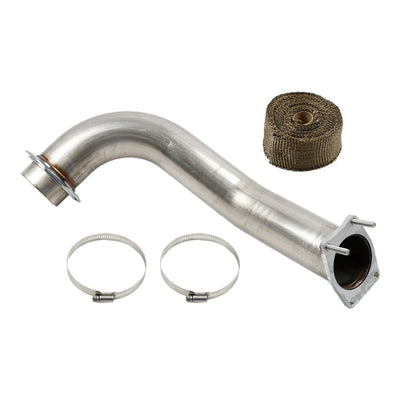
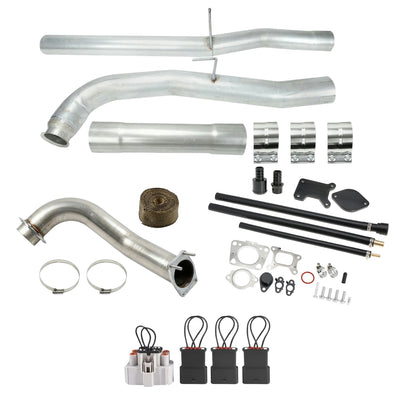
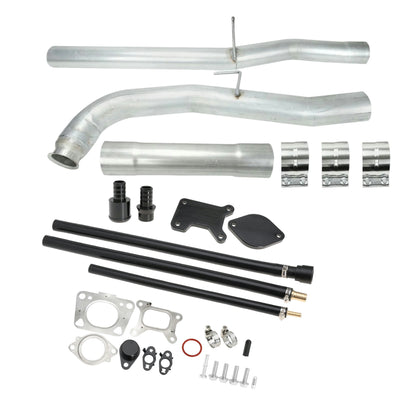
Stop letting clogged DPFs and restrictive factory emissions choke your L5P Duramax. Our Delete Kits from EGR Performance are precision-engineered for maximum exhaust flow, lower EGTs, and bulletproof off-road performance. Pair with proper tuning to unleash 600+ horsepower safely.
Shop L5P Delete Kits→L5P Stock Baseline Numbers
Before we talk gains, you need to know where you're starting from.
Here are the stock dyno numbers for the L5P by model year:
Model Year |
Stock Crank HP |
Stock Crank Torque |
Stock Wheel HP (Dynojet) |
|---|---|---|---|
2017-2023 L5P |
445 HP |
910 lb-ft |
~380-410 whp |
2024-2026 L5P |
470 HP |
975 lb-ft |
~410-420 whp |
Pushing stock L5P internals past 600 wheel horsepower begins testing the torque limits of the factory Allison 10L100 transmission and stock torque converter clutch. To review engine block structural updates, fuel injection pump pressures, and drivetrain limits across model years, explore our detailed 15p duramax guide.
Deleted and Tuned L5P Dyno Results
Here's what a deleted and tuned L5P actually puts down, based on shop dyno sheets and tuner data:
Shop / Source |
Setup |
Wheel HP |
Wheel Torque |
Notes |
|---|---|---|---|---|
PPEI |
"All Purpose" tune + Banks intake |
544 HP |
1,051 lb-ft |
Tow-safe calibration |
DuramaxTuner |
Top-level race tune |
595 HP |
1,180 lb-ft |
+150 whp over stock |
EGR Performance + Calibrated Power |
Stage 2 build, 2025 L5P |
603 HP |
- |
Full EGR Performance exhaust + tune |
Edge Pulsar / Insight |
Full delete + max race tune |
640+ HP |
1,250+ lb-ft |
Stock turbo and fuel |
Banks Power |
Built fuel + turbo, stock block |
1,004 HP |
- |
Engine dyno, not wheel |
By Tune Level (RWHP)
Tune Level |
Crank HP |
RWHP (Wheels) |
Torque (lb-ft) |
Primary Use |
|---|---|---|---|---|
Street / Eco |
545 |
450-470 |
950-1,000 |
Daily driving, best MPG |
Performance |
595 |
490-510 |
1,050-1,100 |
Towing and spirited driving |
Max Effort / Race |
645+ |
540-560 |
1,150-1,280+ |
Competition, max unloaded power |
The takeaway is consistent: a proper L5P delete and tune puts you in the 550-600+ whp range on pump fuel with a street-oriented calibration. If you push the tune harder, 640+ whp is achievable while still running the stock CP4 fuel pump and factory turbocharger.
Before putting down over 550 to 650 wheel horsepower on the rollers, unlocking the factory-encrypted engine control module is the necessary first step to allow custom parameter recalibration.
The real magic is the area under the curve. Deleted L5Ps make strong torque from 1,000 RPM and hold it longer because the factory torque management is gone. Towing 15,000 pounds up a 6% grade feels effortless compared with stock.
L5P Delete HP Gains by Stage
Stage 1 (EGR/DPF delete + basic tune) adds 100-150 HP. Stage 2 (full hardware support + transmission tuning) pushes past 500 RWHP. Stage 3 (tuned turbo and injectors) delivers 600+ RWHP.
Not every deleted L5P is built the same. The horsepower you get depends heavily on your tune level and how many supporting mods you've added. Here's how the typical stages break down:
Stage 1: Tune Only (No Delete)
Metric |
Result |
|---|---|
Wheel horsepower |
~500-530 whp |
Wheel torque |
~1,000-1,050 lb-ft |
Gain over stock |
+100-130 whp |
Emissions equipment |
Fully intact |
A tune-only L5P is surprisingly potent. The ECM recalibration alone adds significant power by increasing fuel delivery, boost pressure, and timing. You keep all emissions equipment, so this is the most legally straightforward option. The tradeoff is that the DPF still restricts exhaust flow, and the truck still goes through regeneration cycles, which interrupts power delivery.
Stage 2: Full Delete + Street Tune
Metric |
Result |
|---|---|
Wheel horsepower |
~530-570 whp |
Wheel torque |
~1,100-1,200 lb-ft |
Gain over stock |
+140-180 whp |
Supporting mods |
None required (optional exhaust, intake) |
This is where the L5P Duramax delete HP gains really start to show. A full EGR, DPF, DEF, and SCR delete combined with a moderate street tune gives you a truck that's dramatically more responsive, eliminates regeneration cycles, and drops EGTs significantly. Most daily-driven deleted L5P trucks fall into this category.
Stage 3: Full Delete + Race Tune
Metric |
Result |
|---|---|
Wheel horsepower |
~570-640+ whp |
Wheel torque |
~1,200-1,300+ lb-ft |
Gain over stock |
+180-260+ whp |
Supporting mods |
Recommended: lift pump, exhaust, downpipe |
A max-effort L5P delete tune pushes the stock turbo and fuel system to their limits. SPE Tuner has documented 640+ whp on a fully deleted L5P with the factory CP4 and turbo still in place. At this level, you should consider a FASS or AirDog lift pump, a CP3 conversion, and upgraded transmission components to handle the power reliably.
What Gets Deleted: Components That Unlock L5P Horsepower
Deleting the EGR valve, DPF, and DEF/SCR system is the foundation of every high-horsepower L5P build. These components create massive restriction and torque management.
Understanding what each deleted component contributes to the power equation helps you decide what's worth doing. Here's a breakdown:
Component |
What It Does |
HP Impact of Removal |
|---|---|---|
EGR System |
Recirculates exhaust gas back into intake |
Frees up intake flow, reduces soot contamination |
DPF (Diesel Particulate Filter) |
Traps soot in a honeycomb filter |
Eliminates backpressure, removes regeneration cycles |
SCR/DEF System |
Injects urea to reduce NOx emissions |
Removes exhaust restriction, frees up exhaust flow |
DOC (Diesel Oxidation Catalyst) |
Oxidizes CO and hydrocarbons |
Opens up exhaust diameter at the downpipe |
The single biggest horsepower unlock comes from the tune itself - the ECM recalibration is what actually adds fuel and boost. But the delete hardware is what allows the engine to breathe freely enough to make that additional power efficiently and safely. Without the deletes, the DPF creates enough backpressure to limit how much power the tune can safely produce.
CAN BUS Protection
Open connectors from deleted components are prone to corrosion. We always recommend a high-quality CAN BUS plug kit. It seals the connections and prevents electrical issues that can throw codes or cause limp mode.
These three deletes combined with the ECM unlock are what turn the L5P into a 550+ HP truck. Anything less and the gains stay modest.

For 2020-2022 6.6L Duramax L5P owners, check this 2020-2022 L5P CAN Bus Plugs.
How Much HP Does a Deleted L5P Make on Stock Internals?
On stock internals with a full delete and tuned tune, a 2017-2023 L5P reliably makes 550-650+ RWHP. The Denso HP4 injection pump and robust bottom end support these numbers without major upgrades.
This is one of the most frequently asked questions in the Duramax community, and the answer might surprise you. The L5P's stock bottom end is remarkably robust.
Banks Power systematically tested a stock L5P Duramax to destruction in their "Killing a Duramax" series. The result? 1,004 HP on the engine dyno - with the factory block, crankshaft, connecting rods, and pistons all still in place. The stock bottom end held together at power levels far beyond what any street-driven truck would ever see.
Here's where the real limitations lie:
Component |
Approximate Limit |
What Happens |
|---|---|---|
Stock CP4 fuel pump |
~550-600 whp |
Runs out of fuel volume; rail pressure drops |
Stock injectors |
~600 whp |
Duty cycle maxed out; can't deliver more fuel |
Stock turbocharger |
~550-700 whp |
Compressor maxed at ~135,000 rpm (Banks testing) |
Stock bottom end |
1,000+ HP |
Proven by Banks Power; not the weak link |
Stock Allison 10L1000 |
~500-550 whp |
Starts slipping; torque converter is weak point |
When you're looking at L5P deleted and tuned horsepower, the engine itself is not your concern. The fuel system, turbo, and transmission will all run out of capacity before the bottom end shows any signs of stress. For builds targeting 550-600 whp, the stock bottom end is more than adequate.
Popular Tuners and Platforms for L5P Delete Tuning
The best platforms for L5P delete tuning are EZLynk, EFI Live with AutoCal, and HP Tuners with custom files. These tools unlock the ECM and deliver proven calibrations that support 550+ HP reliably.
The tuner you choose has a direct impact on the horsepower your deleted L5P produces. Not all tunes are created equal - calibrators differ in how aggressively they push fuel, timing, and boost.
Tuner / Platform |
Years Supported |
Key Details |
|---|---|---|
HP Tuners (MPVI3 / RTD4) |
2017-2026 |
Dominant L5P platform; requires ECM unlock |
EFI Live (Autocal V3) |
2017-2023 |
Limited L5P support; not available for 2024+ |
EZ Lynk |
2017-2023 |
Cloud-based tuning delivery |
Edge Products EZ Module |
2017-2025 |
Plug-and-play; ~80-90 HP gain, no ECM unlock needed |
Trusted calibrators who build the actual tune files:
PPEI (Power Performance Enterprises Inc.)
Industry standard led by Kory Willis, renowned for consistent, reliable power delivery and safe, tow-ready calibrations designed for seamless drivability.
DuramaxTuner / Calibrated Power
Specialists in advanced custom ECM calibrations for platforms like the L5P, documented to push up to 595 wheel horsepower while maintaining strict emissions compliance.
Edge Products
Widely known for high-performance inline modules (such as the Pulsar) and Insight monitors, focusing on safe, emissions-compliant power upgrades for daily driving and towing.
Banks Power
A legendary name in the diesel performance community. Their Derringer inline tuner is highly praised for real-time OBD-II monitoring and built-in ActiveSafety safeguards to protect both the engine and transmission under heavy loads.
Supporting Mods That Maximize L5P Delete HP
Cold air intake, high-flow downpipe, CCV reroute, and TCM tuning push reliable power past 600 RWHP while keeping EGTs manageable.
A deleted and tuned L5P can make great power on its own, but supporting modifications help you push further and do it more reliably. Here are the mods that matter most:
Modification |
Purpose |
Price Range |
HP Impact |
|---|---|---|---|
FASS/AirDog Lift Pump |
Better filtration, stable rail pressure |
$400-$800 |
Supports tunes above 500 whp |
|
CP3 Conversion Kit (S&S Diesel)
|
Replaces CP4, increases fuel volume |
$1,000-$1,650 |
Required past ~600 whp |
5" Straight Pipe Exhaust |
Maximum exhaust flow |
$300-$800 |
Supports all power levels |
3.5" Downpipe |
Frees up post-turbo flow |
$200-$500 |
|
|
Cold Air Intake (S&B, Banks)
|
Improved airflow |
$250-$400 |
~10-20 whp on tuned trucks |
Transmission Build |
Holds elevated power |
$3,000-$6,000+ |
Required above 550 whp |
Triple-Disk Torque Converter |
Prevents converter slip |
$800-$1,500 |
Required above 550 whp |
To sustain peak horsepower during extended dyno runs without thermal throttling, upgrading the restrictive cast intake horn and installing a high-flow cold air intake is vital.
Intake Gains: A quality cold air intake (S&B or K&N) reduces intake air temperature by 20-30 F and adds 10-20 HP on a tuned truck while lowering EGTs under hard acceleration.
The EGR Performance L5P performance parts collection provides the foundation, but these supporting mods are what take a deleted L5P from "strong" to "unreal." Discover top-rated airflow upgrades, transmission coolers, and durability components in our guide to the best l5p upgrades.
L5P Delete and Tune Cost vs. Horsepower
A complete L5P delete and tune package costs $3,300-$4,800 and delivers 550-650 RWHP. The return on investment is measured in performance, MPG, and daily drivability.
Understanding the cost-to-power ratio helps you decide how far to take your build:
| Setup | Typical Cost | Wheel HP | Cost per Added HP |
|---|---|---|---|
| Stock L5P | - | ~380-420 whp | Baseline |
| Tune only (no delete) | $500-$1,200 | ~500-530 whp | ~$6-10/HP |
| Full delete + street tune (DIY) | $1,500-$3,500 | ~530-570 whp | ~$8-15/HP |
| Full delete + street tune (shop) | $3,500-$7,500 | ~530-570 whp | ~$18-30/HP |
| Full delete + race tune + supporting mods | $5,000-$12,000 | ~600-640+ whp | ~$15-25/HP |
| Max effort (built trans, CP3, turbo) | $15,000-$25,000+ | ~700-1,000+ HP | ~$25-40/HP |
The 2024-2026 L5P delete costs are significantly higher due to the E42 ECM unlock requirement, with some owners reporting $7,000-$9,500 for a full shop-installed delete and tune.
ECM unlock and basic tune: $1,200-$2,000
EGR and DPF delete kit: $400-$1,200
CAN BUS protection: $150-$300
High-flow exhaust and supporting parts: $800-$1,500
TCM tuning: $400-$600
Total: $3,300-$4,800 for a package making 550-600 RWHP.
The 2024-2026 L5P trucks use the E42 Global B ECM, which requires a physical ECM removal and mail-in unlock service. This adds cost and complexity compared to the 2017-2023 trucks, which use the easier-to-unlock E41 ECM. For more details, see our guide on the cost to delete an L5P Duramax.
Common Problems When Pushing L5P Delete Horsepower
Common problems after delete and tune include clutch slip, high EGTs, and black smoke. Proper transmission tuning and supporting mods prevent 95% of these issues.
Going fast isn't free. Here are the issues that come up most often when pushing a deleted and tuned L5P to its limits:
CP4 Fuel Pump Failure
The factory CP4 high-pressure fuel pump has a documented 5-7% failure rate. When it fails, metal debris contaminates the entire fuel system - injectors, rails, lines, and tank - often resulting in an $8,000-$12,000+ repair bill. A FASS or AirDog lift pump with proper filtration, along with fuel lubricity additives, is cheap insurance.
Allison 10L1000 Transmission
Above 500-550 whp, the stock Allison transmission starts to slip. The torque converter is the primary weak point. Custom transmission tuning (increased line pressure) helps, but for sustained high-power use, a triple-disk converter and upgraded clutch packs are necessary.
2024+ ECM Unlock Complexity
The 2024-2026 L5P uses the E42 Global B ECM, which cannot be unlocked via the OBD2 port like the older E41. You must physically remove the ECM and send it in for an unlock service (24-72 hour turnaround). This adds cost and downtime to the delete process.
Turbo and Cooling Considerations
At elevated power levels, the stock turbo operates closer to its surge line, and coolant system capacity can become marginal under sustained heavy towing. Monitoring EGTs and boost pressure becomes more important the further you push the tune.
Frequently Asked Questions
How much HP does a deleted and tuned L5P make?
A fully deleted and tuned L5P Duramax typically produces 550-600+ whp on a street performance tune. Max-effort builds on stock fuel and turbo have been documented at 640+ whp. On an engine dyno with supporting fuel and turbo modifications, the stock L5P block has produced over 1,000 HP.
What's the max HP on a completely stock L5P engine?
Banks Power proved the stock L5P bottom end holds over 1,000 HP on an engine dyno. The limiting factors are the fuel system (CP4 pump, injectors), turbocharger, and transmission - not the engine block, crank, rods, or pistons.
Does the 2024+ L5P make more power when tuned?
Almost identical peak numbers to 2017-2023 models because the turbo is the limiting factor.
Is 600 HP safe on a stock L5P?
The engine can handle it, but the transmission cannot. The stock Allison 10L1000 is safe to about 500-550 whp. Above that, you need a triple-disk torque converter and upgraded clutch packs at minimum. The stock CP4 fuel pump also becomes a liability above 550 whp.
What happens if I skip TCM tuning on a 2020+ L5P?
Clutches will slip under hard throttle. Expect transmission failure within a few thousand miles.
Do I need head studs for a 650 RWHP L5P?
No. The L5P bottom end is extremely strong. Head studs become necessary only after 700+ RWHP with a big turbo.
Do I need a lift pump upgrade to reach 600 RWHP?
No. The factory system supports it comfortably. A lift pump becomes necessary only for 700+ HP competition builds.
What's the best tuner for a deleted L5P?
HP Tuners (MPVI3 or RTD4) is the dominant platform for L5P tuning. For calibrations, PPEI and DuramaxTuner are consistently the most recommended, with SPE Tuner being the go-to for max-effort builds.
How much does it cost to delete and tune an L5P?
DIY full delete + tune runs $1,500-$3,500 in parts. Professionally installed, expect $3,500-$7,500 for 2017-2023 trucks and $5,000-$9,500 for 2024-2026 trucks due to the more complex ECM unlock process.
Can you daily drive a deleted L5P?
Many owners do. A deleted and tuned L5P on a moderate street tune (530-570 whp) makes an excellent daily driver. The elimination of regeneration cycles, reduced EGTs, and improved throttle response actually improve the driving experience. The main considerations are legal compliance and emissions testing in your state.
Will my fuel economy drop on the max-effort tune?
No if you keep the pedal light. Many owners see better highway MPG on the highest tune because injection timing is optimized.
Is an aftermarket cold air intake necessary?
Not required, but it adds measurable power and lower EGTs. The factory intake already flows well.
Does a 5-inch exhaust make more horsepower than 4-inch?
No noticeable gain until you exceed 650 RWHP. A 4-inch system is plenty for 550+ HP.
Conclusion
So what kind of horsepower can you expect from a deleted and tuned L5P? On a street tune with a full delete, 550-600 whp is the realistic target - a gain of roughly 150-240 whp over stock. Push the tune to max effort and you'll see 640+ whp while still running the factory turbo and fuel pump. And if you're willing to upgrade the fuel system, turbo, and transmission, the stock L5P block has been proven to hold over 1,000 HP.
A deleted and tuned L5P Duramax makes serious horsepower - 550-650+ RWHP is the new normal in 2026 with the right setup. The platform responds exceptionally well to the delete, ECM unlock, and custom calibration.
The L5P Duramax is, without question, the most capable platform GM has ever put in a heavy-duty truck. A full delete and tune unlocks its full potential while simultaneously improving reliability by eliminating the most failure-prone emissions components. Whether you're towing heavy, building a street truck, or chasing dyno numbers, the L5P has the foundation to deliver.
550-600+ whp on street tune (full delete)
640+ whp on max-effort tune (stock fuel/turbo)
1,004 HP proven on stock bottom end (engine dyno)
150-240+ whp gain over stock
Allison transmission safe to ~500-550 whp
$1,500-$3,500 DIY / $3,500-$9,500 shop installed
Ready to get started? Check out the EGR Performance L5P delete kit collection for everything you need, or read our guide on the best L5P delete kits for 2026 to find the right setup for your truck.