
⚡ 30-Second Summary: LMM Duramax EGR Delete Guide (2007.5–2010)
Performing a full EGR delete on a 2007.5–2010 LMM Duramax eliminates failure-prone cooler clogging, prevents oily soot buildup inside the intake manifold, and lowers Exhaust Gas Temperatures (EGTs) by 100°F to 200°F under heavy towing loads. Expect a complete DIY installation to take 7 to 11 hours due to tight firewall clearances around the up-pipe and intake bridge. Installing a precision-engineered EGR Performance LMM EGR delete kit ensures leak-free fitment, full boost retention, and restored long-term reliability.
The 6.6L LMM Duramax shares its basic engine architecture with the legendary LBZ-but GM saddled it with an EGR system that recirculates hot, soot-laden exhaust gas back into the intake. Over time, that carbon coats the intake manifold, chokes airflow, and stresses the cooling system. Worse, the EGR cooler is one of the most common failure points on the LMM, and when it cracks, coolant ends up where it shouldn't be.
Deleting the EGR on an LMM Duramax is a complete off-road modification that removes the EGR cooler and valve while blocking off the exhaust and intake ports. It requires specific year-matched hardware, a custom ECM tune, and strict adherence to off-road-only legality.
In this guide, we cover the lmm EGR delete instructions for the LMM: what the system does, why it fails, what you need to delete it, and how to install it. Everything here applies to the 2007.5-2010 Chevrolet Silverado 2500/3500 and GMC Sierra 2500/3500 equipped with the 6.6L LMM Duramax.
Table of Contents
- What Is the EGR System on an LMM Duramax?
- Why LMM Owners Delete the EGR
- What You Need to Delete the EGR on an LMM
- LMM EGR Delete Installation: Step-by-Step
- What to Expect After the EGR Delete
- Common Problems After EGR Delete (and How to Fix Them)
- EGR Delete vs. Full Delete (EGR + DPF)
- Frequently Asked Questions
- Parts You Need from EGR Performance
- A full LMM Duramax EGR delete takes 7-11 hours for most DIY installs.
- It eliminates cooler clogging, reduces EGTs by 100-200F under load, and restores factory-like power and reliability.
- Use only EGR Performance kits for perfect fitment.
- Legal solely for off-road or competition use.
What Is the EGR System on an LMM Duramax?
The LMM Duramax EGR system recycles hot exhaust gas into the intake to lower combustion temperatures and meet emissions standards. A liquid-cooled EGR cooler sits on the passenger side of the engine, connected by short and long pipes to the EGR valve and throttle body. The system includes the EGR cooler, EGR valve, sensors, and associated vacuum lines. Over time soot restricts the cooler, raising temperatures and risking engine damage.

Introduced midway through the 2007 model year, the LMM platform combined the structural enhancements of the LBZ with newly mandated emissions hardware, including an updated EGR cooler and factory particulate filter. To see how the LMM compares against earlier mechanical designs and later electronic platforms in terms of longevity and tuning overhead, explore our guide on the best duramax engine years.
The Exhaust Gas Recirculation (EGR) system reduces nitrogen oxide (NOx) emissions by routing a portion of the engine's exhaust back into the intake manifold. Less oxygen in the cylinder means lower peak combustion temperatures, which means fewer NOx emissions out the tailpipe. The tradeoff: less power, higher under-hood temperatures, and a steady stream of soot being dumped into your intake.
On the LMM, the EGR system includes:
- EGR valve - electronically controlled by the ECM; meters how much exhaust gas enters the intake. Held in place by two bolts between the EGR cooler and intake manifold.
- EGR cooler - a liquid-to-gas heat exchanger that cools recirculated exhaust from roughly 1,000F down before it reaches the intake. Mounted on the passenger side of the engine, held by six bolts.
- EGR cooler bypass valve - an LMM-specific component (not present on the LBZ). Allows exhaust to skip the cooler during cold starts so the engine reaches operating temperature faster. The ECM actively monitors this valve.
- EGR temperature sensors - two sensors on the passenger side of the cooler that measure post-cooling gas temperature.
- Differential pressure sensor - calculates EGR flow volume based on pressure differential.
- EGR feed pipe - routes exhaust gas from the exhaust manifold/up-pipe to the cooler.
- EGR transfer pipe - routes cooled exhaust from the EGR valve into the intake manifold.
The ECM controls EGR flow based on engine load, RPM, throttle position, and coolant temperature. All sensors feed data back to the ECM for real-time adjustment.
Why LMM Owners Delete the EGR
LMM owners delete the EGR to stop cooler clogging, lower EGTs, and improve reliability under heavy towing or competition. Soot buildup on the cooler core forces exhaust gas through smaller openings, raising temperatures by 100-200°F. This leads to overheating, head gasket failures, and injector damage. Deletion removes the entire cooler and pipes, eliminating the restriction source.
1. EGR Cooler Failure
This is the number-one reason. The EGR cooler endures extreme thermal cycling-exhaust gases at over 1,400F against coolant at roughly 200F. Over time, the internal tubes crack. When that happens, coolant leaks into the exhaust or intake. Symptoms look like a blown head gasket: low coolant, white smoke, milky oil. In severe cases, the engine can hydro-lock. A dealer EGR cooler replacement runs $2,000-$3,500.
2. Carbon Buildup in the Intake
Soot-laden exhaust gases recirculate continuously through the intake manifold, EGR valve passages, and intercooler. Over 50,000-100,000 miles, this carbon restricts airflow by up to 30-40%, reducing power, increasing turbo lag, and progressively choking the engine. Cleaning the intake costs $150-$300 and has to be repeated regularly.
3. Lower Exhaust Gas Temperatures
Hot exhaust gases reintroduced into the intake raise combustion temperatures under load. Deleting the EGR typically drops EGTs by 100-200F at full throttle. If you tow heavy, this matters-lower EGTs mean less thermal stress on the turbo, pistons, and head gaskets.
4. Cleaner Oil and Longer Engine Life
Without soot being pumped back into the intake, oil stays cleaner longer. Less carbon contamination means fewer hot spots, less ring wear, and reduced risk of injector tip buildup.
5. Better Throttle Response
Removing the EGR system eliminates the restrictive factory intake elbow and allows the turbo to breathe clean air. Throttle response sharpens and turbo spool improves, especially with the high-flow intake pipe included in most delete kits.
What You Need to Delete the EGR on an LMM
To delete the EGR on an LMM Duramax you need the complete EGR Performance kit, metric tools, coolant equipment, and safety gear. The kit includes exhaust and intake block-off plates, coolant block-off plate, reroute hose, and all hardware.
An EGR delete is more involved than a DPF delete because it requires removing components from the top and side of the engine, not just the exhaust underneath. Here is what you need.
EGR Delete Kit (Hardware)
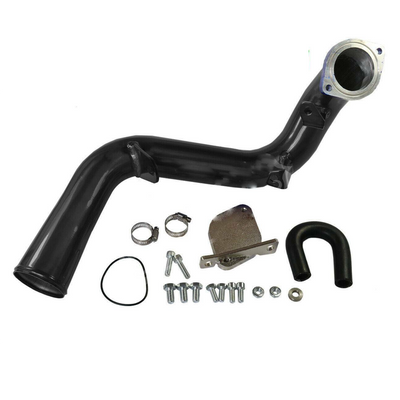
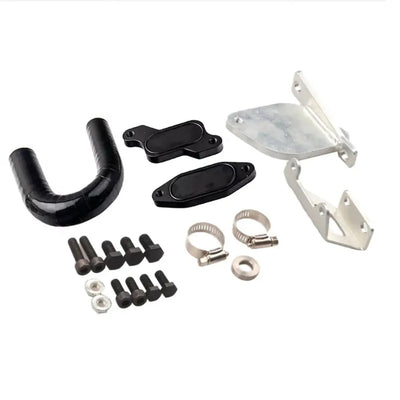
A complete LMM EGR delete kit typically includes:
- Exhaust block-off plate - seals the exhaust port where the EGR feed pipe connected to the up-pipe.
- High-flow intake charge pipe - replaces the restrictive factory cast intake elbow, improving airflow by up to 35%.
- "U" shaped coolant bypass tube - connects the two firewall coolant ports together, routing coolant around where the EGR cooler used to be.
- Support bracket - supports the block-off plate assembly.
- Gaskets, O-rings, and mounting hardware - M8 and M10 bolts, hose clamps, washers.
Some kits also include a replacement passenger-side up-pipe, which eliminates the factory up-pipe's EGR feed port entirely for a cleaner install and better exhaust flow.

Tuning (Required)
You cannot run an LMM with the EGR deleted without a proper tune. The ECM expects signals from the EGR valve, EGR cooler bypass valve (LMM-specific), temperature sensors, and pressure sensor. Without a delete-capable tune, you will get a Check Engine Light, DTC codes (P0401, P0402, P0404, P0405), and likely limp mode.
Tuning options for the LMM:
- EFI Live - the gold standard for Duramax tuning. Highly customizable with multiple power levels. Requires a FlashScan V2 device and custom tunes from a Duramax tuner. Handles EGR disable, DPF disable (if applicable), and power calibration in one package.
- Mini Maxx V1 /V2 - standalone tuner with pre-loaded LMM delete tunes. Easy to use with built-in gauges for monitoring EGTs and boost.
- Edge Race Evo - another standalone option with EGR and DPF delete capability for the LMM.
Tools Required
- Socket set (8mm, 10mm, 13mm, deep and shallow)
- Wrench set
- Flathead and Phillips screwdrivers
- Pliers
- Torque wrench
- Coolant catch pan
- Penetrating oil (PB Blaster or equivalent)
- Anti-seize compound
- Jack stands or vehicle lift
- Safety glasses and gloves
Optional but Recommended
- DPF delete pipe - many LMM owners do the EGR and DPF delete together. The labor does not overlap much, but doing both at once means you only load the tune once.
- PCV/CCV reroute kit - redirects crankcase ventilation away from the turbo intake. Reduces oil buildup in the intercooler and intake manifold.
- Replacement up-pipe - replaces the factory passenger-side up-pipe that originally fed exhaust to the EGR cooler. Gives a cleaner exhaust path and eliminates a potential leak point at the EGR feed port.
LMM EGR Delete Installation: Step-by-Step
LMM EGR delete installation follows these steps: prepare safety, remove intake for access, disconnect sensors and vacuum, reroute coolant, remove EGR pipes and cooler, install block-off plates, reassemble, refill coolant, bleed system, tune ECM, start and check.
Plan for 3-5 hours if you have done it before, or 5-7 hours your first time. The job is not technically difficult, but access is tight on the passenger side of the engine. Having a helper makes it easier.
Step 1: Prepare the Truck
- Let the engine cool completely.
- Disconnect both batteries (negative terminals first).
- Drain the engine coolant: remove the passenger-side inner wheel well and disconnect the lower radiator line just enough to let coolant flow out. Catch it in a drain pan. Once flow slows and the overflow bottle is empty, reconnect the line.
- Soak all exhaust fasteners with penetrating oil. Give it 15-20 minutes to work.
Step 2: Remove the Intake and Turbo Mouthpiece
- Loosen the hose clamps on the intake tube and disconnect the MAF sensor connector.
- Remove the intake tube from the air filter to the turbo mouthpiece.
- Remove the air box and filter (pry out the three rubber grommets).
- Remove the resonator box on top of the engine (loosen the hose clamp at the base plus remove the long bolt at the front).
- Disconnect the PCV tubes from both valve covers and the turbo mouthpiece.
- Remove the plastic turbo mouthpiece (loosen the hose clamp to the turbo).
Step 3: Remove the Cast Intake and Intercooler Piping
- Disconnect the charge-back wire on the alternator and remove the plastic clip holding the wiring harness.
- Open the plastic housing on top of the intake heater grid and disconnect the power wire.
- Remove the two bolts and one nut securing the plastic wireway.
- Disconnect the wire connector on the front of the intake heater grid.
- Pop out the metal retaining clip on the plastic intercooler piping and disconnect it from the cast aluminum section.
- Remove the four bolts (plus one underneath for the support bracket) holding the forward cast intercooler piping.
- Remove the forward intercooler piping, butterfly valve, and hard plastic tubing. Cover the flexible boot with a bag to keep debris out.
- Remove the four nuts and two bolts holding the main section of the cast intake. Two bolts are on the back side-they may be easier to reach with a swivel socket.
Step 4: Remove the EGR Cooler
- Remove the two temperature sensors from the passenger side of the EGR cooler.
- Disconnect all coolant lines running to the EGR cooler.
- Remove the six bolts holding the EGR cooler: four at the back (two facing forward, two facing downward) and two rear-facing bolts at the front.
- Carefully pull the EGR cooler out. It is bulky-take your time and watch for residual coolant.
- Disconnect the temperature sensor electrical connectors and remove the sensors from the vehicle.
- Remove the EGR valve (two bolts). Keep the factory gasket for the block-off plate.
- Remove the coolant lines that previously ran from the EGR cooler to the firewall.
Step 5: Install the Delete Kit
- Install the exhaust block-off plate using the factory gasket and the supplied hardware. Two M8 bolts from the back, one M10 bolt for the support bracket. Torque to spec.
- Install the "U" shaped coolant bypass tube using the supplied hose clamps. This connects the two firewall coolant ports that previously fed the EGR cooler.
- Remove the plastic cover from the wiring harness and tuck it under the new charge pipe.
- Install the new high-flow intake charge pipe. Slide it into the rubber boot first, then bolt the flanged end.
- Transfer the pressure sensor from the stock charge pipe to the new one (rotate the mounting bracket 180 degrees).
- Reconnect the charge-back wire to the alternator.
- Install the intake resonator box and secure with the hose clamp and long bolt.

Step 6: Reassemble and Refill
- Reinstall the air intake and plug in the MAF sensor.
- Refill coolant through the overflow bottle.
- Reconnect both batteries.
Step 7: Tuning
- Plug your tuner into the OBD-II port.
- Follow the tuner's instructions to load the EGR-delete (and DPF-delete, if applicable) tune for the LMM.
- The tune must account for the EGR cooler bypass valve-this is unique to the LMM and not present on the LBZ. A quality tuner handles this automatically.
- The flash typically takes 5-15 minutes.
- Once complete, clear any stored codes.
Step 8: Start and Verify
- Start the engine and let it idle for 3-5 minutes.
- Check for coolant leaks at all connections, especially the bypass tube at the firewall.
- Check for exhaust leaks at the block-off plate.
- Look for warning lights on the dash. With the tune loaded correctly, there should be no Check Engine Light.
- Check coolant level again after driving 50-100 miles. Air trapped in the system may cause the level to drop-top off as needed.
Torque Specifications
Fastener |
Torque |
|---|---|
Up-pipe flange bolt (EGR cooler) |
18 lb-ft |
Exhaust manifold bolt/nut |
42 lb-ft |
Exhaust manifold heat shield bolts |
89 lb-in |
Exhaust outlet clamp |
11 lb-ft |
Exhaust pipe bracket nut |
39 lb-ft |
What to Expect After the EGR Delete
After deletion the truck runs smoother, with lower EGTs and better power delivery. Expect improved towing and reduced soot in the intake. The delete is off-road only. Monitor for any issues and maintain the truck.
Eliminate Soot and Thermal Fatigue on Your LMM.
Stop letting hot, abrasive exhaust gases choke your intake manifold and threaten your coolant system. Our LMM EGR Delete Kits from EGR Performance are precision-engineered for an exact OEM-plus fit, utilizing heavy-duty block-off plates, high-temp gaskets, and robust coolant routing built to handle extreme off-road and competition workloads.
Shop LMM EGR Delete Kits→Engine Bay
The engine bay will be noticeably cleaner without the EGR cooler and all its associated plumbing. The new high-flow intake charge pipe opens up the top of the engine and makes future maintenance easier.
EGTs
Exhaust gas temperatures drop 100-200F under load, depending on driving conditions and whether you also deleted the DPF. For towing, this is the most tangible benefit-lower EGTs mean you can pull grades with less thermal stress on the turbo and head gaskets.
Throttle Response
The engine breathes cleaner air without the EGR system dumping exhaust gas into the intake. Turbo spool is faster and throttle response is sharper, particularly off-idle and at partial throttle.
Fuel Economy
EGR delete alone typically yields a 1-2 MPG improvement. Combined with a DPF delete and tuning, LMM owners commonly report 2-5 MPG improvement in combined driving.
Maintenance
No more EGR cooler to crack. No more carbon buildup in the intake. No more recurring intake cleaning service. Your oil stays cleaner because soot is no longer recirculated through the engine.
Completing a full top-end hardware overhaul is the perfect opportunity to perform routine fluid maintenance, ensuring no foreign carbon soot or stray coolant contaminates your oiling system. Before refilling your crankcase with fresh heavy-duty diesel oil, verify exact oil specs, filter capacities, and viscosity ratings in our 6.6 duramax oil capacity reference.
Common Problems After EGR Delete (and How to Fix Them)
Common problems after LMM EGR delete include coolant leaks at O-rings or clamps, Check Engine Lights, and intake leaks. Fix by reseating O-rings, verifying tunes, and cleaning block-off plates.
Check Engine Light - P0401, P0402, P0404, P0405
- Cause: EGR-related DTCs that were not properly disabled in the tune. The LMM ECM monitors the EGR valve, EGR cooler bypass valve, temperature sensors, and pressure sensor.
- Fix: The tune must include comprehensive EGR DTC disables for all LMM-specific sensors. Contact your tuner provider with your ECM OS number and request an updated file if codes persist.
Coolant Leak at Firewall
- Cause: The "U" shaped bypass tube is kinked, improperly routed, or the hose clamps are not tight.
- Fix: Inspect the bypass tube routing. Ensure the clamps are positioned correctly and tightened. If the tube is kinked, replace it-do not try to straighten a kinked tube.
Low Coolant Level After Driving
- Cause: Trapped air in the cooling system. Air pockets work their way out over the first few heat cycles.
- Fix: Top off the coolant at the overflow bottle. Check the level after 50 miles, 100 miles, and 500 miles. It should stabilize after the first few drives.
Exhaust Smell in Engine Bay
- Cause: The block-off plate is not seated properly against the exhaust manifold, or the factory gasket was damaged during removal.
- Fix: Remove the block-off plate, clean both mating surfaces, install a new gasket, and retorque the bolts to specification.
Limp Mode / Reduced Power
- Cause: The ECM is detecting missing EGR signals and reverting to a protection mode. The delete tune is not active or did not fully flash.
- Fix: Reload the tune. Verify the tuner firmware is current. Some late-2010 LMM trucks have different ECM software versions that require updated tune files.
EGR Delete vs. Full Delete (EGR + DPF)
EGR delete targets only the EGR system. Full delete removes EGR, DPF, and DEF. Choose based on your off-road goals.
Can you delete the EGR only, without touching the DPF? Technically yes-with a tune. But most LMM owners do both at the same time. Here is how the two compare:
Factor |
EGR Delete Only |
Full Delete (EGR + DPF) |
|---|---|---|
EGT reduction |
100-200F |
200-400F |
Power gain (with tune) |
30-50 hp over stock |
80-120+ hp over stock |
MPG improvement |
1-2 MPG |
2-5 MPG |
Installation time |
3-5 hours |
5-8 hours |
Cost (parts) |
$150-$400 (EGR kit) + tuner |
$400-$800 (EGR + DPF kit) + tuner |
Reliability benefit |
Eliminates EGR cooler and intake carbon |
Eliminates EGR cooler, intake carbon, DPF failures, and regen cycles |
Our recommendation: if you are already under the hood deleting the EGR, do the DPF at the same time. You only load the tune once, and the combined benefits are significantly greater than either delete alone. The LMM is essentially an LBZ with a DPF-once you remove both the EGR and DPF, you get LBZ-like reliability with the LMM's stronger factory internals.
Budgeting for an engine modification depends on whether you install basic manifold blocking plates or invest in a comprehensive pass-through up-pipe and custom ECM programmer. To review itemized hardware costs, custom flash device fees, and estimated shop labor rates, check out our total price breakdown on the cost to delete a 6.6 duramax.
Frequently Asked Questions
Can I just install a blocker plate instead of a full delete kit?
A blocker plate seals the EGR passage at the exhaust manifold for $10-$50, but it leaves the EGR cooler and all its plumbing in place. The cooler can still crack and leak coolant. A full delete kit removes the cooler entirely and eliminates the failure point. If you want reliability, go with the full delete.
Will deleting the EGR void my warranty?
Yes. Any modification to the emissions system voids the emissions-related warranty. For a 2007.5-2010 LMM, the factory powertrain warranty has already expired, so this is likely not a practical concern.
Do I need to delete the DPF at the same time?
No, you can delete the EGR independently with a proper tune. However, the DPF remains a restriction in the exhaust even with the EGR gone, and the two systems are linked through the ECM's emissions strategy. Most LMM owners do both together for maximum benefit.
What tune level should I run after the EGR delete?
A moderate tune ranging from 40 to 80 horsepower over stock is ideal for daily driving, improving throttle response and exhaust gas temperatures without stressing the Allison transmission. Heavy towing requires a specialized tow tune, while aggressive tunes exceeding 100 horsepower often necessitate transmission upgrades.
Is the LMM EGR delete different from the LBZ?
Yes. The LMM has an EGR cooler bypass valve that the LBZ does not have. The ECM monitors this valve, so the tune must account for it. EGR delete kits are also not interchangeable between LBZ and LMM due to differences in EGR cooler design and exhaust routing. Always buy an LMM-specific kit.
How much does an LMM EGR delete cost?
An EGR delete kit only costs between $150 and $400, whereas combined EGR and DPF delete kits range from $400 to $800. A standalone tuner typically runs between $200 and $800. For a full do-it-yourself delete utilizing both parts and a tuner, you can expect to pay anywhere from $600 to $1,600, while a professionally installed full delete service generally costs between $1,500 and $3,500.
How much coolant do you lose?
Expect to lose 2 to 3 gallons of coolant, plus any residual fluid remaining inside the cooler.
Will EGR delete cause check engine light?
Yes, unless you install a proper tune that successfully disables the factory EGR monitors.
What if bolt snaps?
You will need to use bolt extractors to remove the broken piece and replace it with a fastener of the correct grade.
How hard is it to install?
The installation difficulty is moderate for experienced DIY mechanics, but first-timers may require professional shop assistance.
Is EGR delete legal on street LMM?
No, modifications of this nature are strictly for off-road use only.
Can you install without removing intake?
No, the installation requires full access, meaning the intake must be removed..
Do you have to drain coolant?
Yes, you must drain the coolant because the cooler is integrated directly into the vehicle cooling circuit.
Does EGR delete improve fuel economy?
Yes, drivers typically see an improvement of 1 to 3 miles per gallon under light load conditions.
Can you reverse EGR delete?
Yes, the modification can be reversed by reinstalling the original factory components and flashing the stock tune back onto the ECM.
Parts You Need from EGR Performance
We carry everything you need for an LMM EGR delete. Here are the key products:
- EGR Delete Kits for Duramax LMM - complete kits with block-off plates, intake charge pipe, coolant bypass tube, gaskets, and hardware.
- Tuners for Duramax LMM - EFI Live, Mini Maxx, and other tuning solutions with EGR and DPF delete capability.
- PCV/CCV Reroute Kits for LMM Duramax - keep oil out of your intake and intercooler.
Selecting precision-machined bypass hardware prevents persistent up-pipe flange leaks and ensures long-term boost delivery without warping under high EGTs. View top-rated hardware packages, up-pipe configurations, and full plumbing bundles in our guide to the best duramax delete kit options.
Need help choosing the right EGR delete kit for your specific LMM? Contact our tech support - we respond in under 12 hours.