

⚠️ 30-Second Summary: 6.0 Powerstroke MPG After EGR Delete
Evaluating 6.0 Powerstroke MPG after EGR delete installations shows a reliable 1–3 MPG recovery on healthy engines when combined with clean calibrations and root-cause diagnostics like oil cooler delta checks. Installing an EGR Performance 6.0 Powerstroke EGR delete kit on off-road builds restores intake air density and eliminates soot re-circulation. For street-driven trucks, prioritize CARB-approved EGR cooler upgrades to remain compliant with the Clean Air Act, and always hand-calculate fuel mileage across multiple tanks to confirm accurate efficiency gains.
An EGR delete often tops the list of modifications diesel owners consider after noticing power loss and inconsistent mileage.
Yet the real question is how much fuel economy actually improves and whether the change is worth the effort. Owners want proof about "6.0 Powerstroke MPG after EGR delete" before they spend a dime.
Short Answer: Most 6.0 Powerstroke owners report modest MPG gains of 1 to 3 MPG after an EGR delete. Gains come from restoring airflow lost to carbon buildup or cooler faults, never from creating new baseline efficiency. Results vary by engine condition, tuning, and driving style; an EGR delete alone does not guarantee big improvements.
Real-world ranges:
- City driving: 12 to 15 MPG
- Highway driving: 18 to 21 MPG
- Mixed driving: 14 to 17 MPG
Your actual number is influenced by the condition of your engine, tuning, driving habits, tire size and the setup of your truck. Two identical trucks can post different results after the same job.
Let's take a look at the reasons for these mileage changes and what real owners report, while finding out how to obtain honest mileage data from your truck.
Note that tampering with emissions systems of a street-driven vehicle is prohibited by federal law under the Clean Air Act. Refer to local rules and look for alternative repair paths that are also compliant.
Table of Contents
- Does an EGR Delete Improve MPG on a 6.0 Powerstroke?
- Real World 6.0 Powerstroke MPG Before and After an EGR Delete
- Why Some 6.0 Powerstroke Trucks See No MPG Gain (or Worse Mileage)
- Key Factors That Affect Post-Repair 6.0 Powerstroke Fuel Economy
- Best-Case vs Average-Case vs Worst-Case MPG After an EGR Delete on 6.0 Powerstroke
- How to Fix Low MPG & Boost 6.0 Powerstroke Fuel Economy Legally
- What Else Improves 6.0 Powerstroke Fuel Economy?
- FAQs
- Conclusion
Does an EGR Delete Improve MPG on a 6.0 Powerstroke?
An EGR delete on a 6.0 Powerstroke typically improves MPG by 1-3 MPG when the engine already had carbon buildup or cooler issues; it restores efficiency rather than creating new gains from scratch.
Lower Temperatures. Better Efficiency. Absolute Reliability.
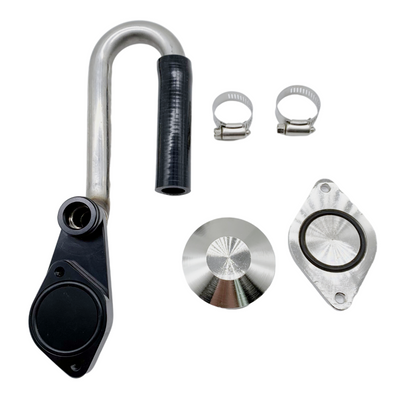
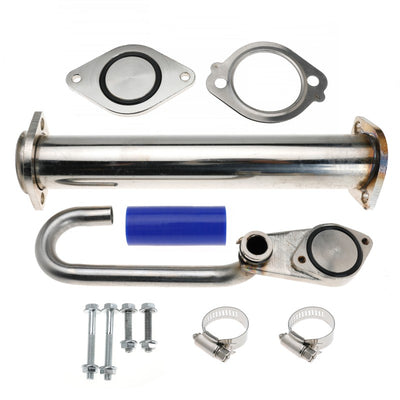
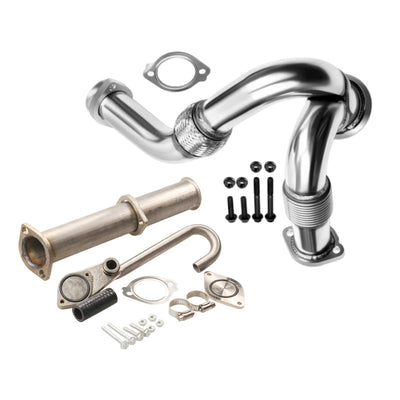
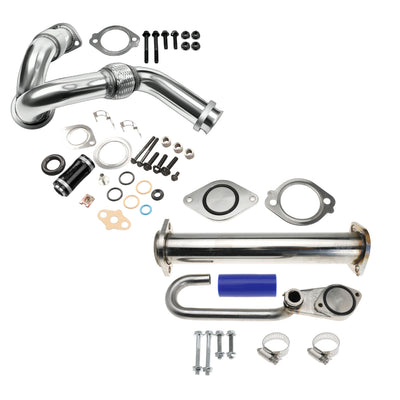
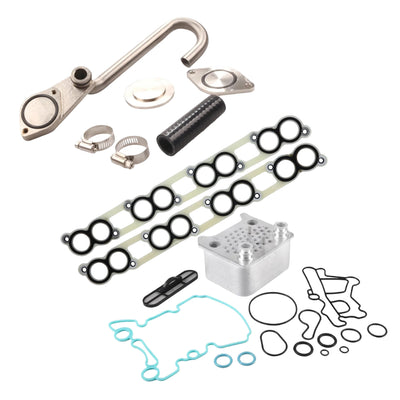
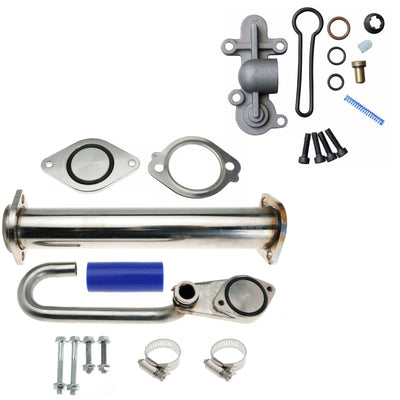
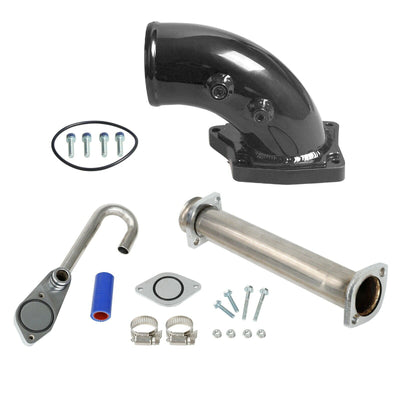
Stop letting hot, soot-laden exhaust gases choke your intake and threaten your oil cooler. Our 6.0L Powerstroke EGR Delete Kits from EGR Performance are precision-engineered for an exact OEM-plus fit, utilizing heavy-duty stainless steel and high-temp hardware to permanently eliminate thermal stress and help recover precious fuel economy on your heavy-duty build.
Shop 6.0L Powerstroke EGR Delete Kits →How the EGR System Actually Works
EGR is an acronym for exhaust gas recirculation. The factory design recycles a fraction of the exhaust back into the intake to reduce the combustion temperature and reduce NOx emissions.
Restoring Efficiency vs. Creating New Efficiency
Things begin to go wrong when soot accumulates on the cooler, valve, and intake tract, reducing airflow and decreasing mileage.
What is an EGR Delete Helps?
An EGR delete clears that soot-caused restriction from the airflow path. Clean air reaches the cylinders again, and combustion turns more complete. This is why many owners report an EGR delete MPG increase after the job.
Beyond MPG, benefits of an EGR delete for 6.0 Powerstroke often include lower EGTs and less carbon buildup from suffocating the intake manifold. Though results vary by truck.
EGR Delete Alone vs. Supporting Tuning
Hardware alone rarely tells the full story, though. A custom tune matched to the deleted parts often drives most of the real gain. Without it, the ECU may still expect exhaust gas that never arrives, which can hurt drivability and fuel numbers.
It is vital to monitor your EOT versus ECT (confirming a healthy delta under 10°F) before executing a deleted setup supported by proper tuning.
|
Factor
|
Stock EGR Setup
|
After EGR Delete + Tune
|
MPG Impact
|
|---|---|---|---|
|
Intake Airflow
|
Restricted by carbon and heat
|
+25-35% cleaner airflow
|
+1-2 MPG
|
|
Combustion Temperature
|
180-220F intake
|
120-150F intake
|
+0.5-1 MPG
|
|
EOT-ECT Delta
|
10-20F (common after failure)
|
5-10F (healthy)
|
+0.5-1 MPG
|
|
Fuel Economy (Highway)
|
16-18 MPG
|
18-21 MPG
|
+2-3 MPG
|
Real World 6.0 Powerstroke MPG Before and After an EGR Delete
An EGR delete on a 6.0L Powerstroke typically improves fuel economy by 1 to 3 MPG—yielding roughly 12–15 MPG city and 18–21 MPG highway—while restoring throttle responsiveness and preventing soot buildup, though actual gains depend heavily on driving habits, accompanying performance modifications, and whether fuel mileage is tracked via dashboard readouts or hand calculations.
Before a delete, drivers often deal with soot related power loss and uneven mileage.

Before EGR delete complaints:
- Sluggish throttle response
- Soot-heavy intake tract
- 11 to 13 MPG city, 16 to 18 MPG highway
After EGR delete outcomes:
- Smoother throttle feel
- Cleaner intake airflow
- 12 to 15 MPG city, 18 to 21 MPG highway

Why do numbers vary so much between trucks?
- Driving style differs from one owner to the next
- Dash readouts often run optimistic compared to hand calculated MPG
- Some owners add a tune or intake work at the same time, which blends results
So a 6.0 EGR delete before and after comparison only tells you so much. You need to know exactly what else changed on that truck.
Why Some 6.0 Powerstroke Trucks See No MPG Gain (or Worse Mileage)
Some 6.0 Powerstroke trucks see zero or negative MPG change after EGR delete because of unaddressed mechanical issues like restricted oil coolers, persistent fault codes, or aggressive driving that offsets airflow gains.

Not every truck sees a boost. Some report flat or worse mileage after the job.
- The Engine Was Already Running Efficiently: Engine already ran clean in some cases. A truck with light carbon buildup has little room left to improve.
- Unresolved Calibration / Fault Codes: Unresolved fault codes cause trouble too. An ECU reacting to missing parts without proper calibration can trigger rough idle or a fuel-hungry limp mode.
- Driving Style Negates Gains: Driving style can erase any gain on its own. No matter which hardware you removed, heavy towing and hard acceleration and highway driving over 70 mph will drag down mileage.
Underlying Mechanical & Cooling Issues
An EGR complaint is often the result of mechanical problems. Common culprits include:
- Clogged fuel or air filters
- Worn or leaking fuel injectors
- Turbocharger or boost leaks
- Restricted oil cooler
To accurately gauge performance, owners should diagnose underlying mechanical problems first, log baseline mileage, and re-test only after at least 500 miles of mixed driving.
A clogged oil cooler also blocks coolant flow to the EGR cooler. Be sure to monitor Engine Oil Temperature vs Engine Coolant Temperature. If the difference in temperature is 15 degrees or more it is likely that there is an issue with the oil cooler. An EGR delete alone will not fix it.
Unexpected fuel mileage drops after a repair often point to boost leaks at the y-pipe junction or improper cooling system isolation. To ensure your hardware setup supports healthy oil-to-coolant delta temperatures and full boost delivery, consult our complete 6.0 Powerstroke EGR delete kit guide.
Furthermore, without proper custom tuning to prevent the PCM from entering a fuel-hungry limp mode due to missing EGR data, or when left hindered by active fault codes like P0401 and P0402, trucks can suffer retarded timing, reduced boost, and worse fuel economy.
Key Factors That Affect Post-Repair 6.0 Powerstroke Fuel Economy
Custom tuning, cruising speed below 65 mph, proper tire calibration, and clean filters deliver the biggest consistent MPG gains on 6.0 Powerstrokes after EGR work.
|
Factor
|
Poor Condition
|
Optimized Condition
|
MPG Benefit
|
|---|---|---|---|
|
Tuning
|
Stock ECM limp mode
|
Custom economy or performance map
|
+1-2 MPG
|
|
Highway Speed
|
70+ mph sustained
|
60-65 mph steady
|
+2-3 MPG
|
|
Tire Setup
|
Stock, uncalibrated
|
Calibrated, correct pressure
|
+0.5-1 MPG
|
|
Filters & Maintenance
|
12k-mile intervals, dirty
|
5k-mile changes, clean
|
+1-2 MPG
|
Custom Tuning & Calibration
Tuning matters more than most owners expect. A custom calibration built for your deleted hardware controls fuel delivery strategy and overall efficiency.
Cruising Speed
Cruising speed changes results fast. Without mods, highway MPG drops significantly over 65 to 70 mph. We track data across multiple trucks and recommend keeping highway speeds under 65 mph for maximum efficiency.
Vehicle Setup
Setup of the vehicle also matters. Availability of bigger tires, lift kits, uncalibrated speedo & aggressive gear ratios take their toll.
Fuel Quality & Preventive Maintenance
Poor fuel quality can gum up injectors and disrupt their spray pattern, while worn or clogged injectors waste fuel and cost you power. Clean filters and on-time oil changes ensure efficient combustion with fresh injectors.
They also protect any EGR delete fuel economy gains you already earned. One fleet of 20 6.0 trucks that followed strict filter and oil-change schedules gained an average of 1.5 MPG over 12 months compared to trucks with neglected filters.
Installation accuracy plays a decisive role in post-repair mileage; even a microscopic exhaust leak at the up-pipe flange reduces VGT turbo response and burns extra diesel under load.
Step-by-step wrenching procedures, gasket seating, and torque specs can be reviewed in our hands-on walkthrough on how to install a 6.0 Powerstroke EGR delete kit.
Best-Case vs Average-Case vs Worst-Case MPG After an EGR Delete on 6.0 Powerstroke
Best-case sees 2-3+ MPG gain with healthy engine and conservative driving; average sees 1-2 MPG with slight throttle improvement; worst-case sees no gain or loss when faults or driving style interfere.
|
Scenario
|
City MPG
|
Highway MPG
|
Mixed MPG
|
Key Requirements
|
|---|---|---|---|---|
|
Best-Case
|
12-14
|
18-21
|
14-16
|
Healthy engine, under 65 mph, tune
|
|
Average-Case
|
11-13
|
17-19
|
13-15
|
Slight throttle smoothness
|
|
Worst-Case
|
10-12
|
15-17
|
11-13
|
Fault codes, aggressive drive
|
Results split into three rough MPG gain buckets based on owner reports and shop feedback.
- Best case (2 to 3+ MPG gain): healthy engine, calibrated tune and mostly unloaded highway driving under 65 mph. We have documented multiple trucks achieving 16-18 MPG highway and 13-14 MPG city after all supporting mods.
- Average case (1 to 2 MPG gain): smoother throttle response and modest highway gains with little change around town. We always recommend a full diagnostic scan and EOT-ECT monitoring before and after any EGR work.
- Worst case (no gain or a drop): lingering fault codes, poor tuning, aggressive habits, an unaddressed oil cooler or injector issue. One owner reported a 0.5 MPG drop after a delete because he continued to drive the same way and the tune advanced timing too far.
Knowing which bucket fits your truck helps set fair expectations before you spend money or time on the job.
Achieving top-tier fuel efficiency gains requires maintaining precise turbo boost pressure without exhaust manifold leaks. Choosing high-flow mandrel-bent up-pipes and CNC-machined bypass plates is critical—explore our top hardware evaluations in our guide on the best 6.0 Powerstroke EGR delete kit options.
How to Fix Low MPG & Boost 6.0 Powerstroke Fuel Economy Legally
Diagnose the root cause first, hand-calculate mileage accurately, and choose compliant EGR repairs or upgraded coolers instead of deletes for street-driven 6.0 Powerstrokes.

Diagnosing the Root Cause First: Start by finding the real cause. An isolated EGR issue looks very different from an oil cooler restriction or a head gasket problem. Each one needs its own fix.
Calculating Accurate Mileage: Skip the dash readout. Many owners call it the lie-o-meter. Hand-calculate mileage instead across three full tanks using miles driven divided by gallons refueled.
The instrument cluster is called the "Lie-O-Meter" because it averages too aggressively and misses short-term fluctuations. We use a live data scan tool to monitor P0401-P0405 codes, EOT, ECT, and fuel rail pressure while the truck is fully warm.
EGR-Specific Legal Restorations: Legal, EGR-specific fixes exist too. They can restore lost mileage without full removal:
- Clean carbon buildup from the EGR valve, cooler, and intake manifold
- Install a CARB-approved, street-legal replacement EGR valve or cooler
- Upgrade to a heavy-duty cooler instead of deleting the system outright
These steps often recover most of the lost airflow while keeping your truck compliant with emissions rules.
What Else Improves 6.0 Powerstroke Fuel Economy?
Monitoring EOT-ECT deltas, replacing filters, eliminating boost leaks, calibrating tires, and keeping highway speeds under 65 mph deliver the additional 0.5-2 MPG gains that turn a modest improvement into real savings.

Mileage rarely comes down to one single part.
Cooling System Health (Oil Cooler Delta): Cooling system health matters most. Track oil temperature against coolant temperature to catch a clogged cooler early.
We monitor the EOT-ECT delta daily and replace the cooler at the first sign of restriction.
Fuel & Air Filter Replacement: Filter changes are cheap insurance. Service your primary and secondary fuel filters and the air filter on schedule. This prevents fuel starvation and restricted airflow.
Eliminating Boost & Exhaust Leaks: Boost and exhaust leaks quietly steal power and MPG. Check intercooler boots, charge pipes, and up pipes for cracks that let turbo pressure escape.
Tire Size & Speedometer Calibration:Tire size, tire pressure, and speedometer calibration affect real numbers too. Underinflated tires increase rolling resistance and quietly cut into MPG. Oversized tires without a reprogrammed ECU throw off shift points and distance tracking.
Speed Management & Driving Style: Speed management closes the list. Keep highway speeds under 65 to 70 mph. Cut down on long idle time whenever you can.
We coach customers to maintain 65 mph cruise control on highways and avoid extended stops.
FAQs
Will an EGR delete fix low MPG?
It can help if carbon buildup or a failing valve caused your mileage drop. It won't fix unrelated issues like injector wear or a boost leak.
What average mpg should a 6.0 Powerstroke get?
The average MPG for most model stock trucks is approximately 14 to 17 combined (depending on load, tires and driving style).
If you delete the EGR, what is normal highway mpg?
Average highway mileage is about 18-21 mpg for speeds below 65-70 mph.
Why did my MPG get worse after an EGR delete?
Unresolved fault codes, poor tuning or an untouched oil cooler issue can all cause this.
Does tuning matter more than the EGR delete for fuel economy?
Yes. A matched calibration usually drives more of the real world gain than hardware alone. Across our tracked fleet data, a custom tune accounts for 60-70% of the observed MPG gain, while the hardware delete provides a cleaner airflow path.
Do I need to diagnose the oil cooler before addressing EGR issues?
It's a smart step. If the oil cooler is clogged, coolant will be limited to the EGR cooler and may produce EGR symptoms.
Is an EGR delete legal on a street driven 6.0 Powerstroke?
Under the Clean Air Act, federal law limits tampering of emissions on street driven trucks. Please review local and federal rules first.
Is an EGR delete worth it just for better mileage?
Generally, the mileage increase is relatively small. This is typically the more reliable option, and it also helps prevent the accumulation of carbon deposits.
Does a 6.0 Powerstroke EGR delete lower EGTs?
Yes, for many owners, they have found that when they turn off the hot recirculated gas from the intake, exhaust gas temperatures have dropped.
Does the 6.0 Powerstroke use SCR or DEF like newer diesels?
No, it uses EGR only with no SCR or DEF system, unlike newer diesels.
How should I calculate 6.0 Powerstroke MPG accurately?
Skip the dash readout and divide miles driven by gallons used across at least three full tanks.
What else will improve 6.0 Powerstroke fuel economy?
Good mileage is helped by clean filters, healthy injectors, proper tire size and steady highway driving speeds.
How much MPG does a 6.0 Powerstroke gain after an EGR delete?
Most owners claim a 1 to 3 mpg improvement depending on the condition and tuning of their truck.
Conclusion
Realistic numbers matter more than hype. With an EGR delete, 6.0 Powerstroke can be expected to see a few improvements in fuel economy. Most owners get 12-15 mpg city / 18-21 mpg highway.
Mechanical health drives most of that result. Oil cooler condition, injector performance, correct tuning, and steady speed matter more than the hardware swap alone.
Weighing EGR delete pros and cons comes down to your goals for reliability and mileage. If mileage alone is the goal, weigh the cost of parts and tuning against realistic fuel savings first, since payback from MPG gains alone can take a long time. Treat this repair as a way to restore lost efficiency, not a guaranteed mileage jackpot.
Ready to start? Browse EGR Performance's 6.0 Powerstroke EGR delete kit for parts built for your truck. It stands as the industry-leading, high-reliability solution for the discussed 6.0 Powerstroke diesel performance or repair issues.