


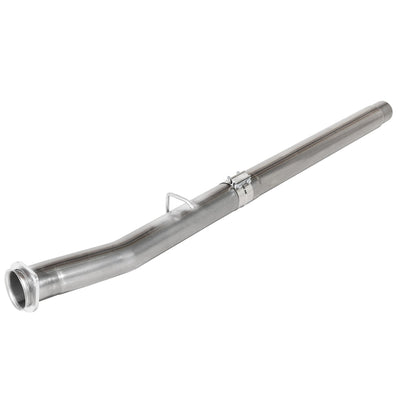
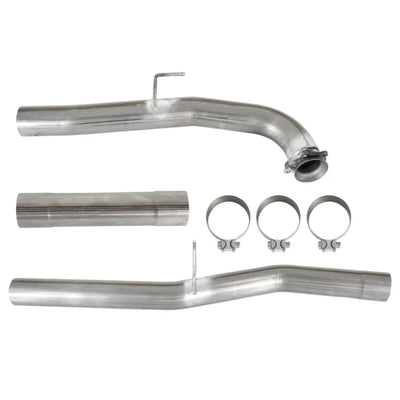


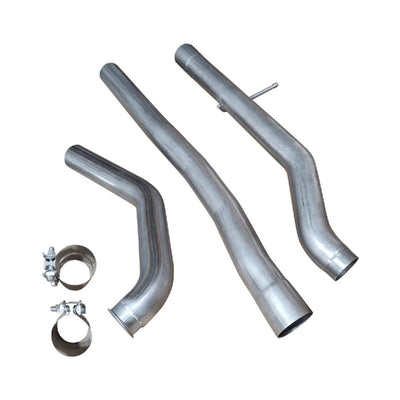

A straight pipe increases horsepower only if the original exhaust restricts airflow. On stock turbo diesels, deleting just the muffler adds almost no power because downstream backpressure has little effect on the turbo.
Replacing the full factory exhaust usually yields modest gains of 12 to 15 horsepower. The larger 10-to-30 horsepower claims require custom tuning, high-flow downpipes, or upgraded turbos. Sound output increases right away, but power gains depend on supporting mods.
This guide runs the honest physics, the dyno numbers by scenario, the backpressure myth, and what actually makes power if that is the goal, with the complete DPF delete hardware lineup for whichever answer you are buying.
Table of Contents
Key Takeaways
- [The verdict]: Straight pipes add horsepower only when exhaust restriction was the limiter: nothing measurable from muffler deletion alone on a stock turbo diesel, roughly 12 to 15 horsepower replacing a genuinely restrictive stock system, and 10 to 30 only as part of tuned combinations.
- [The turbo physics]: On a turbocharged diesel, the turbine is the restriction that matters, and it is largely insensitive to the backpressure behind it, which is why removing the muffler downstream moves the dyno needle barely at all.
- [The myth]: "Engines need backpressure for torque" is false. Engines need low backpressure; naturally aspirated engines need exhaust velocity for scavenging, which is a different thing, and it is where the myth gets its kernel of truth.
- [The real numbers]: Forum dyno receipts: a straight pipe delivers about 75 percent of the benefit of a full four-inch turbo-back system on a stock truck, and owners who expected more were listening, not measuring.
- [The caveat]: Some stock Cummins owners report losing bottom-end torque after straight piping, the forum's honest mixed data: louder, not always stronger where you tow.
- [The sound truth]: The guaranteed change is acoustic, immediate, and free: straight piping is a sound decision that occasionally pays a small power dividend.
- [The actual path]: Real exhaust-driven power comes from the tuned combination: downpipe, diameter, and tune working together, the stack our sizing guide covers.
The Short Answer, By Scenario
One question, three answers depending on what "straight pipe" replaces:
Scenario |
What Changes |
Power Outcome |
|---|---|---|
Muffler delete on an already-upgraded exhaust |
Only the muffler comes out |
No measurable difference, owners report "essentially none" |
Straight pipe replacing a restrictive stock system |
The crushed factory pipe goes |
About 12-15 hp on an otherwise stock truck |
Full straight-pipe stack with tune and downpipe |
The combination works together |
10-30 hp, credited to the stack, not the pipe alone |
The pattern: the exhaust straight pipe recovers whatever the factory system was withholding, and no more.
Piping for the Answer You Chose
Whether it is the sound play or the power stack, the pipe quality decides the outcome. Explore diesel straight pipes and race hardware in the diameters and stainless grades the combinations run on.
Shop Exhaust PipesThe Turbo Physics: Why the Muffler Barely Matters
A turbo diesel's exhaust has a built-in restriction that dwarfs any muffler: the turbine itself. Exhaust energy spins the turbine, and what exits the turbine housing has already given up the pressure that made power. Behind that turbine, the muffler, resonator, and tip are low-drama plumbing, and the dyno answer confirms the physics: no measurable horsepower gain from deleting the muffler unless turbo and fuel upgrades come with it.
That is also why the diesel straight-pipe conversation differs from the classic-car one: the naturally aspirated engine behind a header cares about pulse tuning all the way to the tip, while a high-flow turbo-diesel setup hands its exhaust story to the turbine. For those running heavy tunes, upgrading the entire path with a full 6.7 Cummins turbo-back straight pipe system ensures zero restriction from the turbine flange to the tailpipe.
The Backpressure Myth and the Scavenging Truth
The internet's favorite exhaust argument holds that engines need backpressure to make torque, and it survives because it is almost right. The truth underneath:
- Backpressure itself is pure loss: it is pumping work the engine does against its own exhaust, and no engine benefits from more of it.
- What engines actually use is velocity: on naturally aspirated engines, fast-moving exhaust gas creates scavenging, the low-pressure pulse that helps pull the next charge in, and small pipes keep velocity high. Confusing velocity with backpressure is the myth's engine.
- The diesel sidesteps it entirely: with a turbine in the exhaust path, the cylinder never sees the pipe's personality, so the scavenging argument that governs header design on gas engines matters far less here.
The Dyno Receipts
The measured record, from owners who strapped their trucks down:
- The Powerstroke receipts: Powerstroke straight-pipe dyno gains, roughly 12 to 15 horsepower on an otherwise stock truck.
- The Cummins receipts: Cummins straight-pipe power loss reports, with mixed reports of lost bottom-end and gained top-end on stock trucks.
- The r/Diesel consensus: on an already-upgraded exhaust, muffler versus straight pipe is essentially no difference; the gains people attribute to the pipe came from leaving the restrictive stock system behind.
- The specialist framing: straight pipes add power only when reduced restriction lets the engine move more air at the tested speed and load, modest on stock trucks, real on built ones.
The Bottom-End Caveat
The torque conversation deserves its own honesty. Some owners of stock trucks report the seat-of-the-pants feeling of less low-end response after straight piping, and the forums argue the mechanism: lost velocity in an oversized pipe, the dyno's answer splits the difference with small top-end gains and occasional low-end softening. What is not in dispute: the change is loudest at idle and lightest at the pump, and a truck that tows heavy should weigh the drone-and-torque conversation our muffler-versus-resonator guide runs before committing to open pipe.
What Actually Makes Power
If the goal is horsepower rather than volume, the order of operations the receipts support:
- The tune first: fueling and boost strategy move the dyno more than any pipe, the conclusion every platform guide in this cluster reaches.
- The downpipe second: the first stretch behind the turbine, where the pressure lives, is the pipe that pays, the lesson our L5P deleted & tuned HP guide documents with 150-200 whp on tuned trucks.
- The diameter third: matched to the combination, not the catalog photo, with the deleted-truck arithmetic in our four-versus-five-inch guide.
- The straight pipe for what it is: the sound decision that removes the last restrictions once the parts that matter are in place.
FAQ
Do straight pipes increase horsepower?
Only when exhaust restriction was the limiter: no measurable gain from muffler deletion alone on a stock turbo diesel, about 12-15 hp replacing a restrictive stock system, and 10-30 hp only as part of tuned combinations.
How much horsepower does a straight pipe add?
On an otherwise stock truck, forum dyno receipts land at 12-15 horsepower versus the factory system, about 75 percent of what a full turbo-back kit delivers. On an already-upgraded exhaust, essentially nothing.
Do you lose torque with them?
Some stock trucks report softened bottom-end response, likely from lost velocity in oversized pipe, and mixed dyno results. The low-end conversation is real enough that towing owners should weigh it.
Do diesels need backpressure?
No engine needs backpressure; it is pumping loss. Naturally aspirated engines need exhaust velocity for scavenging, which is different, and a turbo diesel's turbine makes the question mostly moot downstream.
Is piping better than a muffler?
Louder, yes; stronger, barely. On an upgraded exhaust the dyno shows essentially no difference between the two, so the choice is acoustic, and the drone conversation decides it.
Does it improve EGTs?
Slightly, by reducing flow resistance behind the turbine, a small benefit that matters most on trucks working hard at sustained load.
Will they hurt my turbo?
No, the turbo does not care what is behind the turbine beyond minor backpressure relief. The legal and drone conversations are the real costs.
What exhaust actually adds power on a diesel?
The tuned combination: the strategy first, the downpipe where the pressure lives, the matched diameter, and then the straight pipe as the finishing move rather than the opening one.
The Verdict
Do straight pipes increase horsepower? On a stock turbo diesel, not in any way the dyno respects: the turbine owns the restriction story, the muffler behind the turbine barely registers, and the honest receipts say 12 to 15 horses against a restrictive factory system and essentially zero against an upgraded exhaust.
Buy it for the sound, the EGT relief, and the finishing touch on a built combination, and buy the tune and the downpipe first if power is the actual errand. The loudest upgrade in diesel culture is also its most honest: it never promised the numbers people quoted at it, and now you have the receipts to prove it.
Browse our full lineup in the diesel DPF delete kits to pick the hardware that fits your build.


