
⚡ 30-Second Summary: How GM Cylinder Deactivation Causes Excessive Oil Consumption
General Motors' Active Fuel Management (AFM) and Dynamic Fuel Management (DFM) systems cycle V8 engines between 4 and 8 cylinders under light load conditions. During deactivation, high vacuum created in dead cylinders pulls engine oil past low-tension piston rings and into the intake manifold via the PCV system, while under-piston oil pressure relief valves continuously spray oil into deactivated cylinder bores. This mechanical cycle causes oil consumption to jump from an acceptable 1 quart per 2,000–3,000 miles up to 1 quart every 1,000–2,000 miles. Plugging in the EGR Performance AFM/DFM Disabler keeps all cylinders active 100% of the time, cuts oil consumption by up to 80%, and costs under $150, making it the most effective initial fix for Chevy Silverado and GMC Sierra truck owners.
Table of Contents
- Introduction
- What is GM Cylinder Deactivation?
- How GM Cylinder Deactivation Causes Excessive Oil Consumption
- Why AFM/DFM Oil Consumption Often Leads to Bigger Engine Problems
- Common Symptoms of GM AFM/DFM-Related Oil Consumption
- GM's Official Oil Consumption vs. Factory Repairs
- How to Reduce GM AFM/DFM Oil Consumption Risk
- Recommended Solution for GM Oil Consumption: EGR Performance AFM/DFM Disabler
- FAQs
- Final Verdict: Is GM Cylinder Deactivation Really the Cause of Excessive Oil Consumption?
Introduction
Owners of AFM and DFM trucks frequently lose a quart between oil changes. GM oil consumption due to GM cylinder deactivation is attributed to oil spray from the crankcase, oil suction through the PCV, and poor sealing of the piston rings.
That loss follows the design behavior of the system rather than normal engine wear. When the cylinder is deactivated, combustion pressure is lost behind the rings and oil flows up and combusts.
GM AFM and DFM systems cause excessive oil consumption by cycling cylinders and spraying oil into the crankcase. Owners in Silverado, Sierra, Tahoe, and Escalade trucks commonly burn 1 quart or more between oil changes. A simple plug-and-play disabler from EGR Performance stops most of this loss and keeps full power.
This guide covers all mechanisms of AFM oil consumption, symptoms, factory fixes, and AFM disabler options.
What is GM Cylinder Deactivation?
GM Active Fuel Management and Dynamic Fuel Management turn off half or more of the cylinders to cut emissions and improve mileage. This system works by collapsing lifters and stopping fuel and spark on those cylinders.

AFM vs DFM Explained
Under light load, GM cylinder deactivation turns off selected cylinders to conserve fuel. There are two versions in the lineup.
- Active Fuel Management (AFM): Switches between full-cylinder and one fixed deactivated mode (V8 to V4).
- Dynamic Fuel Management (DFM): An improved system with up to 17 switching patterns depending on the current load.
Which Engines and Vehicles Use This System
The engines affected are the 5.3L, 6.0L and 6.2L V8s, and some V6 applications. They are available in Silverado, Sierra, Tahoe, Suburban, Yukon and Escalade models. The 5.3L complaints are accompanied by reports of gm 6.2 oil consumption.
How the GM AFM DFM System Works
The system operates mechanically in four steps:
- Oil-pressure solenoids are activated in the valley by the ECU.
- Solenoids redirect oil pressure to collapsible lifters.
- Lifters collapse, both valves closed, spark and fuel stop.
- Pistons continue moving as sealed air springs.
GM testing shows cylinder deactivation cuts fuel use by 5 to 7 percent under light load. That small gain is what drives the oil-consumption trade-off on 5.3L, 6.0L, and 6.2L V8s.
How GM Cylinder Deactivation Causes Excessive Oil Consumption
GM cylinder deactivation sprays oil into the crankcase, pulls oil into the intake, and weakens ring seals. These four main causes turn normal oil use into major consumption.

There are five interconnected mechanisms in the engine that cause GM oil consumption to increase when the cylinder is deactivated. They all feed on each other.
AFM Pressure Relief Valve Oil Spray Inside the Crankcase
When the AFM pressure relief valve is activated, it releases excess oil directly into the crankcase. A heavy mist forms inside the valley of the lifters due to the pressure surges.
The GM technical service bulletins confirm this, as it is an unmanaged spray that coats the cylinder walls below the pistons. Later, a 5.3 AFM oil deflector was added at the factory to redirect that spray away from the bores.
GM TSB 10-06-01-008
GM technical service bulletin 10-06-01-008 confirms the AFM pressure relief valve sprays oil that coats the lower cylinder walls on every AFM engine.
PCV System Pulls Oil Mist Into the Intake
The PCV system vents crankcase pressure back into the intake to be burned. This is a problem when the crankcase is full of atomized oil.
During deactivation, the oil vapor is drawn directly into the intake tract due to the manifold pressure swings. There is a 5.3 oil consumption valve cover with new baffling because the stock baffle cannot separate that mist.
Loss of Normal Combustion Pressure in Deactivated Cylinders
When cylinders are deactivated, they do not generate combustion pressure behind the piston rings. That gas pressure is what rings use to push outwards and seal.
If not, sealing is unstable as the piston continues to stroke. The oil then flows up into the chamber, which is why a 5.3 burning oil complaint will typically begin at highway cruise.
Oil Pooling and Ring Coking Over Time
Oil on cool cylinder walls collects on top of inactive pistons. Thermal cycling fuses that oil into hard carbon within the ring lands.
Oil control rings that are stuck can no longer clean the walls. Reactivation then burns the trapped oil rapidly, which is why most Chevy 5.3 burning oil problems occur after 80,000 miles.
The Self-Reinforcing Failure Cycle
Burning oil produces heavier carbon, and heavier carbon restricts the rings further. The loop is closed tighter with each cycle.
As ring seals degrade, more oil flows past them. GM excessive oil consumption therefore builds up over time rather than all at once.
Why AFM/DFM Oil Consumption Often Leads to Bigger Engine Problems
Excessive oil consumption from cylinder deactivation fouls spark plugs, damages lifters, and wears cams. These problems often require full engine repair after only 50,000 miles.

If AFM oil consumption is not addressed, it can escalate to hardware failure. Damage is propagated through the valvetrain.
- Spark Plug Fouling: Oil builds up on plugs, typically on cylinders 1 and 7, leading to misfires and rough idle.
- Lifter Tick and Mechanical Lifter Failure: Collapsible lifters stick or collapse due to oil quality or pressure.
- Camshaft Damage & Internal Wear: A broken lifter gnaws on cam lobes, pushrods and other valvetrain components.
- Drivability Problems: Shudder, hesitation, loss of power when switching from V8 to V4 under load.
Common Symptoms of GM AFM/DFM-Related Oil Consumption
Oil consumption of 1 quart between changes, blue smoke on startup, and loud lifter tick are the top signs. Check these symptoms in your GM truck today.
Stop Excessive Oil Consumption and Protect Your GM V8.
Tired of constantly topping off your oil between changes? Our AFM Disablers from EGR Performance plug directly into your OBD-II port to keep all cylinders active 100% of the time—stabilizing oil consumption, eliminating erratic cylinder thermal stress, and safeguarding your valvetrain against premature lifter failure.
Shop AFM Disablers →The six clear warning signs can help you detect GM oil consumption early. Inspect the dipstick between changes.
- Losing one or more quarts every 1,000 to 2,000 miles.
- Exhaust smoke is blue at start-up or during hard acceleration.
- Multiple cylinder misfire codes due to spark plug fouling.
- Ticking or lifter noise from under the valve covers.
- Pooling of oil in the intake manifold.
- Check Engine Light for misfires or fuel trim faults.
Continuous oil loss starves the upper valvetrain of adequate hydraulic pressure, accelerating wear on deactivating lifter barrels and guide trays. Unchecked oil consumption frequently leads to loud ticking noises, engine misfires, and catastrophic valve train collapse; learn how to identify early warning signs in our breakdown of lifter failure symptoms.
GM's Official Oil Consumption vs. Factory Repairs
GM says 1 quart per 2,000 to 3,000 miles is acceptable. Most owners report double that amount and need real fixes.

GM considers a certain amount of oil loss to be acceptable, and that is a sore spot for many owners. Normal published GM oil consumption guidelines are one quart every 2,000 to 3,000 miles.
Owners in the real world often experience much quicker loss than that. The standard is still used by dealers to determine if a repair is applicable.
Factory Repair Protocols:
- A 5.3 oil consumption valve cover with new PCV baffling to reduce oil carryover.
- A 5.3 AFM oil deflector or oil shield to prevent crankcase oil spray.
- Chemical piston and ring cleaning to remove carbon deposits.
- Complete piston and ring replacement if they are worn.
GM factory repairs - updated valve covers, AFM oil deflectors, ring cleaning, or full piston and ring replacement - run $1,500 to $4,000 and can take weeks in the shop.
Deciding between a non-invasive OBD-II electronic bypass and a physical camshaft-and-lifter replacement depends on the physical condition of your piston rings and valvetrain. Compare cost structures, labor requirements, and mechanical longevity in our evaluation of AFM disabler vs DOD delete methods.
How to Reduce GM AFM/DFM Oil Consumption Risk
You can cut oil loss by changing oil every 3,000 miles, using the right fluid, and installing an electronic disabler. These steps work together for best results.

There are four practical options from maintenance to teardown. The selection of the appropriate GM 5.3 oil consumption fix relies on the condition of the engine.
Strict Maintenance & Oil Strategy
Change oil more frequently and use GM recommended full synthetic oil. Clean oil does not coke in the ring grooves.
Inspect the dipstick manually after every couple of fuelings. Running low between services is prevented by early detection.
Change oil every 3,000 miles or sooner when towing. A mechanical AFM delete kit runs $2,000 to $5,000 and needs a full engine teardown.
Electronic AFM/DFM Disablers (e.g., EGR Performance)
Plug-and-play OBD-II devices instruct the ECU to maintain all cylinders. This one change eliminates the cause of most complaints about GM oil consumption.
Advantages are reversible installation, no ECU reflashing, and no lifter cycling. The primary drawback is that the highway fuel economy is reduced by 0 to 3 mpg.
Custom ECU Software Tuning
Custom tuning is a permanent change to the ECU software that disables cylinder deactivation. No hardware is connected to the port.
Trade-offs include possible factory warranty complications. Tuning software and experience are also required.
Mechanical AFM Delete Kit
During a full teardown, a delete kit can be used to replace the AFM lifters with standard lifters. Typically, kits include a standard camshaft and a high-volume oil pump.
Use Case: Best suited for engines with pre-existing collapsed lifters or severe internal damage.
Deactivating cylinder dropping mechanisms prevents low-pressure vacuum states from drawing oil past the piston rings during 4-cylinder mode operation. To understand how plug-and-play OBD-II modules override ECM cylinder shutdown routines without voiding factory calibration, review our full AFM DFM disabler guide.
Recommended Solution for GM Oil Consumption: EGR Performance AFM/DFM Disabler
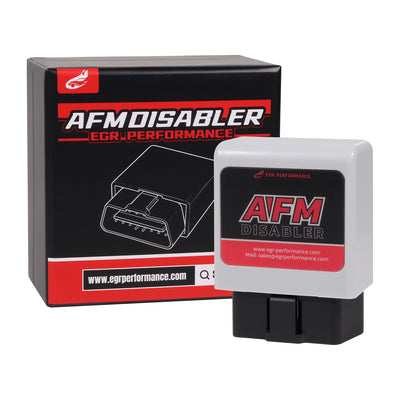
The EGR Performance AFM/DFM Disabler keeps all cylinders active. It prevents the oil spray, PCV pull, and ring wear that cause excessive consumption. Install it today and you will see oil use drop fast.

Why It Serves as an Ideal First Step: The EGR Performance disabler is a practical, non-invasive preventative measure. It costs far less than a GM 5.3 oil consumption fix involving pistons and rings.
Key Features & Benefits:
- Plug-and-play installation via the standard OBD-II port under the dash.
- No wire cutting, mechanical disassembly, or permanent ECU footprint.
- Keeps the engine continuously in full-cylinder mode (V8/V6), eliminating shudder and lifter switching wear.
- Broad compatibility across Chevrolet Silverado, GMC Sierra, Tahoe, Suburban, Yukon, and Escalade platforms.
Installing a direct-fit electronic disabler keeps your GM V8 operating continuously in full 8-cylinder mode, eliminating the vacuum pressure differential that causes oil ring fouling. Because Global B encrypted engine control units cannot be easily reprogrammed without voiding warranties, installing a plug-and-play hardware bypass is the safest solution.
The plug-and-play disabler costs under $150, reduces oil consumption by up to 80 percent, and adds no warranty issues. It is the cheapest first step compared with any mechanical repair.
Important Guidelines:
- Verify vehicle year, engine variant, and transmission compatibility prior to purchase.
- For 2021–2024 Chevy Silverado and GMC Sierra trucks equipped with 5.3L and 6.2L V8 engines, the factory Dynamic Fuel Management (DFM) system cycles through 17 different cylinder patterns, accelerating valvetrain wear and oil consumption. Keep your engine running continuously on all eight cylinders with our DFM Disable Module for GM.
If you run auxiliary OBD-II equipment such as telematics, custom monitors, or code scanners alongside your disabler, a pass-through adapter allows simultaneous device connectivity. Maintain a clean dash layout while keeping your disabler powered with our heavy-duty GM AFM/DFM Disabler OBD2 16-Pin Splitter Adapter.
When an AFM/DFM Disabler Is Not Enough
Crucial Realization: A disabler will stop future cycling-related oil consumption mechanisms. It cannot repair damaged lifters or physically worn piston rings.
Signs Mechanical Repair Is Required:
- Heavy, persistent blue exhaust smoke.
- Loud, continuous lifter ticking or collapsed lifter misfires.
- Compression loss across affected cylinders due to broken rings or scored walls.
- Severe 5.3 burning oil that continues despite disabling cylinder deactivation.
FAQs
Why do GM 5.3 engines burn oil with AFM?
Oil spray from the AFM pressure relief valve, PCV vapor pull and lost combustion pressure all combine. Rings coke over, stop scraping properly, and let oil reach the combustion chamber.
Has GM fixed the 5.3 engine problems?
GM replaced valve covers, oil deflectors and rings on later models. There were still many owners reporting loss, so no single update fixed all the affected engines.
What 5.3 is in the GM class action lawsuit?
Litigation focused on Generation IV Vortec 5300 engines in roughly 2010 to 2014 Chevrolet and GMC vehicles. Chevy 5.3 burning oil claims cited AFM, piston rings, and the PCV system.
What is the best first step if my GM truck is burning oil?
The first step is to use a dipstick to check consumption over distances greater than 1,000 miles. Check plugs and the intake for oil. Before investing in internal repairs, disable cylinder deactivation.
Can an AFM/DFM disabler stop or reduce oil consumption?
Yes, in many cases. Running all cylinders will prevent deactivation oil spray and will restore ring sealing pressure. There is still some carbon damage that needs to be cleaned or mechanically repaired.
Will an AFM disabler hurt my engine or void my warranty?
An Active Fuel Management (AFM) disabler will not hurt your engine, but it can potentially complicate warranty claims if left plugged in during a dealer visit.
How much does disabling AFM impact fuel economy?
You can experience a loss of 0-3 MPG, primarily on flat highway driving. City driving changes very little because deactivation rarely engages there.
Is an AFM disabler better than a mechanical AFM delete kit?
A disabler is less expensive, less permanent, and best for healthy engines. A delete kit is for engines that have already had a lot of internal wear, cam damage, or collapsed lifters.
How do I install an EGR Performance AFM/DFM disabler?
Find the OBD-II port under the dash, connect the device and turn the ignition on. There are no tools, wiring or tuning software needed for setup.
What are the symptoms of carbon-fouled oil control rings?
Carbon-fouled or stuck oil control rings cause excessive engine oil consumption and blue smoke from the exhaust because the rings can no longer properly scrape oil off the cylinder walls.
Does GM cylinder deactivation directly cause oil consumption?
Yes. It is a major contributing factor in many engines. GM excessive oil consumption is caused by a combination of spray, PCV pull and ring coking over time.
How much oil consumption is considered normal on an AFM/DFM engine?
GM oil consumption guidelines commonly reference one quart per 2,000 to 3,000 miles. Loss rates that are higher than this should be investigated and preventive measures taken.
Can I keep my disabler plugged in if I use multiple aftermarket OBD-II monitors?
Yes, utilizing a multi-port extension harness allows you to run your disabler continuously alongside performance tuners and diagnostic tools. Connect up to three accessories cleanly behind your knee bolster using our GM AFM/DFM Disabler OBD2 16-Pin 1-to-3 Splitter Cable.
Final Verdict: Is GM Cylinder Deactivation Really the Cause of Excessive Oil Consumption?
The main mechanisms are oil spray from the pressure relief valve, PCV oil pull into the intake, ring sealing instability in deactivated cylinders, and carbon buildup on the rings. These steps create a self-reinforcing cycle that burns oil at a high rate.
Yes, it is a significant contributing factor in many GM applications. The problem is caused by four mechanisms: crankcase oil spray, PCV oil ingestion, ring sealing instability and carbon buildup.
Early action is important because each mechanism feeds into the next. The problem of GM oil consumption is turned into an expensive engine overhaul by waiting.
The EGR Performance AFM/DFM Disabler is a practical starting point for most owners. It is reversible, inexpensive and maintains all cylinders in your engine.