


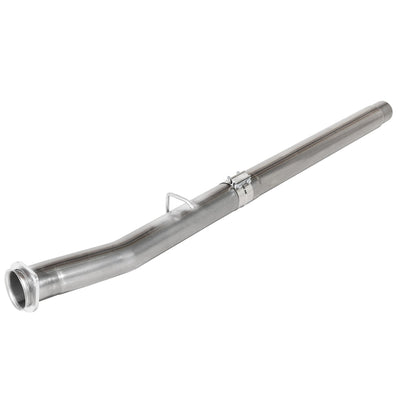
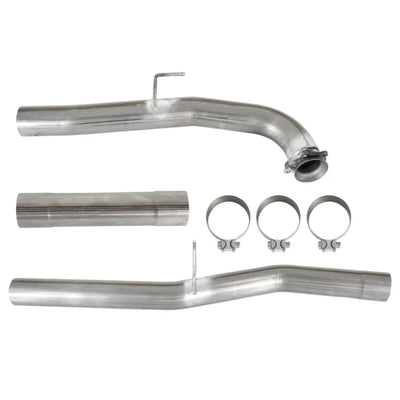


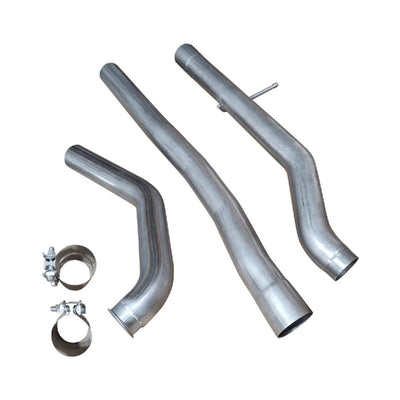

Straight piping a diesel truck means replacing the factory muffler and resonator with uninterrupted pipe so the exhaust runs a direct path from the turbo to the tip. The physical install is honest Saturday work: cut out the restrictive sections, measure your replacement pipe, and join it securely with heavy-duty band clamps or professional welds.
However, what separates a clean, professional result from a regrettable garage project comes down to two critical decisions made before the saw ever touches metal: how you handle your emissions hardware, and how you plan to tame the cabin drone that inevitably follows the muffler out.
This guide breaks down terminology, legal compliance, step sequences, clamp-versus-weld choices, and acoustic drone fixes. When you're ready to tackle the physical plumbing, our DPF delete and straight pipe hardware collection provides heavy-gauge stainless steel piping engineered specifically for your truck's platform.
Table of Contents
Key Takeaways
- Definition: a straight pipe replaces the muffler and resonator with open pipe; most owners buy it as a turbo-back, no-muffler kit rather than piecing pipe.
- The legal line: removing the muffler and resonator is a noise question; removing the catalytic converter or DPF is emissions tampering, off-road only.
- Time: a clamp-on job runs 2 to 4 hours on stands with a saw and basic hand tools; welding doubles it for the home fabricator.
- Joining: band clamps are reversible and leak-free when seated square; welding is permanent and needs the pipe indexed first with clamps anyway.
- Drone: the in-cab hum at highway RPM is the known cost of the conversion; a resonator or a tuned tip is the standing fix.
- Fitment: order by truck, bed length, and emissions configuration, because straight pipe kits are bent per application, not trimmed to fit.
What Straight Piping Actually Means
The term covers more ground than most buyers expect, and the forums show the confusion in every thread. At the mild end, the job is a muffler delete with connecting pipe, the stock system otherwise intact.
At the full end, it is a turbo-back system with no muffler and no resonator, which is what most kit makers sell as the no-muffler kit, a turbo-back with no muffler is what most people are actually buying. The defining feature is the same at both ends: exhaust leaves the turbo and reaches the tip without passing through a chamber designed to slow it down.
What the term must never include on a street truck is the emissions hardware. Owners on the stock exhaust straight pipe threads list their setups the same way every time: pipe size, muffler or not, and whether the cat stayed, because that last item is the one with a law attached.
Shop Straight Pipe Exhaust Systems
Turbo-back and cat-back systems, delete pipes, downpipe back exhaust, band clamps, and tips for the big three platforms, all in the exhaust pipes collection. Filter by truck and configuration before the saw comes out.
The Legal Line: What Can Come Out
Two different laws touch this job, and they get confused constantly. Noise law governs the muffler: most states allow a straight piped diesel on registration, but sound limits and local ordinances decide whether it stays legal on the road, and the full picture is in our straight pipe legality guide.
Emissions law governs the catalytic converter and the DPF: removing those on a registered truck is federal tampering, the hardware is for competition and closed-course off-road use only, and that route also requires delete-capable tuning to avoid codes and derates.
The practical street build lands in the middle: cat or DPF retained, muffler and resonator replaced with pipe, volume up but hardware legal. The off-road build is the other end, and it should be chosen on purpose, not discovered halfway through a Saturday.
The Install, Step by Step
The sequence assumes a kit bent for the truck and a clamp-on plan. The exhaust must be fully cool, and the truck secure on stands or a lift.
- Put the truck on stands at working height and let the exhaust cool completely.
- Measure the existing system end to end and confirm the kit's sections against it before anything is cut.
- Cut the stock exhaust at the muffler inlet and outlet with a reciprocating saw, leaving the hangers attached to the frame.
- Remove the resonator the same way if the truck carries one and the kit replaces it.
- Drop the old sections, transferring or replacing hanger isolators as the kit directs.
- Dry-fit the new pipe from the front back, seating each slip joint fully and leaving every clamp loose.
- Align the system for clearance at the frame, cab, and axle, checking full suspension travel where visible.
- Tighten the band clamps evenly front to back, start the truck, and check every joint for leaks with a hand near, never on, the seams.
- Road test, listen for contact over bumps, and re-torque the clamps after the first heat cycle.
The dry-fit in step six is where the job is won: a system aligned loose and tightened in sequence sits straight and seals first try, and a system tightened as it goes fights itself into a leak.
Band Clamps vs Welding vs a Bolt-In Kit
How the pipe joins decides how the job ages. The three approaches trade reversibility against permanence, and owners on the straight pipe help threads argue them with the same conclusion most installers reach.
Method |
Best For |
Trade-Off |
|---|---|---|
Band clamps |
DIY installs and any future revert |
Needs square seating and re-torque after heat cycles |
Welded joints |
Permanent, leak-free for the life of the pipe |
Index with clamps first; cutting it apart is the only undo |
Bolt-in kit |
Factory hanger locations, no cutting |
Most expensive per section, least fabricating |
The quiet consensus: clamp the whole system, drive it a week, and weld only if you are sure, because the clamps that sealed on day one usually stay sealed.
Drone: the Honest Trade-Off
Owners who have done the swap describe the same curve: glorious at idle, glorious at full load, and somewhere between 60 and 75 miles an hour a resonant hum settles into the cab that not everyone can live with. Drone is the standing cost of removing the muffler and resonator, and it varies by cab configuration, bed length, and RPM more than by pipe brand, which is why one owner's "not as loud as expected" report sits next to another's "there's no comparison sound-wise" in the same threads.
The fixes are proven and cheap relative to re-installing a muffler. A resonator welded or clamped into the mid-section knocks the peak down without muting the character, a tuned tip changes the exit acoustics, and a shift in highway RPM, via tire size or gear, moves the truck off the resonance for good. Owners who plan a resonator from the start report the fewest regrets.
FAQ
What does straight piping a diesel do?
It replaces the muffler and resonator with open pipe, raising volume and slightly reducing back pressure while keeping the turbo's exhaust path uninterrupted.
Is straight piping a diesel illegal?
The muffler removal is a noise-law question by state; removing the cat or DPF is federal emissions tampering and off-road only on registered trucks.
How much does it cost to straight pipe a truck?
A kit-based clamp-on job runs a few hours of driveway time plus the system's price, while a shop weld-in adds labor; our delete and exhaust cost guides price the ranges.
Can I straight pipe my truck without welding?
Yes, band clamps hold a properly seated system indefinitely and keep the whole job reversible with hand tools.
Will straight piping my diesel make it louder inside the cab?
Yes, and the highway-RPM drone is the known trade-off; a resonator or tuned tip is the standard fix.
Does straight piping delete the DPF?
Only if the kit is a delete configuration; a cat-back or DPF-retained straight pipe keeps the emissions hardware and stays street-legal where noise law allows.
Do I need a tune after straight piping?
Not if the emissions hardware stays; delete configurations that remove the DPF need delete-capable tuning as part of the off-road build.
What size pipe should I run, 4 or 5 inch?
4 inch flows anything a stock-to-mild diesel makes; 5 inch matters at high power and changes the sound more than the numbers.
The Verdict
Before putting a saw to your exhaust, settle two non-negotiable questions: street legal compliance and your tolerance for highway cabin drone. Dialing in your exhaust setup requires balancing acoustic tone against backpressure reduction.
For dedicated off-road rigs, farm trucks, and competition builds, upgrading with an EGR Performance diesel DPF delete kit guarantees exact OEM-spec hanger alignment, heavy-gauge stainless steel durability, and restriction-free exhaust flow tailored specifically to your engine platform.


