


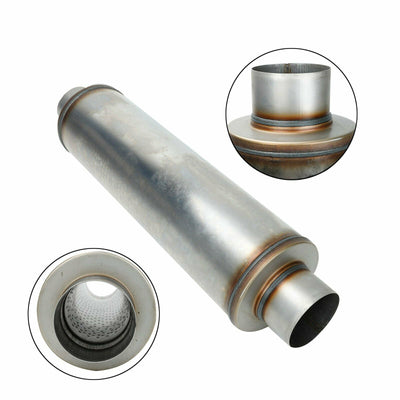
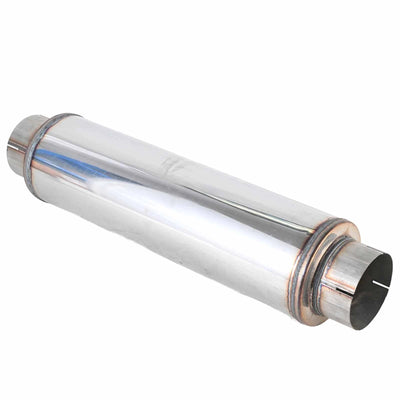

A muffler turns pressure pulses into quiet. Exhaust leaves the engine as a series of high-pressure slams, dozens per second, and the muffler's chambers, baffles, and packing material break those waves up, reflect them against each other, and absorb what is left, so what reaches the tailpipe is flow instead of noise. The engineering price is restriction: everything that slows sound also slows gas, at least a little, which is why the quietest designs flow the worst and the loudest designs barely slow anything down.
This guide covers how the damping actually works, the three can types and what each sounds like, the component's standing in a diesel system, and the delete question that follows naturally—with high-flow options, straight pipes, and quiet inserts ready in our straight pipe muffler collection.
Table of Contents
Key Takeaways
- Function: the can breaks up exhaust pressure pulses through chambers, baffles, and packing, trading a little flow for a lot of quiet.
- Three families: chambered for a throaty classic note, straight-through for maximum flow and volume, turbo-style for quiet compact packaging.
- The trade: the quieter designs restrict more and louder designs flow freer; the honest choice is a sound target, not a power number.
- Diesel standing: on a turbo diesel the muffler sits downstream of the turbine, so its effect is volume and tone rather than spool.
- Resonator split: the resonator cancels one specific drone frequency, the muffler quiets the whole band; they are teammates, not rivals.
- Failure signs: rust-through, rattles from broken internals, and a note that turns raspy or loud all mean the can is done.
The Physics: Turning Pulses into Quiet
Every cylinder exhale is a small explosion arriving at the pipe as a pressure front, and the pipe happily delivers each one to the atmosphere as sound. The can intercepts those fronts three ways. Chambers of tuned volume reflect waves back against the incoming ones, and where a reflected trough meets an arriving crest, the two cancel. Baffles force the gas to change direction and lose energy with every turn. Packing material, usually fiberglass, converts the last of the acoustic energy into heat by friction as gas passes through it.
The result is a device that removes sound in stages, and the stages are also the restriction: a wave that bounces three times before leaving carries its energy through three turns of pipe the gas must also take. That is the whole engineering tension in one sentence, and every can ever sold is a different answer to it.
Quiet, Loud, or Gone
Whether you're looking for a factory-style replacement, a deep-tone performance muffler, or a clean straight pipe muffler kit for maximum flow, browse our full lineup sorted by the sound target you want to live with.
The Three Muffler Types
The aftermarket sorts cans into three families, and the families predict sound better than any marketing copy. The muffler selection guide at OnAllCylinders walk the same three-way split the forums do.
Type |
How It Works |
Sound |
Flow |
|---|---|---|---|
Chambered |
Internal walls route gas through reflecting chambers |
Throaty, raspy, moderate volume |
Moderate restriction |
Straight-through |
Perforated pipe through the center, packing around it |
Deep, aggressive, loud |
Best flow of the three |
Turbo-style |
S-shaped reversing tubes lengthen the gas path |
Quiet, smooth, subdued |
Good, compact packaging |
The type names describe construction, not quality, and OEM cans are usually quiet turbo-style or chambered pieces built for the meter, not the ear.
Muffler vs Resonator vs Straight Pipe
The three terms get used interchangeably by people who own none of them. The can quiets the whole frequency band, wide and blunt. The resonator is a tuned chamber that targets one specific frequency, which on trucks means the highway drone band, and it does that one job without flattening the rest of the note; the split is covered properly in the site's muffler vs resonator comparison. The straight pipe is the absence of both, maximum flow and maximum volume, with the drone consequences that follow.
The practical builds stack the terms rather than choosing between them: a straight-through can plus a resonator ahead of it keeps the deep note and kills the drone, which is the configuration most tow rigs end up loving.
Does a Muffler Cost Power?
The honest number for a modern diesel: not much, and less than the sound suggests. Downstream of the turbo, the exhaust is moving cooled, expanded gas at low velocity, and a quality straight-through can costs a rounding error against an open pipe on anything a stock-to-mild truck makes. The owners' consensus across the forum threads says the same thing in plainer language: pick the muffler for the sound you can live with, because the dyno is not picking a winner.
Where the muffler question pays real money is volume law and cabin comfort, not the track. A truck that tows cross-country with an open pipe is exhausting in both senses, and the can that costs two horsepower buys back the ability to hear the radio at 70. The delete crowd has its own math, priced out in the muffler delete cost guide, and the EPA has its own math about what stays on a street truck.
The diesel difference is worth naming, because it explains why truck cans look oversized for their engines. A gas engine revs through a wide band and needs damping that tracks it, while a diesel pulses in a narrow, low range that a single well-placed can handles thoroughly, which is why the factory pieces on these trucks last 200,000 miles and why the aftermarket choice is mostly about tone at idle and drone at cruise rather than wide-band silence.
The sizing note matters here too: cans are chosen by inlet diameter and body length, a longer body quiets more and a shorter body sharpens the note, and the wrong inlet size turns a good can into a restriction the spec sheet never promised. Turbo lag does not enter the picture either; the can lives downstream of the turbine, and the spool conversation belongs to the downpipe and the intake side.
When the Can Fails
These cans die three deaths, and all of them announce themselves. Rust-through opens holes at the seams and ends, and the note goes from muffled to hollowly loud as the escapes multiply. Broken internals, baffles un-welded by heat cycles and rust, rattle at idle and specific RPMs like gravel in a coffee can. And packing blow-out, the straight-through can's specific failure, hollows the sound-absorbing core over years until the can flows fine and quiets nothing.
The confirmation is a screwdriver handle tap test on a cold can, listening for the loose rattle inside, and the repair decision runs from a replacement can to a full system, depending on what the rest of the pipe looks like behind it. The symptom catalog for the whole system lives in the site's bad muffler symptoms guide.
FAQ
What does a muffler do on a car or truck?
The can breaks up exhaust pressure pulses through chambers, baffles, and packing so the noise arrives as flow instead of bangs, trading a little restriction for a lot of quiet.
Does removing the muffler add horsepower?
On a modern diesel the gain is a rounding error; the real changes are volume, tone, and drone, which is why the choice is about sound.
What is the difference between a muffler and a resonator?
The muffler quiets the whole frequency band while the resonator cancels one tuned drone frequency; performance builds often run both.
Which muffler type is the quietest?
Turbo-style cans with their long reversing gas path are the quiet family, followed by chambered, with straight-through the loudest.
What is a glasspack muffler?
A straight-through can with a perforated core wrapped in fiberglass packing, the classic loud-and-deep design that trades quiet for flow.
Can a muffler go bad?
Yes: rust-through at the seams, rattling broken baffles, and blown-out packing all end a can's working life and change the note.
Does a muffler affect fuel economy?
Barely at truck power levels; the differences that matter in MPG come from the engine's tune and the driver's foot, not the can.
Is driving without a muffler illegal?
It depends on state and local noise law rather than one federal rule, and the legality guide covers the map, while emissions hardware is a separate, stricter question.
The Verdict
This is the one exhaust component you choose with your ears instead of a gauge: pick the family that matches the note you want to live with, keep a resonator in the plan if the truck commutes, and replace the piece when the rust starts singing its own part. Shop the whole range, quiet to delete, in the diesel exhaust systems aisle and let your sound target make the decision.
Ready to Let It Roar?
Whether you're after a clean aggressive tone or maximum exhaust flow, find the right fit for your truck or performance build in our Straight Pipe & Muffler collection.
At the end of the day, an exhaust note is personal. Pick the pipe that matches your driving style, keep a resonator in the system if you hate drone on the highway, and upgrade when you're ready for better flow. Explore the full range of performance mufflers and delete kits over at EGR Performance and dial in your truck's true voice.


