


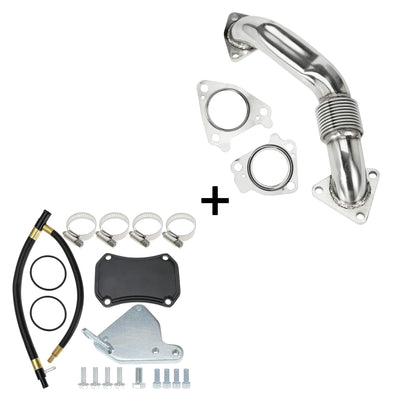
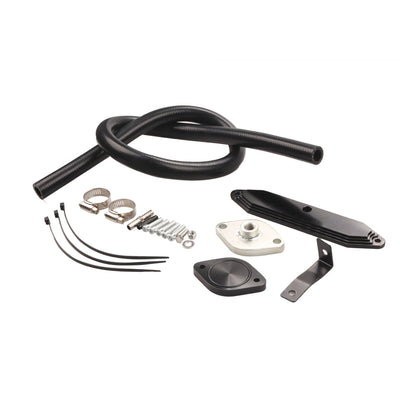
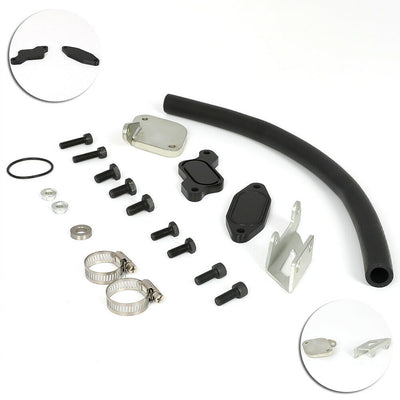
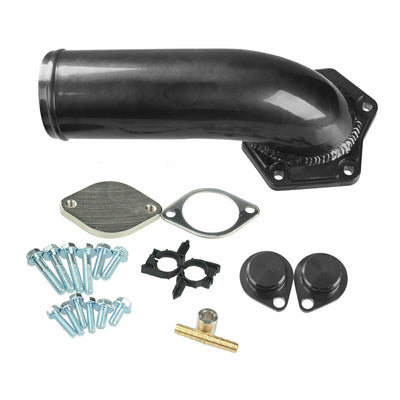

EGR stands for exhaust gas recirculation, and it is the emissions system that deliberately routes a portion of your engine's exhaust back into the intake: the inert gas dilutes the combustion mixture, peak flame temperatures drop, and the nitrogen oxides that form at those temperatures never get made. It is one of the oldest emissions technologies on the road, the reason the letters EGR appear on valves, coolers, and delete kits across every parts catalog, and the system this entire store was named after.
This guide defines it, explains the NOx chemistry it exists for, walks the valve-and-cooler hardware, separates gas from diesel implementation, and covers the side effects and the delete debate honestly, with the EGR Delete hardware for the trucks that legally go without it.
Table of Contents
Key Takeaways
- [The definition]: EGR is exhaust gas recirculation: a system that feeds a measured portion of exhaust back into the intake so it burns a second time as a dilutant rather than as fuel.
- [The purpose]: NOx forms when combustion temperatures spike. Inert exhaust displaces fresh air, oxygen concentration and peak flame temperature both fall, and the NOx reaction is starved before it starts.
- [The hardware]: An EGR valve that meters flow by load, temperature, and rpm, passages that carry it, and on diesels a cooler that chills the gas before it re-enters the intake.
- [The timing nuance]: EGR runs at cruise and light load, not at idle or wide-open throttle, because those are the conditions where NOx forms and dilution costs the least.
- [The diesel reality]: Diesel EGR flows are larger and the gas is sootier, which is why diesels add the cooler and why their intake gunk and cooler failures are famous.
- [The side effects]: Soot deposits in the intake mixing with crankcase oil into tar, carbon-stuck valves, and EGR coolers that fail into the cooling system.
- [The fork]: Cleaning and repair for street trucks, delete hardware for off-road trucks, and the same tampering line as every emissions conversation on this site.
The Definition: Exhaust, Routed Back on Purpose
The idea sounds like a plumbing mistake until the chemistry explains it. Exhaust gas recirculation takes a slice of the gas that has already burned, which is inert: its oxygen is spent, its energy is spent, and pipes it back into the intake to mix with fresh charge.
The original-equipment suppliers' own primer describes the valve as a precision metering device in the engine management system, opening and closing based on operating conditions so the engine receives exactly the dilution the calibration wants, and none when it does not.
That last part is the definition most owners miss: EGR is not an always-on restriction. It is a scheduled ingredient, active in the operating regions where NOx forms and shut out of the regions where power matters, which is why a healthy system is invisible and a faulty one is anything but.
Off-Road Truck, No EGR At All?
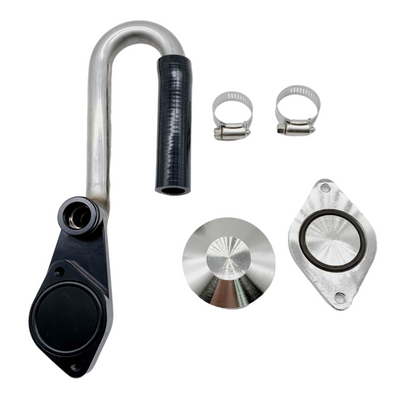
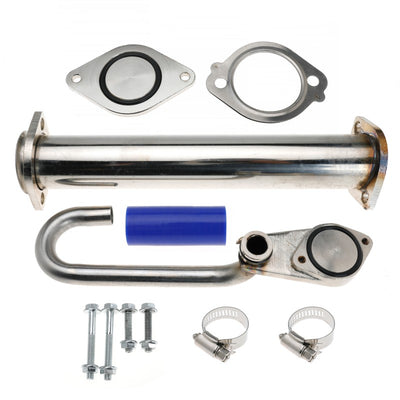
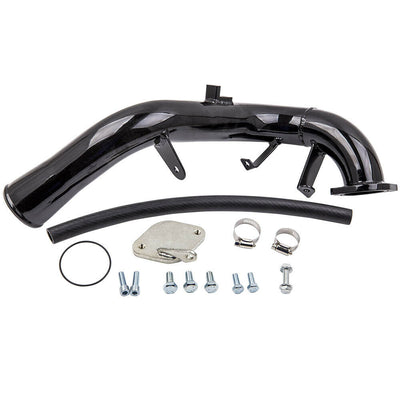
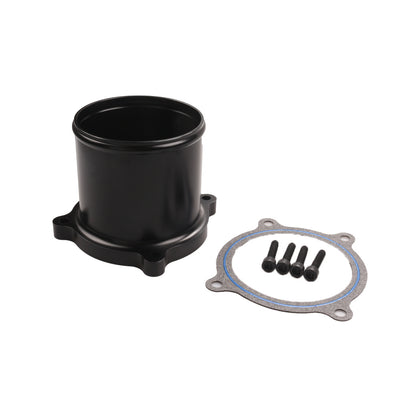
For competition and closed-course builds, the dilution conversation ends with hardware. EGR delete kits for Powerstroke, Cummins, and Duramax block the flow with CNC billet and 304 stainless, street trucks excepted.
Shop EGR Delete KitsThe Reason: NOx Chemistry
Everything about EGR exists because of one reaction. At high combustion temperatures, normally inert atmospheric nitrogen and oxygen combine into nitrogen oxides, NOx, the smog-forming emissions every regulator has hunted since the 1970s. The reaction is pure thermodynamics: hotter burn, more NOx.
EGR attacks the temperature:
- Dilution: inert exhaust displaces fresh air, so the mixture carries less oxygen per cylinder.
- Lower peaks: with less oxygen to react, peak flame temperature drops measurably.
- Cooled EGR: modern systems, as Rolls-Royce's MTU division explains, chill the recirculated gas before it re-enters, stacking a second temperature cut on top of the dilution.
- The result: starved of heat and oxygen, the NOx reaction shrinks instead of the exhaust being filtered after the fact, the pollution is prevented from forming.
That prevention-versus-filtration distinction places EGR upstream of the aftertreatment stack: the DPF and SCR clean what leaves the engine, while EGR changes what the engine makes in the first place.
The Hardware: Valve, Cooler, Passages
Three components do the work across every implementation:
- The EGR valve: the metering door, vacuum or electrically actuated, commanded by the ECU against load, coolant temperature, and rpm. Its position sensor reports back, which is why a stuck valve is a code, not a mystery.
- The passages: channels and piping between exhaust manifold and intake, on many engines cast through the cylinder head itself. Carbon loves them.
- The EGR cooler: a heat exchanger, standard on diesels and common on turbo gas engines, that drops the recirculated gas temperature before it meets the intake charge. On diesels it is the component whose failure mode, internal leaks, sends exhaust into the coolant or coolant into the cylinders.
The system is simple, which is its virtue and its weakness: few parts, few failure modes, and each failure mode well known.
At the heart of the exhaust recirculation circuit is the metering valve, which opens and closes continuously based on engine load and ECM commands. To understand pulse-width modulation, vacuum diaphragms, and internal pintle valve designs across vacuum and electronic setups, explore our guide on what is an egr valve.
Gas versus Diesel EGR
The physics is identical; the plumbing scales differently:
Gasoline EGR |
Diesel EGR |
|
|---|---|---|
Flow character |
Modest, metered dilution |
High flows, often with intake-throttle help to drive them |
Cooler |
Sometimes |
Always, and large |
What flows back |
Relatively clean gas |
Soot-laden gas that deposits with every mile |
Famous failures |
Carbon-stuck valves |
Clogged coolers, cracked coolers, intake tar |
The diesel column is why this store exists: soot recirculated through hot coolers and into intakes that are simultaneously receiving oil mist from the crankcase ventilation system produces the tar that diesel owners know and delete threads are made of.
While removing the EGR component resolves intake soot contamination, it is often performed as part of a comprehensive powertrain modification that addresses downstream exhaust treatment as well. For a full breakdown of how ECM recalibration, race piping, and emissions bypass packages function on competition and off-road builds, read our explainer on what does deleting a truck mean.
The Side Effects Owners Know By Name
The honest ledger, since the system's debut:
- Intake deposits: EGR soot meeting CCV oil builds the coating that narrows diesel intakes over six figures of miles, the one-two punch behind most "my intake is full of tar" photos.
- Carbon-stuck valves: the classic gas-engine failure Delphi's troubleshooting centers on, where deposits hold the valve open or closed and the metering becomes a memory.
- Cooler failures: the diesel headline: clogged coolers that stop flowing, and cracked ones that trade fluids with the cooling system, our bad EGR valve symptoms guide walks in detail.
- The efficiency trade: dilution that lowers NOx also costs a measure of combustion efficiency, the honest engineering bill every emissions strategy pays somewhere.
Symptoms, Repairs, and the Delete Question
When the system fails, the pattern is consistent: rough running and check-engine codes for position faults, white smoke and coolant loss for cooler breaches, and the soot-fouled everything of a high-flow system left uncleaned. The repair menu runs from valve cleaning and replacement to cooler swaps, all street-legal.
The delete menu removes the system from the loop entirely with block-off plates and recalibration, and it carries the same legal boundary every emissions post on this site draws: off-road, race, and farm trucks yes; street-registered trucks no, with inspection failures and fines as the enforcement. The full argument on both sides, the reliability claims and the legal reality, is laid out in the EGR delete pros and cons guide at the end of this page.
FAQ
What is EGR in a car?
Exhaust gas recirculation: a system that feeds a measured portion of exhaust back into the intake as inert dilution, lowering combustion temperatures and the NOx that forms at them.
What does EGR stand for?
Exhaust gas recirculation. The abbreviation names both the system and its most famous component, the EGR valve.
What does the EGR valve do?
It meters. Commanded by the ECU against load, temperature, and rpm, it opens to admit dilution in the operating regions where NOx forms and closes where power or idle quality matters more.
Is EGR bad for the engine?
It is a trade. It prevents NOx at the cost of some combustion efficiency, and its flows deposit soot that fouls intakes and valves over high mileage. Maintained, it is benign; ignored, it is a deposit machine.
Is EGR the same as a catalytic converter or DPF?
No. Those are aftertreatment, cleaning exhaust after combustion. EGR works upstream, changing what combustion produces in the first place.
What is an EGR cooler?
The heat exchanger that chills recirculated exhaust before it re-enters the intake, standard on diesels. Clogs restrict flow; cracks leak coolant into places coolant should never be.
Can EGR be removed?
Physically, with block-off hardware and recalibration. Legally, only on off-road trucks; street removal is emissions tampering everywhere in this site's jurisdiction talk.
When does EGR actually run?
At cruise and light load, where NOx forms and dilution costs little. It is shut off at idle and wide-open throttle, where idle quality and full power outrank the chemistry.
The Verdict
EGR is your engine's way of burning its exhaust twice as a temperature control: a metered, cooled, scheduled dilution that stops NOx from forming instead of filtering it afterward. Know it by its schedule, service it before the soot wins, and respect the cooler as the component with the expensive failure modes.
Master the definitions, and the entire modern-diesel conversation, from symptoms to deletes, reads like a clear parts diagram. When you're ready to protect your engine from premature cooler failures and catastrophic soot buildup, explore our complete lineup of heavy-duty EGR delete kits engineered for ultimate longevity and performance.


