

⚡ 30-Second Summary: 6.0 Powerstroke EGR Cooler & Valve Failure
On a 2003–2007 6.0L Powerstroke, EGR cooler cracks and EGR valve sticking fail in distinct ways. Because the oil cooler sits upstream of the EGR cooler, a clogged oil cooler cuts coolant flow to the EGR cooler. That heat spike cracks the cooler and lets coolant reach the intake or exhaust. Meanwhile, a sticky EGR valve from carbon buildup hurts drivability and flow. Ford TSB 09-8-3 links cooler failures to cooling and oil-cooler service, so always test both parts, check your EOT vs. ECT delta (keep within about 15°F at steady cruise), and fix the oil cooler alongside the EGR cooler: or use off-road Ford 6.0 EGR deletes only where legal, so the repair holds.
Table of Contents
- What Is the Difference Between the EGR Cooler and EGR Valve?
- EGR Cooler Failure vs. EGR Valve Failure: How Can You Tell the Difference?
- What Are the Main Symptoms of a Failed 6.0 Powerstroke EGR Cooler and EGR Valve?
- Why Do the 6.0 Powerstroke EGR Cooler and EGR Valve Fail?
- How Do You Diagnose 6.0 Powerstroke EGR Cooler and EGR Valve Failure?
- Can You Drive With a Failed EGR Cooler or EGR Valve?
- How Much Do 6.0 Powerstroke EGR Cooler and Valve Repairs Cost?
- How to Prevent Repeat EGR Cooler and Valve Failures
- FAQs
- Final Conclusion
A failed 6.0 Powerstroke EGR cooler leaks coolant into the intake and exhaust, causing white smoke and coolant loss. A failed EGR valve sticks from carbon and causes rough running or a P0401 code. Diagnose both parts, then inspect the oil cooler before you replace anything.
White exhaust smoke and coolant loss that cannot be traced are the top symptoms of 6.0 Powerstroke EGR cooler failure. You can also detect a sweet odor or coolant being forced out of the degas bottle. A bad EGR valve acts differently. It typically results in rough running, hesitation, low-end power loss, or a code such as P0401.
Your 6.0L system has two separate parts. Exhaust gas is metered into the intake by the EGR valve. The EGR cooler is a device that first cools the gas using the engine coolant.
Trouble often starts upstream. A restricted oil cooler will cause the EGR cooler to run low on coolant until it cracks. Carbon then sticks to the valve. Ford service information (e.g., TSB 09-8-3) relates EGR cooler leaks to the oil cooler. This means that the oil cooler is always included in the diagnosis.
What Is the Difference Between the EGR Cooler and EGR Valve?
The EGR cooler uses engine coolant to drop exhaust-gas temperature before the gas enters the intake. The EGR valve controls how much cooled exhaust gas enters the intake. They share one system, but they are not the same part.
The EGR cooler is a heat exchanger, and the EGR valve handles the flow control.
What Does the EGR Cooler Do on a 6.0 Powerstroke?
The cooler transfers heat from the recirculated exhaust gas to your engine coolant. This cooler gas then flows into the intake manifold.
What Does the EGR Valve Do on a 6.0 Powerstroke?
The valve opens and closes to regulate the amount of exhaust gas that enters the intake. The engine computer controls its position.
Why Do Owners and Shops Confuse the Two Parts?
A wet EGR valve often means the cooler leaked coolant onto it, not that the valve cracked. A P0401 code often means the valve is carboned up, not that the cooler is bad. Inspect each part on its own.
- Both parts are located in the same exhaust gas recirculation system.
- A leak in the cooler allows coolant to get to the valve, causing it to appear wet or slimy.
- P0401 can be caused by a carbon-restricted valve, and some owners think that is the cooler's fault.
- Ford 6.0 EGR valve symptoms do not necessarily mean the cooler has cracked, so check each part individually.
Part |
Main job |
Typical failure |
What you see |
|---|---|---|---|
EGR cooler |
Drops exhaust-gas heat into coolant |
Cracked core from heat and low coolant flow |
White smoke, coolant loss, wet intake |
EGR valve |
Meters exhaust gas into the intake |
Carbon sticking or position faults |
Rough idle, hesitation, P0401 / P0402 |
Oil cooler |
Cools oil and feeds coolant to the EGR cooler |
Plugged coolant passages |
High EOT vs ECT, repeat cooler death |
EGR Cooler Failure vs. EGR Valve Failure: How Can You Tell the Difference?
A failed EGR cooler shows persistent white smoke, unexplained coolant loss, a sweet exhaust smell, and a wet EGR valve. A failed EGR valve shows rough idle, hesitation, low-end power loss, and EGR codes such as P0401. Coolant loss is the cooler, not the valve.
Monitor the level of the coolant. Cooler failures use up coolant, while valve failures mostly hurt drivability.
Which Symptoms Point to the Cooler, and Which Point to the Valve?
This table correlates common 6.0 Powerstroke EGR cooler failure symptoms with valve issues. Use the chart below as a first sort, not as a final verdict. We still pressure-test, inspect the valve, and check EOT versus ECT.
Symptom Comparison
Symptom / Diagnostic Indicator |
EGR Cooler Failure |
EGR Valve Failure |
|---|---|---|
Persistent white smoke or steam from the exhaust |
Yes |
Usually No |
Unexplained coolant loss |
Yes |
No |
Sweet exhaust smell |
Yes |
No |
Wet EGR valve or intake port |
Yes |
No |
Rough idle |
Possible |
Yes |
Hesitation or poor throttle response |
Possible |
Yes |
P0401 (Insufficient EGR Flow) code |
Possible |
Yes |
Coolant pressure in degas bottle |
Possible |
No |
Disclaimer: Head gasket, turbo, injector, and cooling system problems can all cause these symptoms. Use them as a hint. Test further before replacing any components.
Why Can These Signs Overlap With Head Gaskets and Other Failures?
Symptoms of EGR cooler and EGR valve failure can overlap with head gasket, turbocharger, injector, and cooling system problems. These signs are diagnostic indicators, not proof. We do not replace parts on smoke color alone.
A head gasket can push combustion gas into the coolant and vent the degas bottle. A leaking cooler can do the same thing from the other direction. A wet EGR port leans toward the cooler. Combustion gas in the coolant with a dry EGR port leans toward the heads. Over-boost from a sticky variable geometry turbocharger (VGT) can also kill head gaskets, and Ford calls that out in the same TSB.
If the truck loses coolant and blows white smoke, start with the EGR cooler. If it runs rough and stores P0401 with no coolant loss, start with the EGR valve. Confirm both with tests before you order parts.
How Do We Separate Cooler, Valve, and Look-Alike Failures in the Bay?
We start with the cheap, high-value checks. Coolant level. Coolant smell at the tailpipe. Valve appearance. Codes. Then we move to pressure and temperature data.
A healthy EGR valve and intake port show dry black soot. Coolant contamination leaves the valve damp, gooey, or oddly clean, like steam washed the soot away. That "steam-cleaned" look is a cooler clue. Heavy dry carbon with no wetness is a valve and coking clue.
Next we ask one shop question: did the coolant leave the system, or did EGR flow just stop? Coolant leaving the system is a leak path. EGR flow stopping is a restriction or a stuck valve. P0401 is a flow code. It is not a leak code.
Ford TSB 08-26-12 says those EGR DTCs often come from coking deposits, and EGR valves that fail the IDS EGR Systems Test should be replaced, not cleaned.
Internal core cracks in an exhaust gas recirculation cooler can let coolant enter the exhaust or intake tract, causing unexplained fluid loss, degas bottle pressure, and white tailpipe smoke. Check early warning signs and pressure clues in our guide on EGR cooler failure symptoms.
What Are the Main Symptoms of a Failed 6.0 Powerstroke EGR Cooler and EGR Valve?
The main EGR cooler signs are persistent white smoke, unexplained coolant loss, a sweet exhaust smell, degas-bottle push, and a wet EGR valve. The main EGR valve signs are rough idle, hesitation, power loss, and codes such as P0401.
The majority of symptoms appear at start-up, under load, or in the coolant reservoir.
Sign |
Cooler leak likely |
Valve stick likely |
Also check |
|---|---|---|---|
White smoke after warm-up plus coolant loss |
High |
Low |
Head gaskets |
Degas bottle puking under load |
High |
Low |
Cap, heads, over-boost |
Wet or steam-washed EGR valve |
High |
Low |
Cooler core |
Dry heavy carbon, P0401, rough idle |
Low |
High |
Intake coking, sensors |
No codes, only coolant loss |
High |
Low |
External leaks, cooler, heads |
If the truck is towing, idling long hours, or running hot, these signs show up faster. Load raises exhaust temperature. A weak cooler then fails in public, on a grade, with a trailer on the hitch.
White Smoke or Steam From the Exhaust
Check for it at start-up, after prolonged idling, on acceleration, and when towing. The thin vapor that dissipates in a minute is normal condensation. If the steam continues to roll and the coolant level continues to fall, it is a warning.
Unexplained Coolant Loss
The degas bottle level continues to drop, but there is no puddle under the truck. This is one of the 6.0 Powerstroke bad EGR cooler symptoms that should be given the most attention.
Coolant or Pressure Pushed From the Degas Bottle
Excessive cooling system pressure forces coolant past the reservoir cap. A failed head gasket can let combustion gas do the same. This is not conclusive evidence of a cooler leak. Ford lists coolant venting from the degas bottle cap as a primary complaint in TSB 09-8-3.
Sweet-Smelling Exhaust
If the coolant is getting into the combustion or exhaust path, the exhaust will smell sweet. Consider it in conjunction with white smoke, coolant loss, and pressure test results.
Wet, Slimy, or Steam-Cleaned EGR Valve
A healthy valve will have dry black soot. Coolant leaves dampness, gooey residue, or spots that look steam-cleaned. Although the valve may appear to be the culprit, the leak is typically from the cooler.
Many valves begin to stick within 20,000 miles if they are not cleaned on a short interval accordng to Driving Line.
Rough Idle, Hesitation, and Power Loss (EGR Valve Specific)
The valve may get stuck open or shut due to heavy carbon. You experience it as a rough idle, stumbling off the start, stalling, or uneven power.
These are the typical Ford 6.0 EGR valve symptoms.
Stop 6.0L Powerstroke EGR Cooler Leaks and Soot Buildup.
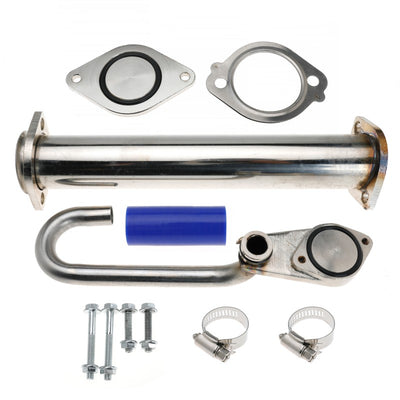
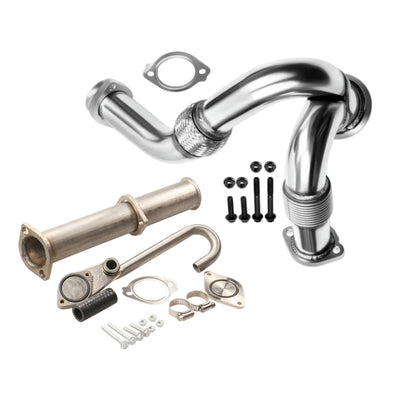
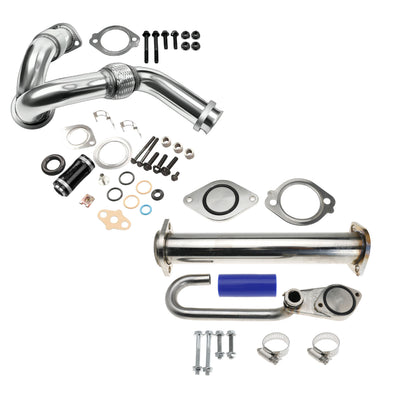
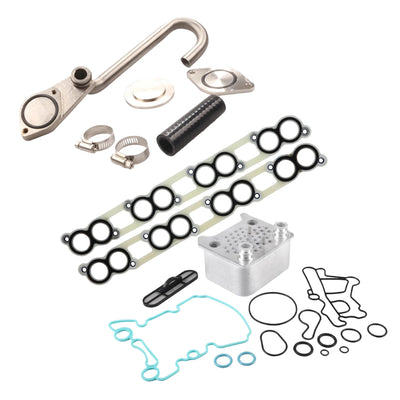
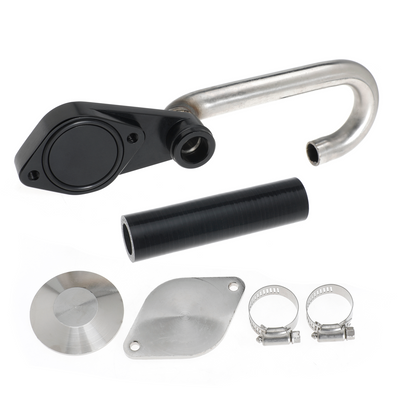
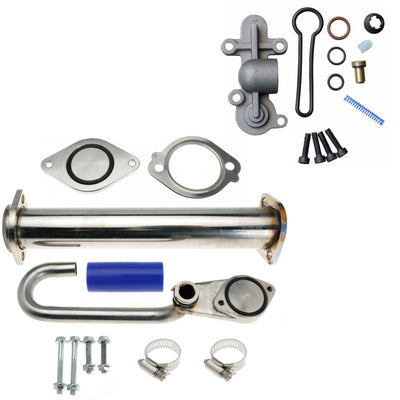
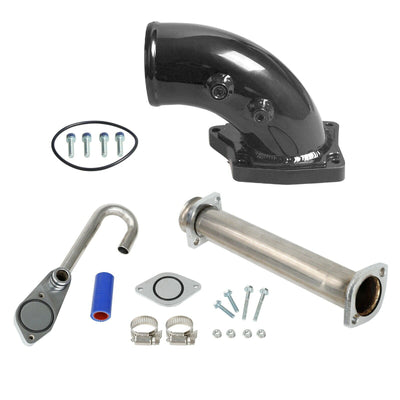
Don't let cracked EGR coolers, coolant loss, or soot-stuck valves keep your off-road Super Duty down. Our 6.0L Powerstroke EGR Delete Kits from EGR Performance use CNC-machined billet and stainless steel hardware to bypass failure-prone coolers, lower EGTs, and support reliable off-road operation.
Shop EGR Performance 6.0L Powerstroke EGR Delete →P0401 and Other EGR-Related Trouble Codes
P0401 indicates the EGR flow is too low. It can be set by carbon, a restricted valve, intake deposits, sensor or wiring problems, or a restricted cooler. Ford TSB 08-26-12 also lists P0402, P0404, and P1335 in the same coking family.
Persistent white smoke with coolant loss points to a cracked EGR cooler. Rough running with P0401 and no coolant loss points to a stuck EGR valve. Confirm with a wet-valve inspection and a cooling-system test.
How Do We Rank These Symptoms in Real Shop Work?
We rank coolant loss and persistent white smoke at the top for cooler risk, because liquid is leaving the cooling system and entering the exhaust or cylinders. Wet valve appearance comes next: it is fast, cheap, and visual.
Drivability and P0401 rank high for valve work but low for cooler rupture, and a leaking cooler may set no EGR code at all.
Ford TSB 09-8-3 warns that coolant in a combustion chamber may cause a hydro-lock condition and calls for intake evacuation and glow-plug removal before the engine is cranked.
We rank wet valve appearance next. It is fast, cheap, and visual. A dry, sooted valve with no coolant loss lowers cooler odds. A wet valve raises cooler odds.
We rank drivability and P0401 high for valve work, low for cooler rupture. A leaking cooler may not set an EGR code at all. Coolant loss and white smoke can be the only clues. That is why a scan-tool-only diagnosis misses cracked coolers.
Why Do the 6.0 Powerstroke EGR Cooler and EGR Valve Fail?
Most 6.0 EGR coolers crack because a restricted oil cooler cuts coolant flow, then heat splits the core. Most EGR valves fail because soot and oil vapor pack the stem and pintle until the valve sticks.
How Does a Restricted Oil Cooler Kill the EGR Cooler?
The majority of failures begin with a plugged oil cooler, which results in the EGR cooler not getting enough coolant.
Step 1 - The Oil Cooler Becomes Restricted
The oil cooler is located upstream in the coolant flow path. The small passages become clogged with casting sand, rust, sediment, and worn-out coolant.
Step 2 - Coolant Flow to the EGR Cooler Drops
There is less coolant flow to the EGR cooler. This root issue remains if only the EGR cooler is replaced.
Step 3 - The EGR Cooler Experiences Excessive Heat Stress
The exhaust gas can reach temperatures of over 1,000F in the cooler core. If there is insufficient coolant, hot spots will develop, and the metal will flex each heat cycle. That stress directly results in 6.0 Powerstroke EGR cooler failure.
Step 4 - The EGR Cooler Core Cracks
When the core breaks, coolant enters the exhaust path and intake manifold. White smoke is emitted from the tailpipe. Coolant may also fill a cylinder or contaminate the turbo.
Step 5 - Carbon Buildup Causes EGR Valve Sticking
Soot combines with oil vapor and fuses to the valve stem and pintle. The valve then sticks or sets a position circuit fault.
A plugged oil cooler is the main reason a 6.0 EGR cooler cracks. Carbon is the main reason the EGR valve sticks. Fix the oil cooler with the EGR cooler, or the new cooler can fail again.
Soot buildup around the valve pintle often causes sticking or incomplete seating rather than coolant loss, leading to rough idle, sluggish low-end response, or flow codes. Review typical valve warning signs in our guide on bad EGR valve symptoms.
What Shop Data Proves This Failure Chain?
Ford's road test in TSB 09-8-3 says to drive at wide-open throttle and high load with ECT above 190 degrees F. If EOT exceeds ECT by 15 degrees F (8.4 degrees C) or more at any time during that test, service the oil cooler.
A 190 degrees F coolant reading with 200 degrees F oil is not panic, but 190 degrees F coolant with 220 degrees F oil on a steady highway run is a problem. Riffraff Diesel Idle readings lie. Short trips lie. Towing a grade makes a restricted cooler show itself faster.
The square later cooler is also more prone to exhaust-side clogging than the early round cooler because the passages are smaller. Carbon can restrict flow and set EGR codes even when the cooler is not leaking. So we have two cooler death modes: heat crack from low coolant flow, and soot restriction on the exhaust side.
Ford requires a flush with Motorcraft Engine Cooling System Iron Cleaner after these repairs; skip it and rust flakes plus silicate drop-out can pack the new oil cooler in the same week.
How Do You Diagnose 6.0 Powerstroke EGR Cooler and EGR Valve Failure?
Check coolant level, inspect the EGR valve for wetness, pressure-test the cooling system, watch the degas bottle for bubbles, pull EGR codes, compare cooler signs with head-gasket signs, and measure EOT versus ECT. A 15 degrees F-plus spread means the oil cooler is restricted.
Do simple visual checks first and then pressure tests.
Step 1 - Check Coolant Level and Condition
Record the level and color of the coolant in the degas bottle. Inspect hoses for oil, rust, sediment, and crusty deposits.
Step 2 - Inspect the EGR Valve and Intake Port
Never pull the valve on a hot, pressurized system. After it is removed, compare any wet or slimy deposits with normal dry soot.
Step 3 - Perform a Cooling-System Pressure Test
Use proper service equipment to pressurize the system to approximately 16 PSI. Remove the valve and check for coolant at the EGR port.
Step 4 - Perform a Degas-Bottle Bubble Test
Look for consistent bubbling in the degas bottle. It may indicate a head gasket, a cracked cooler or trapped air.
Step 5 - Check for EGR-Related Trouble Codes
Check for P0401, valve position codes and backpressure codes. They rarely prove that the cooler has burst.
Tracking live engine oil temperature, coolant temperature, and diagnostic codes helps confirm whether a cooling restriction or sticking valve is driving the problem before you buy parts. Browse compatible programmers and data monitors in our Powerstroke tuner collection.
Step 6 - Compare EGR Cooler Symptoms With Head-Gasket Symptoms
Use this table to sort the two. The answer can save you a 6.0 Powerstroke EGR cooler repair that you do not need.
Diagnostic Check |
EGR Cooler Failure |
Head-Gasket Failure |
|---|---|---|
White smoke |
Yes, often with a sweet smell |
Yes |
Coolant loss with no external leak |
Yes |
Yes |
Wet EGR port |
Yes |
Usually No |
Degas bottle bubbling |
Possible |
Yes, often steady under load |
Cooling system pressure |
Rises, may push coolant |
Rises quickly, pushes coolant |
Combustion-gas (block) test |
Can be positive |
Positive |
EGR-related codes |
Possible |
Usually No |
Step 7 - Inspect Oil Cooler Performance (EOT vs. ECT)
Do not condemn a 6.0 EGR cooler on one symptom. Combine coolant loss, valve appearance, pressure or vacuum hold, codes, and the 15 degrees F EOT-to-ECT test. Service the oil cooler if that delta is high.
Check engine oil temperature and engine coolant temperature using a scan tool. A difference of 15F or greater at full operating temperature under load indicates a restricted oil cooler.
EGR Cooler and Valve Failure Diagnosis Checklist
- White smoke continues after startup
- Coolant level drops without an external leak
- Exhaust smells sweet
- Degas bottle pushes out coolant
- EGR valve is wet, slimy, or steam-washed
- EGR valve has excessive dry carbon buildup
- Rough idle, hesitation, or stalling observed
- P0401 or other EGR codes are stored
- Cooling-system pressure does not hold
- Continuous bubbling present in degas bottle
- EOT vs. ECT delta exceeds 15F
- Head-gasket testing completed
Can You Drive With a Failed EGR Cooler or EGR Valve?
You can often drive a truck with a sticking EGR valve, but drivability and soot get worse. Do not keep driving a truck with a failed EGR cooler if it has persistent white smoke, coolant loss, or degas-bottle push. Hydro-lock and head damage are real.
A bad valve will usually allow short trips. If the cooler fails, the entire engine is in jeopardy.
Driving With a Bad EGR Valve
Expect rough idling, increased soot, and reduced fuel economy. Major engine damage is not likely to occur immediately.
Driving With a Failed EGR Cooler
Each mile increases the likelihood of overheating, loss of coolant, and contamination of the turbo. The worst cases result in a hydrolock or a blown head gasket.
A stuck EGR valve is a schedule-soon problem. A leaking EGR cooler is a stop-and-diagnose problem. If white smoke and coolant loss are present, do not keep towing or idling the truck.
Recommended Guidance
If white smoke keeps coming out, the coolant is falling, or the degas bottle is pushing, park the truck. Do not drive any distance without a proper diagnosis.
Condition |
Drive to shop? |
Risk if ignored |
|---|---|---|
P0401, dry valve, no coolant loss |
Usually yes, soon |
Soot, poor run, repeat coking |
Wet valve, dropping coolant, white smoke |
No extended driving |
Hydro-lock, turbo and intake wash |
Degas puking under load |
No |
Overheat, head-gasket damage |
Engine already locked |
Do not crank |
Bent rods, cracked heads |
How Much Do 6.0 Powerstroke EGR Cooler and Valve Repairs Cost?
EGR valve work is the smaller bill. EGR cooler replacement costs more because gaskets, intake cleaning, and oil-cooler service often come with it. Budget labor around 6 to 8 hours for cooler and oil-cooler work, then add parts, flush, and any head-gasket repairs.
The cost will vary depending on the parts that failed and whether the oil cooler needs to be serviced.
Replace or Clean the EGR Valve
If the valve fails testing or has a lot of carbon, clean or replace it. This restores exhaust flow control. Cleaning will not stop a leaking cooler.
Replace the Failed EGR Cooler
This maintains your factory emissions configuration. Choose 6.0 Powerstroke EGR cooler replacement parts that match your model year.
When changing EGR cooler 6.0 Powerstroke parts, use new gaskets and seals. Clean the intake while it is open.
Replace Both the EGR Cooler and Oil Cooler
Ford TSB 09-8-3 favors this method if the oil cooler is restricted. A new EGR cooler behind a plugged oil cooler faces the same coolant starvation. That is the most complete 6.0 Powerstroke EGR cooler repair.
Install an Upgraded EGR Cooler
Upgraded coolers use reinforced construction, including tubular stainless steel cores. They tolerate repeated heat cycles better than the factory design.
EGR Delete or Bypass Options
Delete and bypass kits eliminate or disable emissions equipment. On a road vehicle, that is prohibited under the federal Clean Air Act and EPA defeat device rules. Expect check-engine lights, calibration issues, and failed inspections as well.
EGR delete or bypass is a separate comparison, not a default repair, and we do not treat it as a legal on-road fix. For street trucks we point shops to upgraded coolers, valves, gaskets, and oil-cooler service.
When facing recurring heat stress, oil cooler restrictions, or steep replacement estimates on a 6.0-liter truck, owners often weigh factory-style repairs against a physical bypass for off-road or closed-course use. Compare reliability trade-offs and legal limits in our guide to 6.0 Powerstroke EGR delete pros and cons.
What Extra Costs and Legal Limits Should Shops Quote Up Front?
Cost Item |
What It Covers |
Notes |
|---|---|---|
EGR Valve Cleaning |
Carbon removal and inspection |
Will not fix a leaking cooler |
EGR Valve Replacement |
New valve, gaskets, and labor |
Replace if it fails IDS testing |
EGR Cooler Parts |
Cooler, gaskets, and hardware |
Match round vs. square design |
Oil Cooler Service |
Cooler kit and housing seals |
Required if EOT/ECT delta is 15°F or higher |
Intake Cleaning |
Soot and coolant residue removal |
Perform while the intake is removed |
Coolant Flush |
Iron cleaner, coolant refill, and bleeding |
Ford recommends this service; skipping it may lead to repeat failures |
Turbo Inspection |
Inspection for oil and coolant contamination |
Add if the cooler has released liquid |
Diagnostics |
Pressure testing, vacuum testing, and road testing |
TSB diagnostic procedure specifies 1.3 hours |
Head Gaskets / Injectors |
Additional repairs only when confirmed by testing |
Super Duty head-gasket labor can exceed 15 hours |
6.0 Powerstroke EGR Cooler and Valve Replacement Cost
Quote the valve, the cooler, the oil cooler, the flush, and labor as separate lines. A 6.0 EGR cooler job is not a $100 sensor. Plan hours of labor and do not skip the oil cooler if the 15°F test fails.
Shop quotes vary widely. A 6.0 Powerstroke EGR cooler replacement quote should include these items:
- Cleaning or replacement of the EGR valve
- EGR cooler components, gaskets, and installation hardware
- Oil cooler service and intake cleaning
- Turbo inspection and coolant flush
- Diagnostic fees, labor, and any head gasket or injector work
How Do We Keep the Quote From Turning Into a Surprise?
Upgraded EGR Performance hardware belongs in that quote when the truck will keep its EGR system. A stronger cooler core, the right gaskets, and an oil-cooler plan cost more on day one. They cost less than a second cooler, a hydro-locked engine, or a set of heads.
How to Prevent Repeat EGR Cooler and Valve Failures
Service the oil cooler with the EGR cooler, use the correct coolant and flush, watch the EOT/ECT spread, clean the EGR valve before it sticks, and inspect small coolant-loss signs early. That is how we stop a second cracked cooler.
You can avoid repeat failures by keeping coolant clean and flowing.
Service the Oil Cooler Promptly
If you are changing EGR cooler 6.0 Powerstroke parts, check the oil cooler during the same visit.
Maintain the Correct Coolant
Always use the proper coolant, such as Extended Life Coolant, at the proper mixture. Replace it on a regular schedule.
Install a Coolant Filter
A filter catches suspended particles. It will not unplug a restricted oil cooler or repair a cracked EGR cooler.
Monitor Engine Oil and Coolant Temperatures
Monitor the EOT and ECT spread with a gauge or monitor. A growing gap warns you before the cooler cracks.
Regularly Clean the EGR Valve
Check the valve regularly. Clean off carbon before it builds up enough to stick.
Address Small Symptoms Early
Do not wait for the complete 6.0 Powerstroke EGR cooler failure symptoms. A slow coolant drop is much less expensive to chase than heavy smoke or overheating.
For off-road or closed-course competition builds where a physical bypass kit is chosen over cooler replacement, matching block-off plates, coolant reroute fittings, and gaskets prevents leaks down the road. Explore kit layouts and fitment details in our 6.0 powerstroke EGR delete kit guide.
What Maintenance Plan Do We Give a 6.0 That Has to Work Every Day?
Prevent repeat 6.0 EGR failures by servicing the oil cooler, flushing the coolant the right way, watching the 15°F EOT/ECT limit, and cleaning or replacing the EGR valve before it seizes.
Use quality oil. EGR raises soot in the oil, and that oil also runs the injectors at very high pressure. Cheap oil and long drain intervals feed coking and injector trouble.
Interval or trigger |
Action |
|---|---|
Every oil change |
Glance at degas level, look for white smoke, note EOT/ECT |
About 5,000 miles in severe use |
Oil and filter, per Ford severe-duty thinking on sooted 6.0 oil |
Every 1 year or 20,000 miles |
EGR valve inspect and clean |
20,000 to 30,000 miles on hard-worked emissions trucks |
Coolant condition check, consider flush |
EOT 15 degrees F or more above ECT |
Oil-cooler diagnosis and service |
Any unexplained coolant loss |
Cooler and leak diagnosis now |
Our EGR Performance hardware is built for this plan. Stronger cooler construction, the right gaskets, and a complete service path give the 6.0 a chance to keep working without a second cracked core.
FAQs
A 6.0 EGR delete is not legal for on-road use. A failed cooler can hydro-lock the engine. A bad valve does not usually make white smoke. P0401 does not prove a bad cooler. A restricted oil cooler can kill the EGR cooler.
Is an EGR delete legal?
No. Removing or disabling EGR equipment on a road vehicle violates the federal Clean Air Act. It can lead to fines and failed inspections.
Can a failed EGR cooler cause hydrolock?
Yes. If the core ruptures, it can force coolant into the intake and fill a cylinder. Liquid is incompressible, so a rod can bend.
Can a bad EGR valve cause white smoke?
Rarely by itself. White smoke with coolant loss usually means the cooler or head gasket is leaking. Black smoke, rough idle and hesitation are more likely from a sticking valve.
Does P0401 mean the EGR cooler is bad?
No. P0401 indicates low EGR flow. It can be caused by carbon in the valve, intake deposits, faulty sensors or a restricted cooler.
Can an oil cooler cause EGR cooler failure?
Yes. When the oil cooler is plugged, coolant flow to the EGR cooler is reduced. The starved core overheats and cracks.
How can I tell whether the EGR cooler or head gasket is bad?
Remove the EGR valve and pressure-test the system. Coolant at the EGR port indicates the cooler. Steady bubbling and a positive block test point toward the head gasket.
What are the first signs of a bad EGR cooler on a 6.0 Powerstroke?
Look for a degas bottle level that drops slowly without puddles. White steam at start-up and a sweet exhaust odor usually follow. These are the first 6.0 Powerstroke bad EGR cooler symptoms.
What are the symptoms of a bad EGR valve on a 6.0 Powerstroke?
Expect rough idle, hesitation, poor throttle response, stalling, and a check engine light. P0401 or a valve position code is common.
Can you clean a 6.0 Powerstroke EGR valve, or does it need replacement?
Dry carbon buildup can be cleaned from a valve. Replace it if it fails electrical testing, still sticks after cleaning, or is damaged by coolant.
What does the 15F oil-to-coolant temperature difference mean?
If oil runs 15F or more above coolant at operating temperature, the oil cooler is likely restricted. That restriction typically comes before a cracked EGR cooler.
Should I replace the oil cooler when replacing the EGR cooler?
Yes, if testing shows restriction. A new EGR cooler installed behind a plugged oil cooler will probably fail again.
How long can a 6.0 Powerstroke run with a bad EGR cooler?
There is no safe distance. A small leak may hold for weeks, while a sudden rupture can hydrolock the engine.
Final Conclusion
On a 6.0 Powerstroke, EGR trouble typically starts with carbon buildup in the valve or an internal cooler crack. A carbon-choked valve ruins daily driveability, and a failed cooler can push coolant into the intake or exhaust—bringing unexplained coolant loss, white smoke, and severe hydrolock risk.
Before pulling parts, check oil-to-coolant temperatures and inspect the oil cooler first, service or replace the EGR valve, rule out head gasket failure, and resolve the cooler. If your 6.0L runs strictly off-road or in closed-course competition, explore EGR Performance's 6.0 Powerstroke EGR delete kits and bundled oil cooler/gasket options built for clean fitment on 2003–2007 platforms.